
White House wobbles, distancing Trump from initial response to Minnesota killing

Trump moved from castigating Minnesota Gov. Tim Walz as a cause of the violence in Minneapolis and declaring that, in a call, he and the governor “seemed to be on a similar wavelength.”

The New York Times
January 26, 2026 at 11:49PM
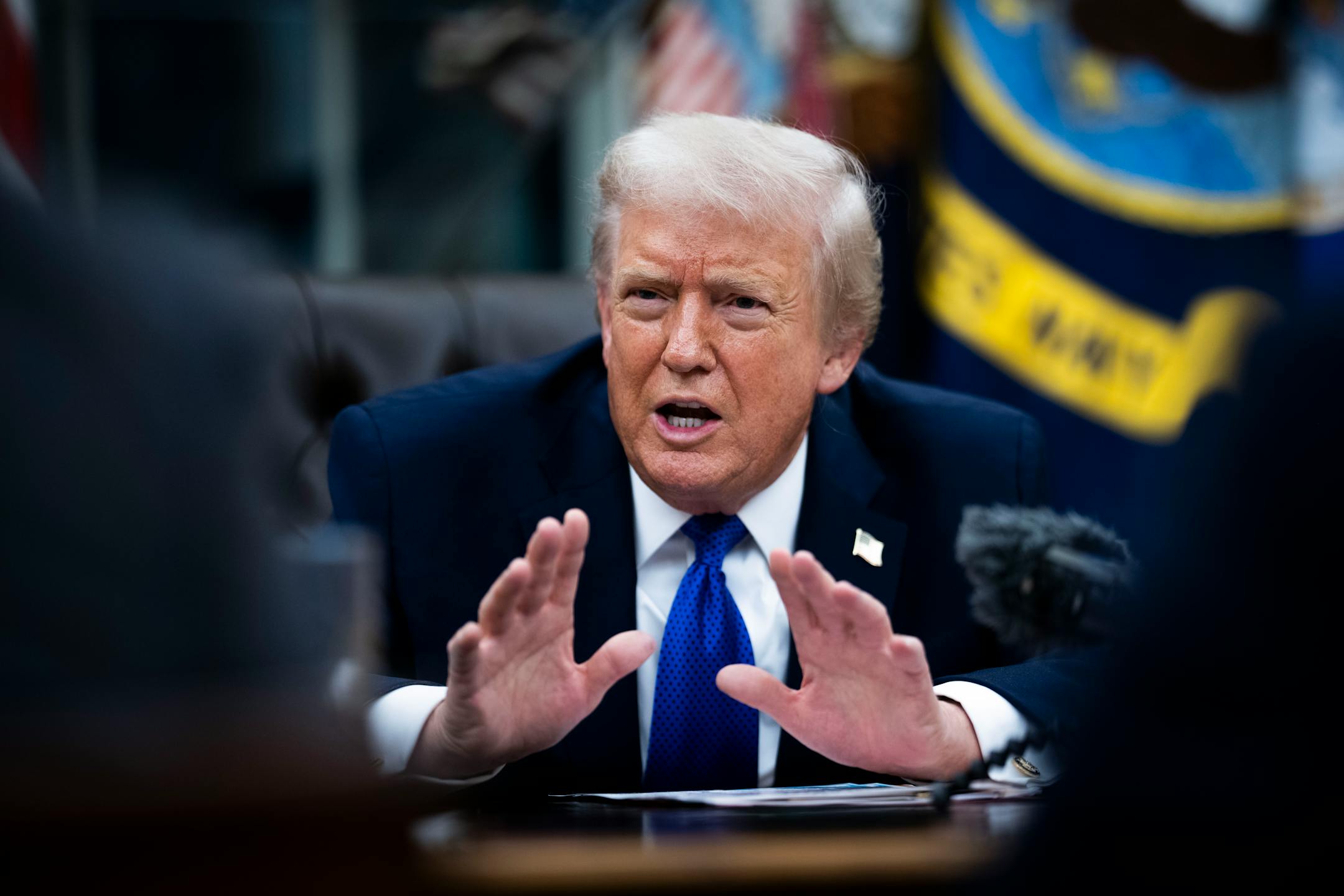
President Donald Trump gestures during an interview with The New York Times in the Oval Office on Wednesday, Jan. 7, 2026. (Doug Mills/The New York Times)

WASHINGTON — Faced with broad outcry over the killing of a protester Saturday in Minneapolis, the White House tried Monday to distance President Donald Trump from the response of his most senior officials, who had immediately characterized the man fatally shot by federal agents as a “domestic terrorist” who was “brandishing” a gun, before video evidence undercut their charges.

Karoline Leavitt, the White House press secretary, notably did not defend the rhetoric of White House officials, including Stephen Miller, the deputy chief of staff, and Kristi Noem, the homeland security secretary, who were the most vocal in spreading false accusations against the victim, Alex Pretti. Pretti was shot roughly 10 times by immigration agents after he was apparently filming them with his camera.

He was licensed to carry a gun in Minnesota, but video from several angles shows he never pulled one, and his hands were visible as he was shot in the back.

White House officials clearly understood that the killing, the second of an American citizen protesting the presence of Immigration and Customs Enforcement in Minneapolis, posed one of the gravest political threats to Trump since his inauguration just a little more than a year ago. Yet they seemed frozen in place, unwilling to walk back the statements by Miller and Noem, which were widely repeated throughout the administration, while sending Leavitt out to insist that “we will let the facts lead and we will let the facts play out in this investigation.”

They provided no evidence to back up the statements by the two officials, who have become the face of Trump’s efforts to deport immigrants in the U.S. illegally. And while Leavitt would not contradict the two officials, she insisted to reporters that “nobody in the White House, including President Trump, wants to see people getting hurt or killed in America’s streets.”

She also declined to defend the attacks on Pretti.

“This has obviously been a very fluid and fast-moving situation throughout the weekend,” Leavitt said. “As for President Trump, whom I speak for, he has said that he wants to let the investigation continue and let the facts lead in this case.”

For two days, the White House has struggled to contain the fallout from the killing. Democrats have been withering in their criticism of the administration’s actions, and Republicans have begun joining calls for a fair investigation into the killing. Even the National Rifle Association, long an ally of Republican administrations, has defended Pretti, who had a concealed-carry permit.

The bipartisan pushback on Capitol Hill now risks another government shutdown as lawmakers threaten to withhold funding for ICE after the killing of Pretti.

On Monday, Trump dispatched his border chief, Tom Homan, to oversee the immigration enforcement operation in Minneapolis and backed off his attacks on Minnesota’s governor after a phone call with him.

As Homan takes over that job, it was not clear what would become of Gregory Bovino, the official in charge of Trump’s Border Patrol operations.

Leavitt did not directly answer a question about whether Bovino would remain in Minneapolis after Homan’s arrival. She called Bovino “a great professional” who “is going to very much continue to lead Customs and Border Patrol throughout and across the country.”

In his latest pivot, Trump moved from castigating Minnesota Gov. Tim Walz as a cause of the violence in Minneapolis and declared that, in a call, they “seemed to be on a similar wavelength.”

Trump said on social media that Walz was “happy that Tom Homan was going to Minnesota.” Trump announced earlier in the day that Homan would be his personal representative overseeing ICE operations in the state.

It was a sharp contrast from his weekend pronunciations, in which the president blamed Walz and other Minnesota Democrats for Pretti’s death. Those remarks echoed his comments after the fatal shooting by federal agents of a Minneapolis woman, Renee Good, this month.

As he hailed operations in Washington and other cities as a “tremendous success,” Trump said crime in Minnesota was “way down.” He added, “Both Gov. Walz and I want to make it better!”

In a statement, Walz’s office described the call as “productive” and said the two men had discussed broader issues that have been at the center of the state’s complaints about the crackdown.

According to the governor’s office, Walz told Trump that impartial investigations into the two killings were needed, and he called for a reduction in the number of federal agents in Minnesota. Trump agreed to ensure a fair investigation and to look into reducing the number of agents, the governor’s office said.

But even as Trump tried to mend fences with Walz, Leavitt continued the administration’s previous strategy of arguing that the governor and Democrats in Minnesota bore the blame for the chaos. “This tragedy occurred as a result of a deliberate and hostile resistance by Democrat leaders in Minnesota for weeks,” she said.

The administration’s reaction to the killing of Pretti was similar to its initial approach the killing of Good.

In both cases, administration officials rushed to attack the victims and defend the ICE agents before an investigation had taken place. After video emerged raising serious questions about the cause for both killings, White House officials changed their tone.

Last week, Trump said the killing of Good was a “tragedy” about which he “felt terribly,” adding that the immigration agents he had deployed were sometimes “going to make a mistake.”

The change in tone was stark for the president, who said he had been told that Good’s father was a strong Trump supporter. No longer did the administration suggest she was a domestic terrorist.

“You know, when the woman was shot, I felt terribly about it,” he said. “And I understand both sides of it.” He called the shooting “a horrible thing.”

In the hours after Pretti’s killing, Trump referred to him as a “gunman” in a social media post. But after video emerged showing that Pretti carried a cellphone, and that agents took his legally carried gun from him before shooting him, the White House had a different message.

“Nobody here at the White House, including the president of the United States, wants to see Americans hurt or killed and losing their lives in American streets,” Leavitt said Monday. “And we mourn for the parents.”

This article originally appeared in The New York Times.

about the writers

about the writers

Luke Broadwater

The New York Times

David E. Sanger

The New York Times

More from News & Politics

See More
card image
Doug Mills/The New York Times

Trump moved from castigating Minnesota Gov. Tim Walz as a cause of the violence in Minneapolis and declaring that, in a call, he and the governor “seemed to be on a similar wavelength.”