
Opinion | The resilience of Black women should no longer be this country’s contingency plan

Black women are often the first to lose jobs when budgets tighten. They also are among the nation’s fasting growing group of entrepreneurs.

November 15, 2025 at 11:00AM
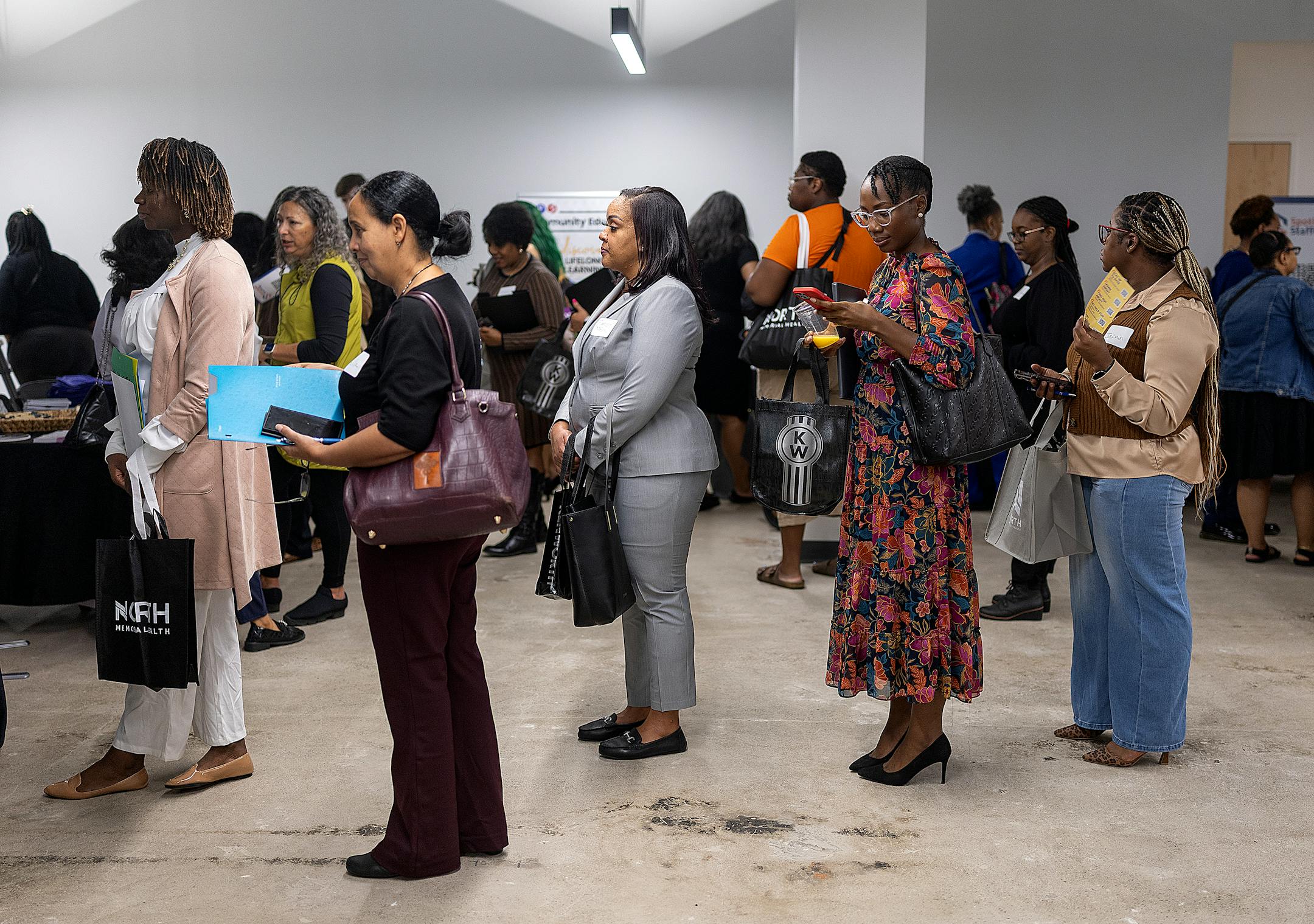
Women line up to speak to job fair vendors during a job fair for Black women at the Coliseum in Minneapolis. (Elizabeth Flores/The Minnesota Star Tribune)

Opinion editor’s note: Strib Voices publishes a mix of guest commentaries online and in print each day. To contribute, click here.

•••

Recent headlines about corporate downsizing and economic restructuring reveal a troubling pattern that stretches across decades: the persistent undervaluing of Black women’s labor.

Whether in public service, health care, education or the private sector, Black women remain central to the functioning of our economy and yet too often are treated as expendable when budgets tighten or profits dip.

Across the country, employment among Black women fell by more than 300,000 jobs through June this year. That was the largest decline among any demographic group, according to the U.S. Bureau of Labor Statistics.

That reality is especially visible this November as we mark National Entrepreneurship Month. As some Black women lose jobs, they move on by creating their own opportunities through entrepreneurship. This path reveals both their ingenuity and the persistent barriers they face.

Comments on LinkedIn posts about the hundreds of thousands of Black women ousted from the workforce reveal some of their personal stories. One woman wrote: “The job market left me no choice. After countless applications and interviews with no follow-through, I got tired — tired of waiting for someone to say ‘yes.’ So I decided to build something of my own.”

Another poster pointed out another truth: “Building our own companies, yes but still generating the least amount of revenue of all ethnicities and genders in America.”

While Black women are among the fastest-growing groups of entrepreneurs in the country, according to JPMorgan Chase, their businesses remain significantly undercapitalized, underfunded and often underrecognized.

Other recent reports underscore that disparity: Black women-owned businesses generate more than $100 billion in annual revenue but receive less than 1% of venture capital and continue to struggle for access to traditional financing. These entrepreneurs are driving growth despite systemic barriers.

Additionally, their determination mirrors a broader economic reality. Even as Black women drive innovation and business creation, they remain disproportionately vulnerable to economic instability.

In Minnesota, the unemployment rate for Black workers climbed to 7.7% in August 2025, up from 5.2% the year before, which is more than twice the rate for white Minnesotans, according to Minnesota’s Department of Employment and Economic Development. Both the local and national unemployment rate for Black women is well above the national average of 4.3%.

We have seen this story before. During the 1960s and 1970s, the Great Society programs and civil rights legislation opened new doors for Black women in public-sector employment as teachers, nurses and administrators. These jobs offered a measure of stability that earlier generations had been denied. Yet decades of evidence show that each time the economy contracts, whether it was during the recessions of the 1980s, the downturn of 2008, or now, Black women are among the first to lose work and among the last to recover.

A University of Minnesota report found that women of color in Minnesota faced higher risks of layoffs during the pandemic. Even in times of growth, Black women in Minnesota face greater job insecurity and lower pay. They earn about 62 cents for every dollar earned by white men, according to the 2024 Status of Women and Girls+ in Minnesota report.

History doesn’t repeat itself, but it echoes. Today, as schools, hospitals and governments consolidate services, the same echoes return. The women who form the backbone of our social infrastructure face renewed uncertainty.

Yet what history also reveals is resilience. Black women have never been solely defined by the jobs they hold. They are innovators, entrepreneurs and community builders. They are also heads of households whose spending power influences nearly $1.6 trillion in consumer activity each year, according to a NielsenIQ’s consumer study.

Imagine what our state and national economies could look like if that power were met with equity, if Black women were paid fairly, promoted transparently and given equitable access to capital. Real equity means ensuring that women of color are not just participants but are partners in shaping economic strategy. It means investing in supplier diversity, supporting their small businesses and ensuring equitable pay for equitable work.

For employers, these steps are not about optics, they are about economic survival. Another Black woman’s post on LinkedIn summed it up: “Your next competitor might be the brilliant woman you just passed over for promotion.” Another noted: “Entrepreneurship by force should not be a solution but is often the only option after we are pushed out of long-term careers.”

It’s worth remembering that Black women’s labor, leadership and spending have steadied families and communities through recessions, pandemics and recoveries. When denied opportunity, they find a way to create their own, but the burden to rebuild should not rest solely on their shoulders.

Their resilience should no longer be the country’s contingency plan; it should be our blueprint for a stronger, fairer economy.

Sheree R. Curry is an independent journalist and co-president of the National Association of Black Journalists - Minnesota (NABJ-MN). Yohuru Williams is distinguished university chair, professor of history, and founding director of the Racial Justice Initiative at the University of St. Thomas.

about the writer

about the writer

Sheree R. Curry and Yohuru Williams

More from Commentaries

See More
card image
Tribune News Service

This problem has been over half a century in the making, and is beyond the forces of one college or university to fix.

card image
card image