

How did the University of Minnesota first get its maroon and gold colors?

The hues have been associated with the school for about 150 years.

The Minnesota Star Tribune
December 5, 2025 at 12:00PM
A fan is completely outfitted in Gophers gear at a game against the Wisconsin Badgers at Huntington Bank Stadium. (Aaron Lavinsky/The Minnesota Star Tribune)

Listen and subscribe to our Curious Minnesota podcast: Apple Podcasts | Spotify

“Fight on, fight on for Minnesota, for the glory of the old maroon and gold….”

So go the words to the march John Philip Sousa composed for the University of Minnesota nearly 100 years ago. The colors have been associated with the school for even longer.

Jim Dorsey has been thinking about maroon and gold lately. His grandparents went to the university in the late 1910s, and his late uncle once told him a captivating story about the colors’ origin.

His uncle said the university chose maroon and gold “because the Mississippi gorge [right next to the U], with its oak and maple trees, turns maroon and gold each fall,” said Dorsey. “That’s a great story. And a believable one. The gorge of the Mississippi really is beautiful. But I can’t find any proof.”

Dorsey, who lives in Grant, asked Curious Minnesota, the Strib’s audience-powered reporting project, to find out more about when and why the colors were chosen.

It turns out that the motivation behind the color selection is unknown. University of Minnesota publications — like “Minnesota Hats Off to Thee,” a centennial history of the university’s marching band — credit an English instructor from the late 1870s named Augusta Norwood Smith for the initial color choices, but don’t share anything about why she chose those hues.

What little is known about the colors’ provenance in Minnesota comes thanks to the curiosity of a Minneapolis Morning Tribune reporter in 1912, newspaper records show.
‘Aflutter with maroon and gold’

“The east side is aflutter with maroon and gold, especially in the neighborhood of the university,” the article begins, setting the scene. “Chapter houses are bedecked with bunting and banners and pennants outside and in and stores and even private residences are showing the permeation of the spirit that means ‘Wisconsin must be beaten.’”

When the reporter asked faculty members “of years of service,” about how maroon and gold came to be Minnesota’s colors in the first place, they all admitted that they didn’t know.

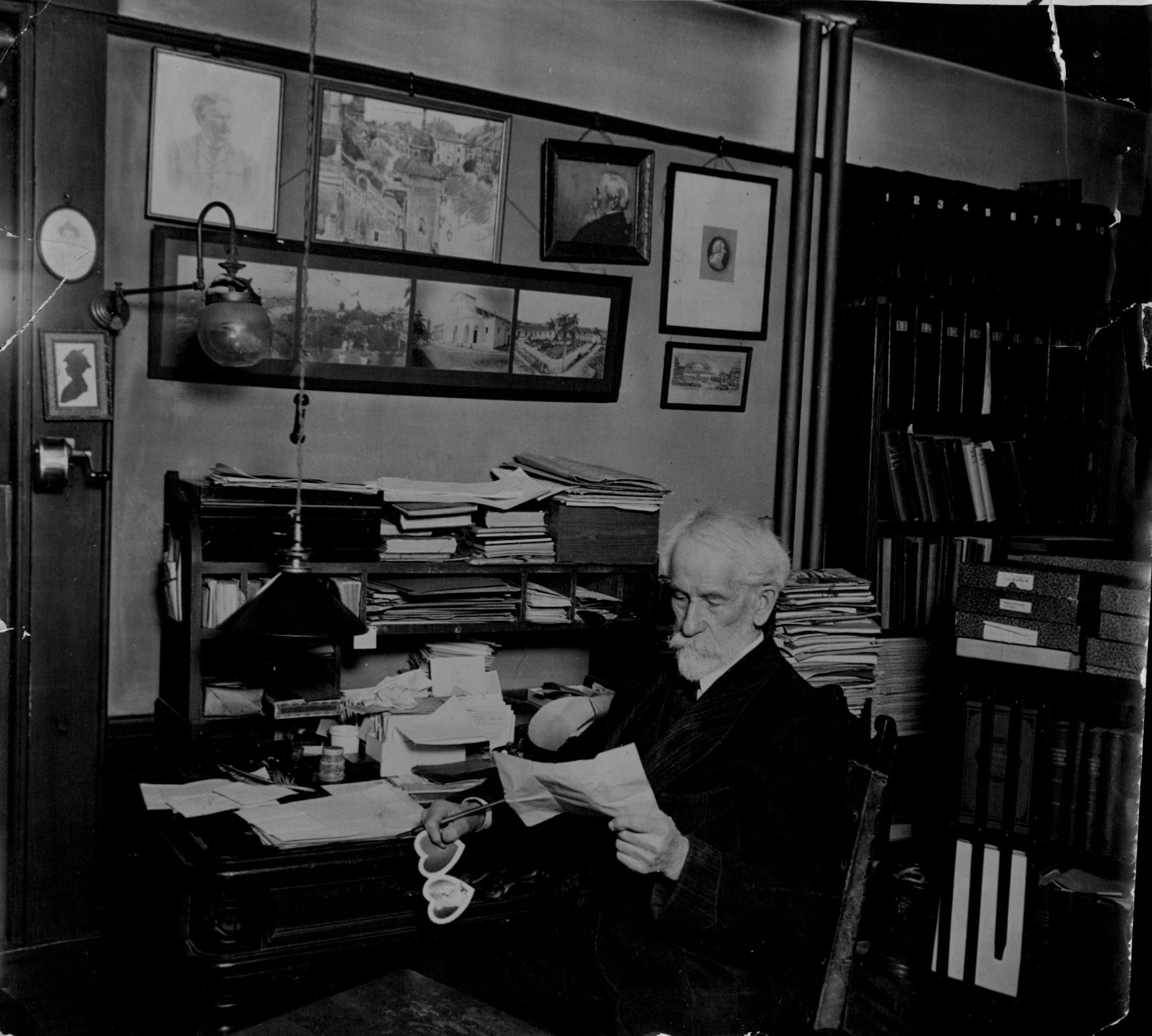
William Watts Folwell, the first president of the University of Minnesota, in his study. (Minneapolis Journal)

However, the university’s first president, William Watts Folwell, remembered when they were used for the first time.

“It’s years and years since I thought of that,” he told the Tribune. It was likely in the late 1870s, he said, adding that up until that point, “the question of colors had come up informally from time to time, but nothing had been done.”

In those days, the university’s diploma was “a big sheet of parchment that needed considerable tying,” he said.

A woman ‘of excellent taste’

During preparations for one commencement, Folwell asked Smith “to buy some ribbons for the tying and to use her own judgment on the color effect,” he said. “Mrs. Smith was a woman of excellent taste. The colors she chose were used on the diplomas, and they created a favorable impression. There was no formal adoption by either faculty or students, but they were used on the diplomas the next year and the next, and then they became habitual.”

In time, the university began using the diploma ribbon colors everywhere, and they became a part of the school’s identity.

Smith had been dead since 1886 when Folwell told this story, and the reporter left it at that.

But while Folwell insisted that Smith, who taught and served as a kind of women’s dean called a “preceptress,” be given credit decades later, newspaper records show she didn’t get much thanks at the time.

In 1879, the university’s board of regents (including Folwell) met and decided to “dispense with her services,” the St. Paul Globe reported after the meeting, lamenting that it was “a secret session” and suggesting that Smith being let go “raised something of a breeze in certain outside circles.”

Smith, who lived in Minneapolis, continued to write poetry after her dismissal. Back then, the Minneapolis Tribune often ran poems, and published at least two of hers. One published in February 1881 shares a mournful, snow-covered Minnesota moment, beginning:

No flowers to cheer, no singing birds;

The skies are cold and rude winds blow,

The beautiful summer lies to-night

Under the snow.

If you’d like to submit a Curious Minnesota question, fill out the form below:

Read more Curious Minnesota stories:

about the writer

about the writer

Erica Pearson

Reporter

Erica Pearson is a reporter and editor at the Star Tribune.

See Moreicon

More from Curious Minnesota

See More
"Santa" waved to people as he made his way to the Christmas photo booth at Southdale Mall, Friday, December 4, 2015 in Edina, MN.
card image