
Rash: Twin Cities Marathon posters marry art and athletics

From ancient Greece to modern Minneapolis and St. Paul, the long link endures.

Columnist Icon
The Minnesota Star Tribune
October 3, 2025 at 7:06PM
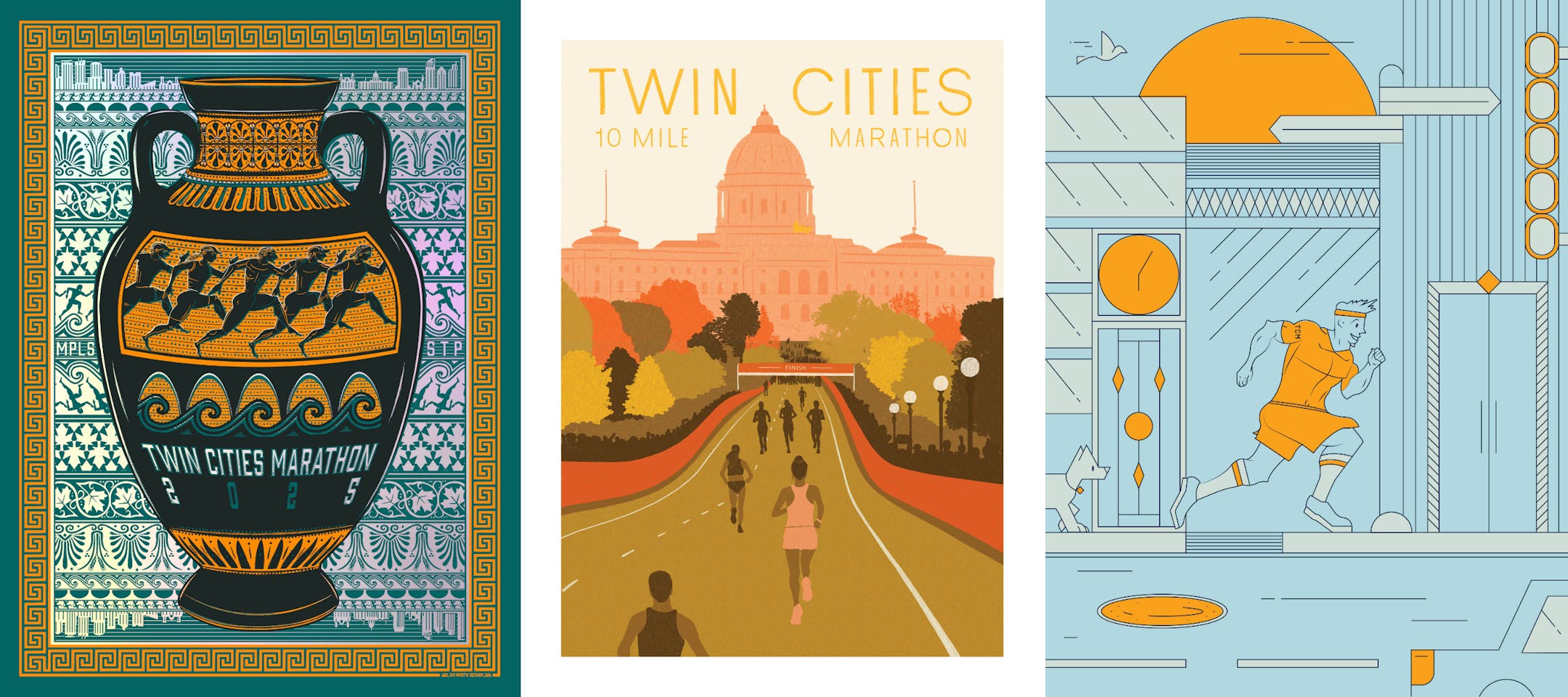
Left to right: Twin Cities Marathon 2025 posters created by artists Zach Serre, Annie Tyner and Brandon Lord. (Courtesy of Visit St. Paul)

Opinion editor’s note: Strib Voices publishes a mix of commentary online and in print each day. To contribute, click here.

•••

The long link between athletics and art goes back to the premodern Olympics in ancient Greece, where competitions were held not only in eternal sports like running, wrestling and boxing, but also elemental expressions in art and music. There was even a contest in heraldry, with winners honored by being allowed to announce victors in athletic events.

The modern games initially included arts competitions too: For four decades, from 1912 to 1952, medals were awarded in architecture, literature, music, painting and sculpture categories, with each piece inspired by sport.

Unfortunately, that artistic aspiration faded. Olympic posters, however, have endured. So too should the posters for the Medtronic Twin Cities Marathon — especially since for the second year running there isn’t just one official version, but 16 created by local artists showcased in “26.2: A Marathon Poster Show.”

The work, which can be seen on Friday and Saturday at the Health and Fitness Expo at the St. Paul RiverCentre, is all part of a marathon weekend that features family races, a 5K and 10K on Saturday and a 10-mile, half-marathon and marathon race on Sunday.

One of those artists, Zach Serre, said his poster is inspired by the marathon’s origin.

“I saw some black-figure pottery,” Serre said, “and wanted to fuse ancient Greek imagery combined with the marathon and the Twin Cities and bring that together as a modern retelling of an ancient-Greek view of art.”

Interspersed in the running figures from antiquity are present-day motifs, including what Serre described as “hidden and subliminal imagery” — waves under a bridge and, naturally, leaves for the fall marathon.

Serre, who’s run the race, describes it as “a way to have unity between both cities.”

Unity not just between Minneapolis and St. Paul but between runners, wheelers and spectators will be apparent in what is the state’s biggest annual sporting event. Especially because race-weekend registrations are at a post-pandemic high, said Charlie Mahler, senior media and communications manager for Twin Cities in Motion, which organizes the events.

“For the runners themselves, it’s their Super Bowl,” said Mahler. For the cities they run through, too. “Our trademark tagline has been ‘The Most Beautiful Urban Marathon in America’ since the early ’80s, which helps brand Minneapolis and St. Paul to anyone who considers running our race.”

And for anyone considering the cities in general, which is a welcome respite from much of the recent news narrative surrounding Minneapolis and St. Paul.

“It’s absolutely a contrast to what we’re seeing too much of in the news,” said Mahler. “There aren’t that many opportunities in the community where people come out and do positive things for the better part of a day and do things for other people.” (Twin Cities in Motion expects to raise more than $1.1 million for charity this year.)

If history inspires Serre’s Grecian urn, urbanity is behind Brandon Lord’s poster, which features a dynamic runner against static city lines. “When you are in motion, everything else is running around you,” said Lord, who added that his image is meant to invoke “everything moving together.”

That’s apparent in the poster, but also in a broader sense. “When you are in a marathon, or when you are part of a run, you have that end goal inside; we’re all working towards that,” Lord said, adding: “We’re trying to make for a better future.”

North Carolina native Annie Tyner said she chose the Twin Cities to make her better future in part because of the creative community she’s now part of as a designer and illustrator — and now a marathon-poster creator. Tyner’s also a runner and will take on the 26.2 miles on Sunday. A veteran of the 10-mile race, which like the marathon finishes at the Capitol, Tyner said that one of her favorite aspects is “how you can see the finish line once you get over the hill — just how grand and really nice it is, with spectators alongside the road and, when it’s a good year, you can see a bunch of fall colors” — an image colorfully captured in her poster.

Heat, not crisp autumn vibes, may mark this year’s race, but it’s the warmth of the race and the cities it traverses that seems to inspire all three artists.

“It’s really good to have these moments where there’s so many people from different realms of life — this poster show, this marathon — it brings a lot of people together,” said Lord.

“It’s by far the most special and meaningful race,” reflected Tyner. “I mean, getting to go through all different parts of our cities and getting to see the most beautiful sites makes me really proud to live here and to be part of this community.”

Serre said that he “makes art partially as an expression of joy. And I think that with the times we’re in now, being able to express joy and connection and companionship with other people is more important than ever.”

Indeed, it’s worth heralding. And while it may be a stretch to revive that event from Olympic history, it’s evident that from ancient times until now, art — like this year’s marathon posters — amplifies athletics.

about the writer

about the writer

John Rash

Editorial Columnist

John Rash is an editorial writer and columnist. His Rash Report column analyzes media and politics, and his focus on foreign policy has taken him on international reporting trips to China, Japan, Rwanda, Kazakhstan, Turkey, Lithuania, Kuwait and Canada.

See Moreicon