
Trump looks like a negative for economy, Goldman Sachs says

So far, any predictions that Trump will be a drag on the economy have fallen flat.

Bloomberg News
February 13, 2017 at 7:58PM
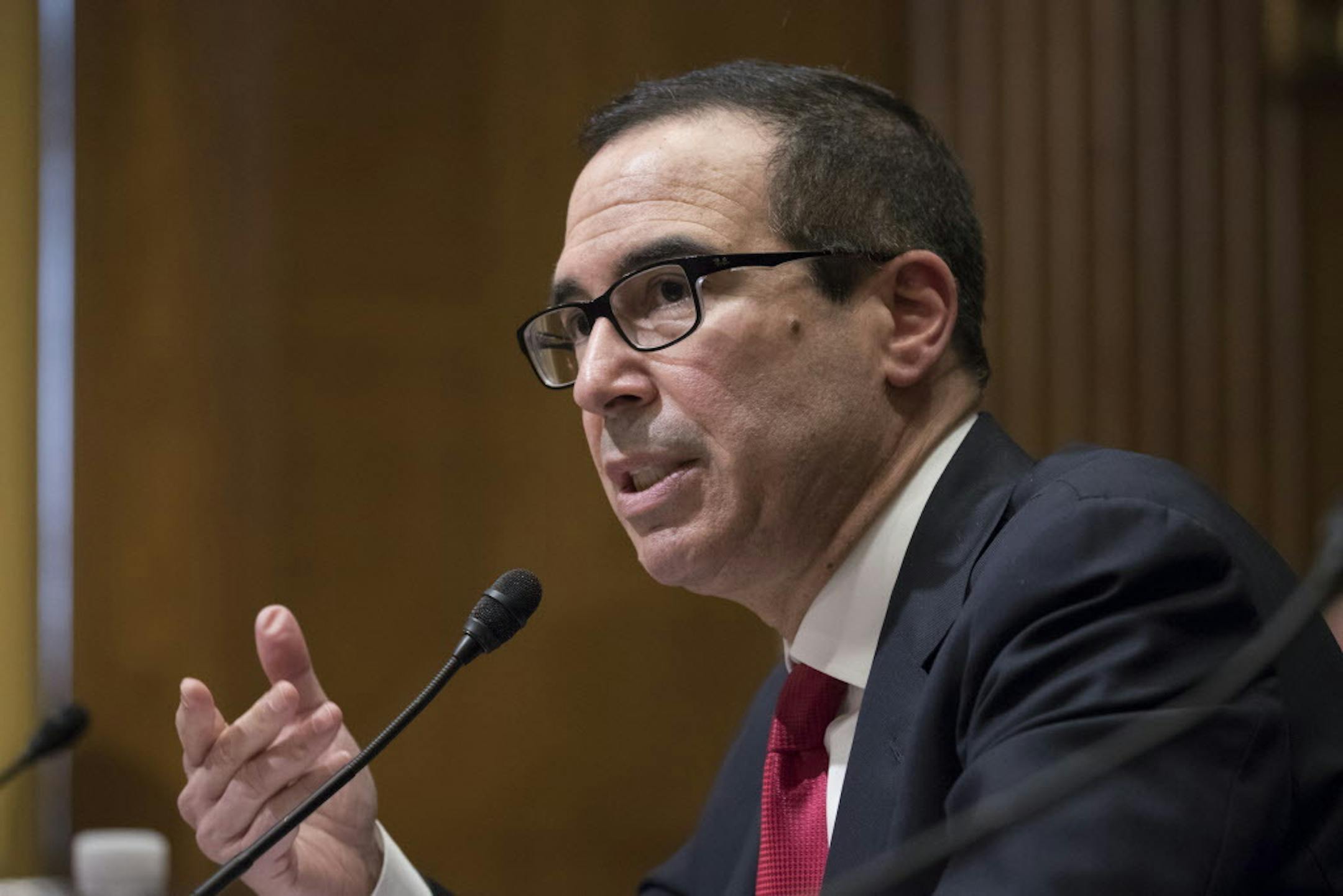
FILE - In this Jan. 19, 2017 file photo, Treasury Secretary-designate Steven Mnuchin testifies on Capitol Hill in Washington at his confirmation hearing before the Senate Finance Committee. The Senate is poised to confirm Mnuchin despite complaints by Democrats that Mnuchin failed to protect thousands of homeowners from unnecessary foreclosures when he headed OneWest Bank. (AP Photo/J. Scott Applewhite, File)
In this Jan. 19, 2017 file photo, Treasury Secretary-designate Steven Mnuchin testifies on Capitol Hill in Washington at his confirmation hearing before the Senate Finance Committee. The Senate is poised to confirm Mnuchin, one of several Goldman Sachs alumni in President Donald Trump’s inner circle. (The Minnesota Star Tribune)

Add Goldman Sachs' chief economist to the list of those concerned that President Donald Trump won't jump-start economic growth.

A week after a group of the bank's political analysts warned of risks from protectionist moves, Jan Hatzius and economist Jari Stehn wrote that they anticipate a delayed boost from increased government spending because a bill likely won't pass until late 2017 or early 2018. In addition, the economists noted that "the more adverse parts" of the Trump agenda remain substantial.

"The risks around U.S. policy have also turned somewhat more negative," Hatzius and Stehn wrote in a note to clients on Monday.

So far, any predictions that Trump will be a drag on the economy have fallen flat. The S&P 500 is up more than 8 percent since his election, climbing Monday for a fifth day to a fresh record. The dollar has rallied 3.5 percent and bonds have fallen as investors bet the administration and Republican Congress will supercharge growth rates.

Goldman, though, is growing concerned. Indeed, when you put the bank's assumptions about Trump's plans into the Federal Reserve's economic forecasting model, the conclusion is that the policies will actually be a negative for growth relative to the status quo by the end of his term.

"An increase in the effective tariff rate on imports seems likely and we now assume a somewhat bigger decline in net immigration flows than we did immediately after the election," they wrote.

The investment bank's increasing pessimism is striking considering the plethora of Goldman alumni in the president's inner circle, including Treasury Secretary nominee Steven Mnuchin, National Economic Council Chief Gary Cohn and Dina Powell, who is working on economic growth issues and empowering women.

Cohn, who was Goldman's president before taking the position with the administration, is reportedly leading the effort to create a "phenomenal" tax plan.

Hatzius and Stehn compiled a "full Trump" case that includes $450 billion in fiscal stimulus through a combination of infrastructure and tax cuts, tit-for-tat tariffs, and immigration restrictions that reduce the labor force by 2.5 million from the pre-election baseline underpinning the Federal Reserve's September projections.

While the economists don't spell out this conclusion specifically, the "Full Trump" case results in the level of gross domestic product rising by a little over 7 percent by the end of 2020, compared to baseline growth of 8 percent in the Fed's projection. Based on the data, Goldman's house view also anticipates a smaller economy by the end of 2020 compared with the Fed's September forecast.

"Our simulations suggest that Mr. Trump's policies could boost growth slightly in 2017 and 2018, but are likely to weigh on growth thereafter if trade and immigration restrictions are enacted," they wrote.

One part of Trump's fiscal policies is conspicuous by its absence from Goldman's report. There's no reference to deregulation boosting growth and offsetting the supply-side hit caused by stricter immigration controls.

While some skeptics may also call into question the legitimacy of Goldman's projections given the persistent yawning gap between the Fed's "dot plot" and actual rate hikes, it's worth noting that monetary policymakers did fairly well forecasting the evolution of economic variables in 2016.

about the writer

about the writer

Luke Kawa

More from Business

See More
The newly renovated Parkway Theater is next door to the new restaurant El Burrito Mercado.
Star Tribune/The Minnesota Star Tribune

The new rule, which goes into effect March 1, says only firms owned by citizens or U.S. nationals will qualify for Small Business Administration loans.

card image
card image