Rash: The president should promote, not disparage, mail-in voting

Here’s what Minnesota Secretary of State Steve Simon has to say about Trump’s quest to upend voting protocol.

Columnist Icon
The Minnesota Star Tribune
August 26, 2025 at 2:35PM
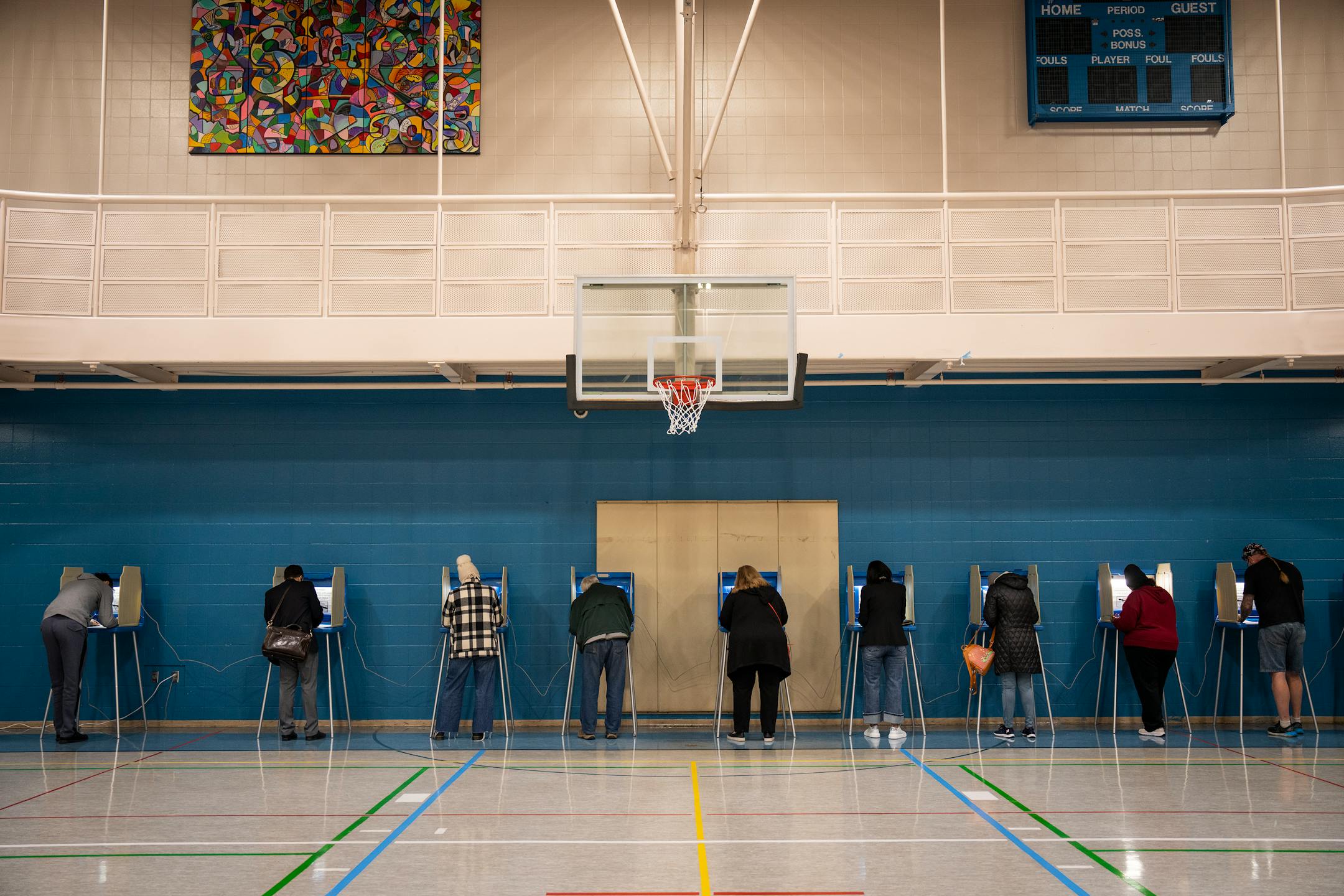
Voters cast their ballots on Election Day at Highland Park Community Center in St. Paul on Nov. 5, 2024. (Leila Navidi/The Minnesota Star Tribune)

Opinion editor’s note: Strib Voices publishes a mix of commentary online and in print each day. To contribute, click here.

•••

An unsubtle, unsettling mix of policy and politics was apparent in President Donald Trump’s Aug. 18 social-media message.

“I am going to lead a movement to get rid of MAIL-IN BALLOTS,” it began, later adding “Highly ‘Inaccurate,’ very Expensive, and Seriously Controversial VOTING MACHINES” to what he said would be an “EXECUTIVE ORDER to help bring HONESTY to the 2026 Midterm Elections.”

The missive was like a missile to election officials across the country because of two key words: executive order.

“So this wasn’t him just shaking a fist at a process he doesn’t like,” said Minnesota Secretary of State Steve Simon. “This is him saying he was in the process of crafting an actual executive order, which he would claim would have the force of law.”

Speaking constitutionally (and characteristically calmly), Simon explained that Article I, Section 4 is “quite clear: It says states determine the time, place and manner of elections, except that Congress may step in, as they have during the Voting Rights Act and other times.”

There’s nothing in the Constitution, continued Simon, that allows the president “to wave a magic wand in the Oval Office and just decree these sweeping changes to the election system.”

There’s near complete concurrence among experts to that view, including from Jasleen Singh, senior counsel and manager in the Brennan Center’s Democracy Program.

Singh, who focuses on voting rights and elections, said that “states run elections; Congress has a role to set national standards, but under the law, under the Constitution, presidents have no role to play in setting election rules.” Using “executive edict” to get rid of mail-in voting, she added, “would be nakedly unconstitutional.”

A congressional fig leaf might be Republicans’ inclination (or instruction, from Trump). But because mail-in voting has such universal usage (including previously by the president himself, let alone scores in Congress), that might be a heavy legislative lift.

And mail-in voting dates back to the Civil War, said Simon, who added that nearly 40% of Minnesotans used it in the last election and a majority voted so amid COVID-19 in 2020.

“It’s very popular, and with good reason,” he said. “Increasingly, people don’t necessarily want to be told that they can only vote on a given day at a given physical location during a given set of hours, and they like the freedom and flexibility.”

And it’s not just the modern-day equivalent of Union soldiers voting by mail.

“Think about all the Minnesotans,” said the secretary, “who are in the military or living and working abroad, who are students or diplomats or missionaries or business people.” Consider, continued Simon, a long-haul truck driver called on short notice to drive out of state. And beyond those cohorts, “it’s about everyday people who otherwise would not vote. They’re busy. They’ve got complicated, hectic lives, and they have become accustomed to this way of voting.” And if that’s taken away, said Simon, “they might just opt not to vote. And that would be a shame; that would really diminish our democracy.”

To the president’s presumption that voting by mail results in “MASSIVE VOTER FRAUD,” Simon counters that the system is “extremely secure.” Features including identifying information have made fraud virtually nonexistent, with no cases Simon could recall since he’s been secretary. Additionally, he said, all 87 counties are required to report “not just convictions, not just charges, but even pre-charge investigations into voting-related misconduct,” and again Simon could not recall such an occurrence.

In effect, the perception of fraud, in Sherlock Holmes parlance, is the dog that didn’t bark — meaning that the absence of evidence regarding the alleged circumstance indicates that something else may be going on.

Singh put that “something else” in context by saying: “This is one specific issue, but it’s actually part of a concerted strategy” in which the administration “in really an unprecedented manner, is trying to intervene in elections, undermine confidence in elections in advance of the 2026 midterms and beyond.” The strategy, she added, ranges from “defunding election-security programs or trying to gain access to state voter rolls.”

That request is another fight for Simon, with the Department of Justice threatening the state with a lawsuit if it continues to resist handing over its voter-registration list. But it’s beyond a standard request, said Simon: “They’re asking for much more than that; they’re asking for personal identifying information, including Social Security information, driver’s license information and other personal information that our laws have created a clear dome of privacy around in the state of Minnesota.”

While Minnesota’s slender legislative margins make it unlikely the state will get swept up into the redistricting race to the bottom that was started by Texas, countered by California, and may soon be a cross-country contagion, Simon worries that the redistricting spiral “just feeds cynicism that politicians are choosing their own voters instead of the other way around: voters choose their politicians. And that cynicism is likely to head in one direction, which is lower engagement, lower turnout, if people perceive that their vote is just caught up in gamesmanship.”


Simon’s objective is the opposite: maximizing participation for the 2026 election (in which he’ll be on the ballot, either running for re-election or potentially for governor if Tim Walz declines to run for a third term).

Despite the continual controversies over voting, Simon is still optimistic, however, hoping that Minnesota will once again lead the nation in voter turnout, as, he said, “nature intended.”

about the writer

about the writer

John Rash

Editorial Columnist

John Rash is an editorial writer and columnist. His Rash Report column analyzes media and politics, and his focus on foreign policy has taken him on international reporting trips to China, Japan, Rwanda, Kazakhstan, Turkey, Lithuania, Kuwait and Canada.

See Moreicon