
Travelers see flight cancellations ease, but not disappear, as federal government reopens

Cancellations mandated by the FAA were reduced to 3% of flights, effective Saturday, at 40 major airports including MSP.

The Minnesota Star Tribune
November 14, 2025 at 5:25PM
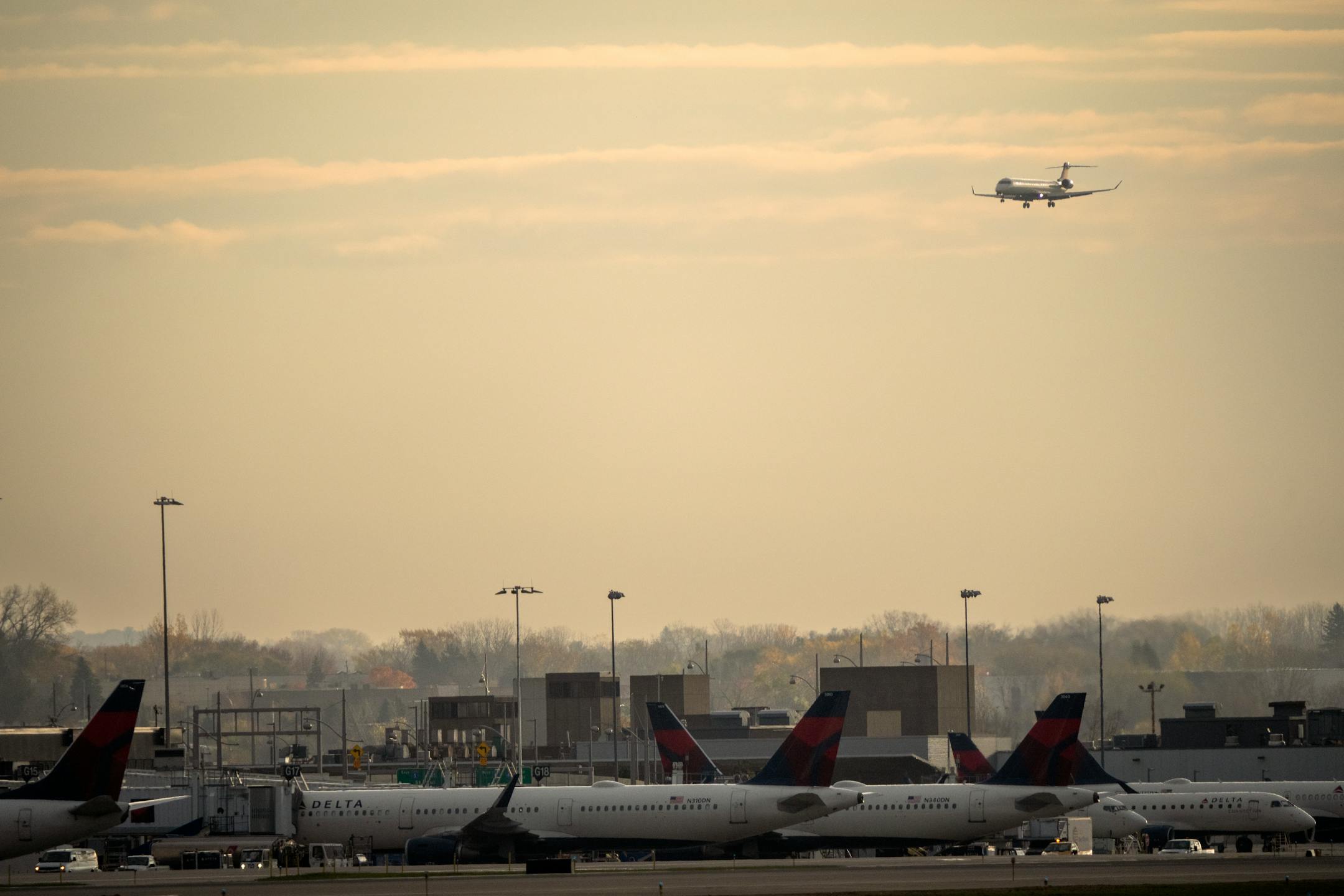
A plane lands at Minneapolis-St. Paul International Airport on Nov. 7. MSP is among the 40 airports nationally seeing flight reductions even after the end of the federal government shutdown. (Leila Navidi)

Airlines continue to cut flights from their weekend schedules, disrupting travel plans at Minneapolis-St. Paul International Airport (MSP), as the return of paychecks for air traffic controllers has not yet convinced federal officials to lift all travel restrictions.

The longest federal government shutdown in U.S. history, which ended late Wednesday, led to wide flight disruptions as air traffic controllers began to call out sick with greater frequency, adding pressure to a system already strained by low staffing. Air traffic controllers were required to work without pay during the shutdown.

The federal government is still enforcing restrictions limiting the flow of air travel to 40 of the nation’s busiest airports, including MSP.

The Federal Aviation Administration (FAA) first throttled air travel across the nation through a Nov. 7 emergency safety order that required airlines to ultimately cut flight operations by 10%. On Wednesday, the FAA issued a renewed order that froze cancellations at 6%, citing a significant reduction in controllers calling off work.

Late Friday, the FAA issued another directive, scaling down mandatory cancellations to 3%, effective Saturday morning.

Among the travelers affected by the disruption was Chuck Hommen, 59, of Somerset, Wis.

His 91-year-old father flies out of MSP each year to spend winters in Arizona. On Sunday morning, Hommen dropped him off at the airport and was nearly back at the Wisconsin border when his father called him to say that his flight to Tucson, Ariz., had been canceled.

Early Monday morning, Hommen awoke to learn his father’s Delta Air Lines nonstop to Tucson had been canceled yet again. A travel agent helped arrange a different route through San Francisco, but snafus along the way turned what should’ve been a 3-hour direct flight into a 14-hour journey.

“It was hard on a 91-year-old man,” Hommen said. “He was struggling by the end of the day.”

Many of the inbound and outbound flight reductions at MSP have been limited to smaller regional routes. As of Friday morning, there were 613 flight cancellations across the U.S., including 18 at MSP, according to flight tracking website FlightAware.

The eased cancellations this week came after a weekend spike that hit 10.2% nationwide Sunday. That day and Monday were among the worst in the past two years for air travel, according to data from Cirium, an aviation analytics company.

Even as the FAA instituted a slowdown, an analysis from Airlines for America, an industry group for major airlines, recorded a worsening cancellation rate attributed to air traffic controller issues. For example, on Sunday, of the 1,704 cancellations across the nation, 819 stemmed from the FAA-mandated orders and another 885 were tied to further staffing delays.

U.S. Department of Transportation Secretary Sean Duffy has said staffing shortages of air traffic controllers led to significant delays Saturday, Sunday and Monday. But as the end to the longest federal government shutdown neared, he said, many were returning to work.

Duffy said the FAA-mandated cancellations were put in place as a safety measure based on data, including aircraft flying too close together and complaints of deteriorating communication between pilots and controllers. He said the mandated cancellations would scale down when the data supports doing so.

“We are going to look at the data and make the best decisions possible to keep the traveling public safe,” Duffy said during a press event at Chicago’s O’Hare, where he referenced the midair collision between American Airlines Flight 5342 and an Army helicopter on Jan. 29 outside Ronald Reagan Washington National Airport, which killed 67 people.

Air traffic controllers were understaffed before the 43-day federal government shutdown required them to work without pay. Leaders with their union, the National Air Traffic Controllers Association, have called for greater attention to the nation’s continuing need for a well-trained workforce as controllers continue retiring or leaving the profession.

Airlines sought to minimize disruptions across their networks, limiting many of the prescribed FAA cancellations to regional domestic routes. But staffing constraints and some weather events ushered in wider cancellations than were initially ordered by the government.

Delta CEO Ed Bastian said Thursday on CBS News his airline’s only cancellations over the past two days were on smaller aircraft to align with the government mandate, saying he expected to be mostly “full steam ahead” by the weekend. Many of the Atlanta-based airline’s 2,000 flight cancellations stemmed from “significantly lower” staffing in air traffic control system as typical inclement weather snowballed into large scale disruption.

“Saturday was a perfect illustration. We had a little storm pass through Atlanta, not anything terribly unusual. The overall level of arrival rates got reduced down to 20 an hour. Normally it’s 80 an hour,” he said.

Minnesota-based Sun Country Airlines, the second-most-traveled carrier at MSP, said the flight schedule was expected to return to normal over the coming week. The airline said it proactively communicated cancellations to customers.

On Thursday, of about five dozen people informally surveyed at the airport, most made their way through MSP unscathed, reporting no serious delays or disruptions on their trips.

“I expected worse,” said Lamie Carroll, 29, of Minneapolis, returning home from a work trip. Carroll said some of his friends had issues getting home and people staying at his hotel voiced problems.

Others weren’t as lucky as Carroll.

Cameron Houston, 62, of Detroit, travels frequently for work as a field service engineer. One of his flights was canceled as air traffic controller staffing strains started cropping up in late October. He opted to drive from Ann Arbor, Mich., to New Castle, Ind., for a job rather than risk being delayed.

Kathy Presperin, 64, of Wayzata, made it home from a work trip Thursday without a travel hiccup on the last leg of the journey. But it was a different story a few days ago, when her flight from New York’s LaGuardia to Indianapolis was canceled.

“The whole board was red,” she said.

Presperin said she had to scramble to find a hotel and she missed a day of work. She said she felt like a small player in a larger political game surrounding the government shutdown.

“It’s kind of frustrating to be a pawn,” she said.

about the writer

about the writer

Bill Lukitsch

Reporter

Bill Lukitsch is a business reporter for the Star Tribune.

See Moreicon

More from Business

See More
card image
Dick Enrico