
Tolkkinen: At 27 below, Brainerd diver helped rescue lost cable in Lake of the Woods

Bill Matthies, 90, died this month, leaving behind a legacy of exploits and the love of scuba diving.

Columnist Icon
The Minnesota Star Tribune
December 26, 2025 at 12:01PM
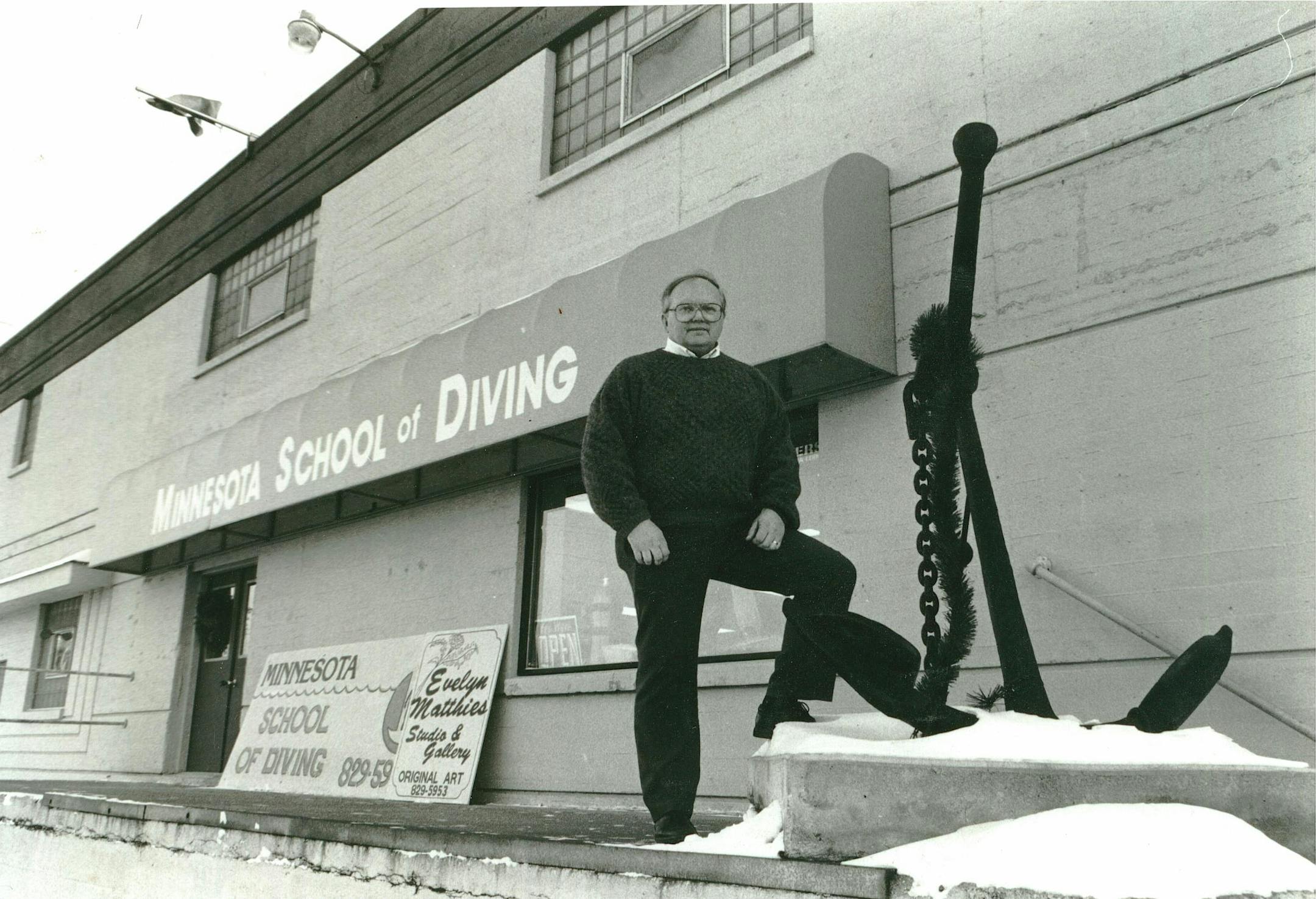
Bill Matthies, pictured here in the late 1980s outside the Minnesota School of Diving he founded in Brainerd, once had to be pried off the ice while recovering electrical cable in Lake of the Woods in the early 1970s. (Provided)

Bill Matthies got the call in mid-December 1973.

A trawler carrying 11 reels of electrical cable capsized on Lake of the Woods that fall. The boat captain lost his life and the reels were missing. That part of the lake is about 725,000 acres. A marker showing the exact spot where the reels would be had disappeared.

At that time, the Northwest Angle had no electricity, which meant the predominantly white settlement of Angle Inlet and 50-100 people living on Red Lake Nation land had to rely on smelly, noisy generators. By the early 1970s, a year-round road had been built that connected the area to the rest of Minnesota through Canada, but it was still isolated.

Matthies agreed to try to find the reels. An Albert Lea native who caught the scuba diving bug after meeting a guy from Hawaii, Matthies later moved to Brainerd to teach math, and founded what would become the Minnesota School of Diving Inc. For years, he was the only rescue diver in central Minnesota, said his son, Todd Matthies, who took over the business.

Over Christmas vacation, Bill Matthies took off for the Northwest Angle along with a local photographer, in a tale he recounted in his book “One Earth Two Worlds.” They found 4 feet of ice on Lake of the Woods, as well as daytime temperatures of 27 below zero. A crew set up warm icehouses for him to change into his still-primitive scuba gear. The first time he exited the lake, his wet suit froze solid. He needed to be pried loose from the ice and help getting into the fish house.

After that, a Canadian Mountie moved the fish house, with Matthies in it, to the next hole. He plunged immediately into the next hole, where water temperatures were in the high 30s. He dove over and over. It was shallow and muddy and limited to about a foot of visibility despite a powerful underwater light, so he felt his way by touch.

For three days Matthies dove and found nothing. They were 10 miles out on the lake.

“Because of the strong winds blowing snow and the cold, I could not see shore in any direction,” he wrote. “I felt I were someplace in the middle of Siberia.”
On the third day, a plane with skis landed near them on the lake. The pilot regularly shuttled mail, passengers and supplies to the Northwest Angle. He had passed over where the boat sank and marked the spot from the air. He flew off from the group and dropped a bag of red dye to mark the spot, about 2 miles away from where Matthies had been looking.

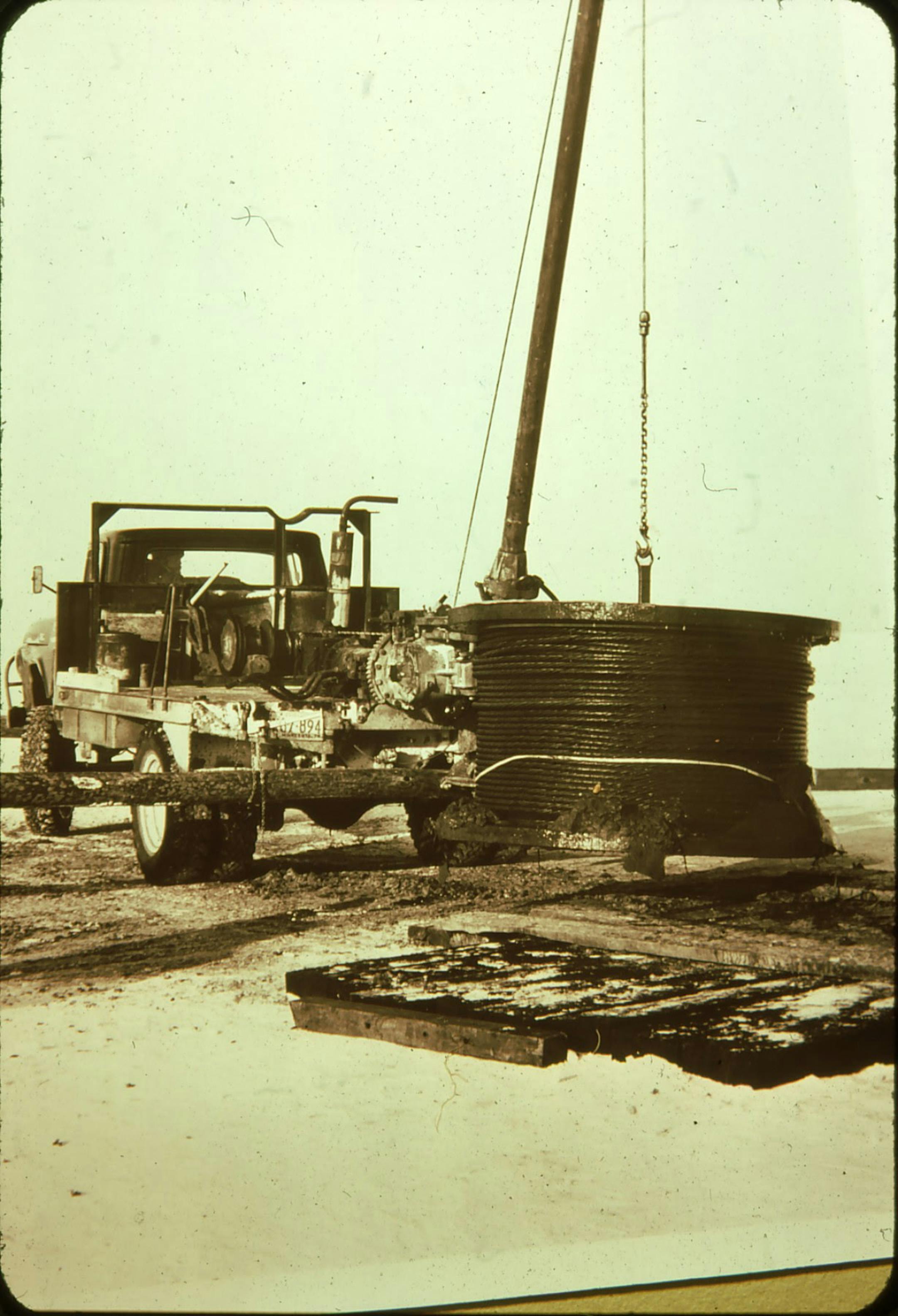
The new spot proved fruitful. Matthies was able to see a deep groove in the lake bottom where the boat had been dragged by a recovery team. The groove led to the spools, which he connected to hooks so a boom truck shored up on planks could hoist them out of the lake.

By spring, the Northwest Angle had electricity, bought at the cost of a man’s life and the tenacity of a Brainerd math teacher. It seems to me they could have delayed the installation until better weather, but the project was already behind schedule and I suppose they wanted to forge ahead.

According to the Washington, D.C.-based TeleGeography Blog, which covers the telecommunications industry, a mile of submarine cable costs about $32,000 today, while trans-ocean cable can cost into the hundreds of millions of dollars.

I told Todd Matthies I hoped his dad earned good money on that job.

“Knowing him, I doubt it,” he said.

A boom truck hoists an electrical cable reel out of Lake of the Woods in early January 1974. A boat capsized in fall 1973, leading to the death of the captain and the loss of 11 cable reels. (Provided)

Bill Matthies, who died on Dec. 14, was one of those guys who couldn’t sit around, he said. He coached football and wrestling and taught driver’s ed. One of the first to scuba dive through Minnesota’s lakes and rivers, he pulled up metal pikes used by logging crews while rafting timber down the rivers. His three kids rode bicycles he pulled from the drink.

He liked to explore river bottoms near bridges, a logical place for people to throw evidence of crimes. Nowadays, divers leave the artifacts they come across for future divers, but in the early days, it was still common practice to bring their finds home. Matthies pulled up many guns and slot machines still with nickels in their chambers, his son said. Whether any of this evidence helped solve crimes, he wasn’t sure. But his dad did help recover the bodies of 99 drowning victims. People would also hire him to find lost objects.

“His success rate on wedding rings was most impressive,” Todd Matthies wrote on Facebook.

It was because of Bill Matthies that Aaron Cross went scuba diving again after a bicycle accident left him a partial quadriplegic at age 15.

Cross, of Foley, Minn., first went scuba diving at age 9. In the years following his accident, he contacted diving schools in Minnesota but didn’t hear back. Then he called Matthies’ business, which immediately offered to help. Matthies wanted to see how adaptive diving worked, so he became his diving buddy.

“I remember talking to him just saying, ‘I really hope one day I’ll be able to dive with sharks,’” Cross recalled. “And he just put his hand on my shoulder and said, ‘You will.’”

It took years. But Cross finally realized his dream by swimming with the sharks in 2022 in the Caribbean. He is the now president of Free-Daptive Divers, which helps people with disabilities scuba dive.

Matthies’ memorial service is set for Jan. 3 in Brainerd.

“That guy lived a life,” said Doug Klein, whose Minnesota Scuba Diving Facebook page has 6,000 members. “Between teaching and being a scuba instructor, he touched a lot of people’s lives.”

about the writer

about the writer

Karen Tolkkinen

Columnist

Karen Tolkkinen is a columnist for the Minnesota Star Tribune, focused on the issues and people of greater Minnesota.

See Moreicon