

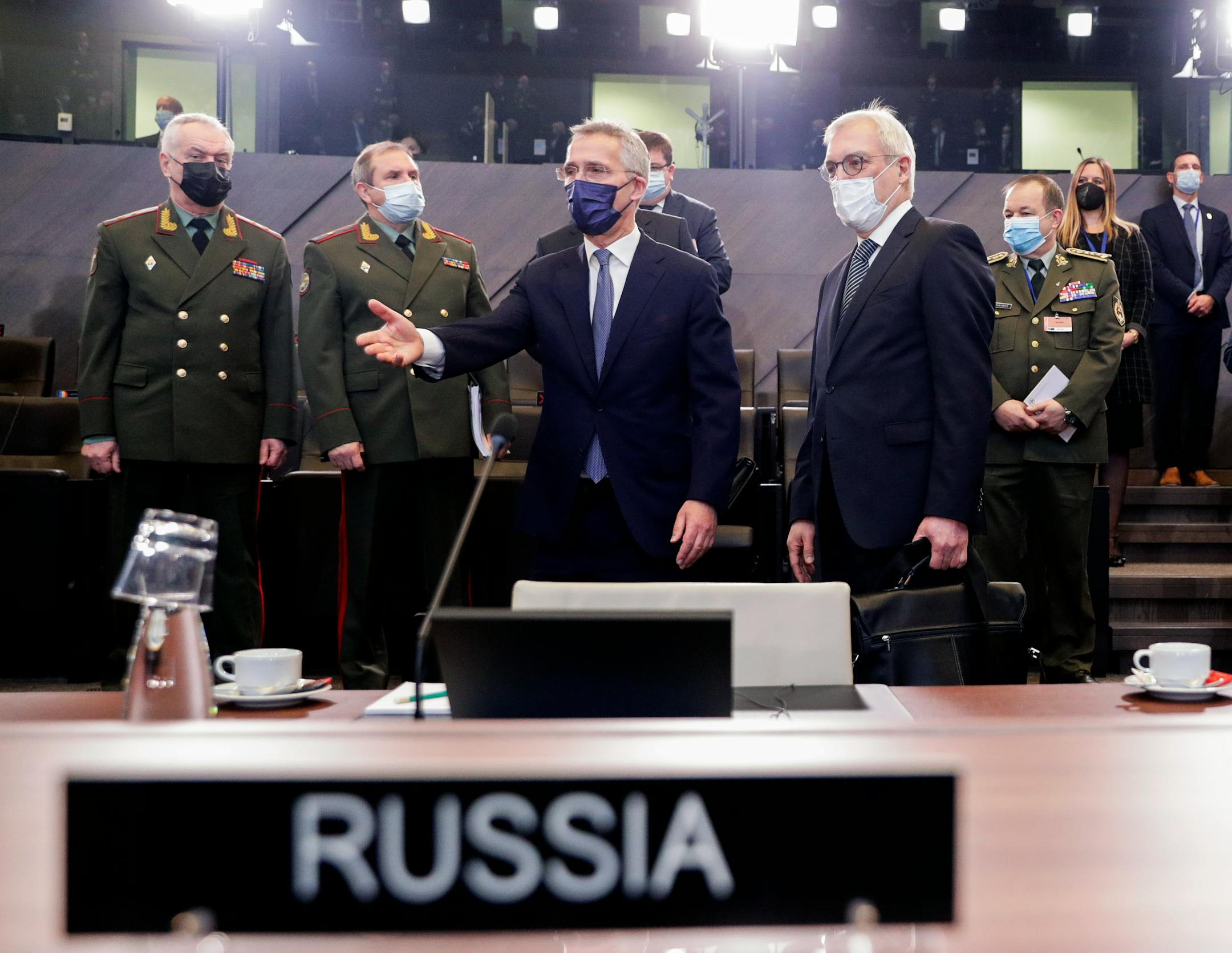
In justifying his invasion into Ukraine, Russian President Vladimir Putin has consistently pointed to one culprit as the main driver for the crisis: NATO's expansion into Eastern Europe and its military cooperation with Ukraine, including providing billions of dollars in training and equipment.
Whether Moscow's perception of insecurity is caused by the North Atlantic Treaty Organization's growing reach or whether that's merely pretext for Putin's neo-imperialist mission to reclaim parts of the former Soviet Union is subject to debate. And there are few tools to assess Putin's motivation.
Still, some have argued that Putin has a point. As the Biden administration and allies impose economic sanctions to respond to Russian troop movement into Ukraine, NATO's role in the conflict is in question. NATO has courted Russia's neighbors and some countries have joined the Euro-Atlantic alliance, while others such as Ukraine cling to the hope that they will follow suit. But it's unclear if and when these countries will be allowed to do so. This limbo has left them vulnerable, for three reasons.
First, NATO has created a security risk for the new states that emerged after the Cold War. The tantalizing prospect of eventual NATO membership perhaps made it less of an imperative for these states, including Ukraine, to cultivate alternative, more regionally rooted security arrangements for dealing with their various internal conflicts and with Russia itself. It made them reluctant to adopt more pragmatic foreign policy approaches with the Russian bear next door.
Second, NATO has come to represent something of a "civilizational choice" for the former Soviet states. Along with European Union membership, NATO membership became integral to the democratic aspirations of many of these countries. NATO effectively equated democracy with a Western orientation and forced a geopolitical choice on states that are outside of the security bloc.
Putin has exploited this contrast domestically by framing NATO as a perpetual security threat for the "besieged Russia" narrative that he was creating. This narrative was used to suppress democratic breakthroughs within nations in Russia's orbit, or even in Russia itself.
Third, NATO's framework cannot solve all of the distinct security challenges in many post-Soviet states. Defense, deterrence and crisis management are NATO's strengths. But beyond its members, NATO has been less effective as an exporter of security. Its goals of defense and deterrence at times conflict with its messages of democratic values and cooperation.
The post-Soviet region today is afflicted by a string of unresolved conflicts, weak states and limited democratic spaces. They require mostly local and bottom-up solutions, while NATO's purpose is centered on top-down approaches.


