
Timings of mobile phone alerts varied after back-to-back missing child cases. Here’s why.

Minnesota’s patchwork of emergency systems issued two alerts in two days — but on different timelines and terms.

The Minnesota Star Tribune
August 7, 2025 at 7:39PM
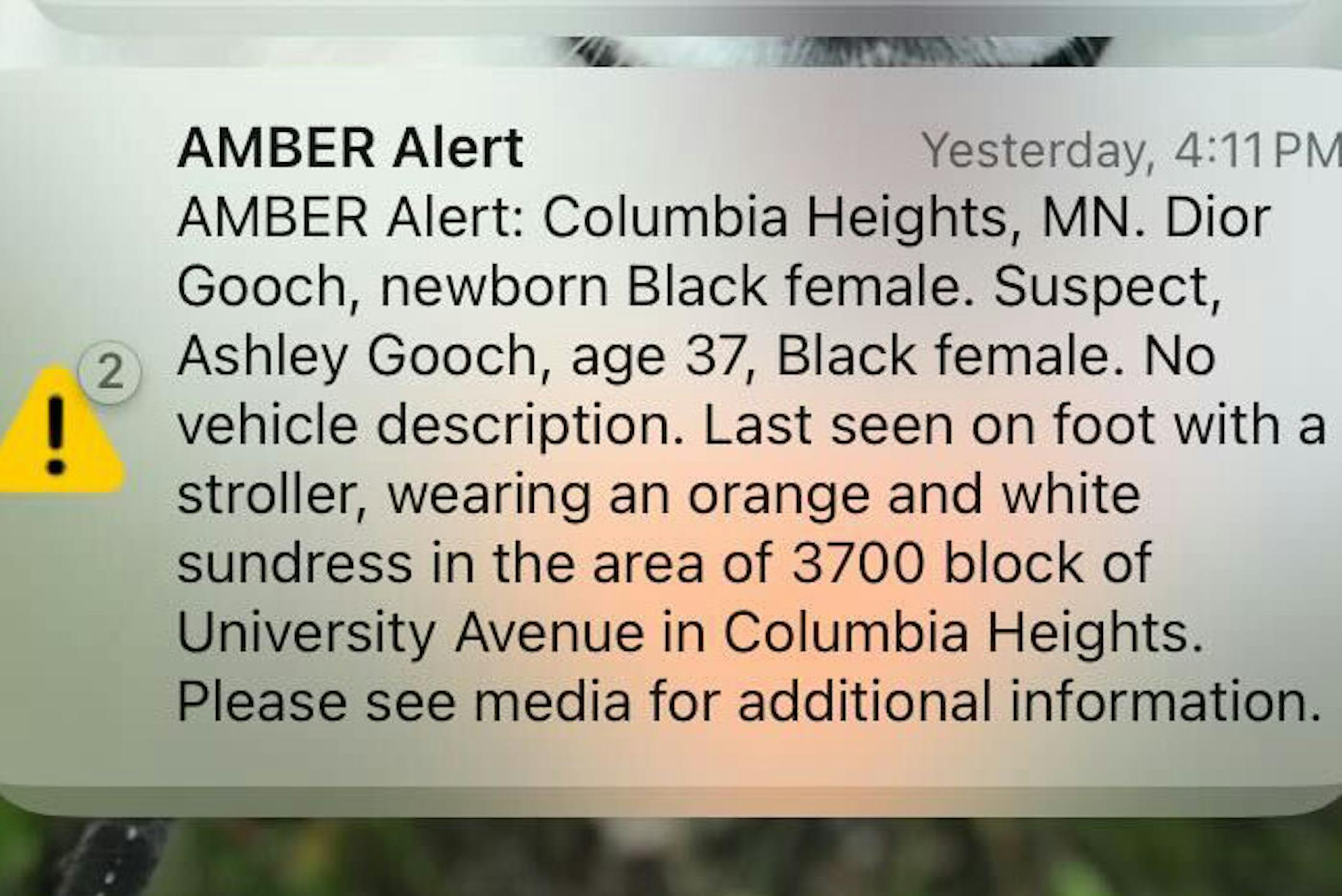
An AMBER Alert sent to cell phones in the Twin Cities after a 3-month-old girl was taken by her noncustodial mother in Columbia Heights. Both were later found safe. (Abby Simons)

A 12-year-old girl disappeared from her south Minneapolis neighborhood on Saturday. Police sent out a citywide emergency alert three days later — just hours before she was found safe at a friend’s house.

The next day, an Amber Alert was issued within hours after a 3-week-old baby was abducted in Columbia Heights.

Both children were ultimately found unharmed. But the timing of the alerts — one delayed, one immediate — has renewed questions about how Minnesota agencies determine when and how to notify the public in missing child cases.

Multiple types of alerts are issued in Minnesota. Amber Alerts — reserved for confirmed child abductions — are the most well-known. But law enforcement agencies can also request Wireless Emergency Alerts (WEAs), which are part of a federal system that delivers critical warnings to mobile phones in a targeted geographic area.

Victoria Alexandria Jackson, the 12-year-old girl, was reported missing Saturday evening after leaving Minnehaha Falls. According to Office of Community Safety spokesperson Scott Wasserman, police notified the public through social media the next morning and began searching the area with officers, drones, K-9 teams and assistance from local agencies.

As the search extended into its third day, concerns grew over Victoria’s medical condition — she uses an insulin pump to manage Type 1 diabetes. Minneapolis police then requested a Wireless Emergency Alert through Hennepin County.

That alert was sent Tuesday afternoon. Hours later, Victoria was found at a friend’s house.

Wasserman said police inquired about an Amber Alert earlier in the search but were told the case did not meet the required criteria. In Minnesota, the state Bureau of Criminal Apprehension (BCA) oversees the Amber Alert system and determines whether a case qualifies based on federal and state guidelines.

Just a day later, a case in Columbia Heights did meet those requirements. Police said 3-week-old Dior Gooch was taken from her guardian by a woman who had previously made threats of violence.

The woman was last seen Wednesday morning pushing a stroller near 37th and University Avenue. An Amber Alert was issued later that morning, and law enforcement asked the public for help finding the infant.

Emergency alerts in Minnesota operate under a patchwork of state, local and federal protocols. The Federal Emergency Management Agency (FEMA) and the Federal Communications Commission (FCC) administer the Wireless Emergency Alert system, but local agencies — such as the Minneapolis Police Department — decide whether to request one in cases involving missing or endangered people. Amber Alerts, however, are authorized and issued by the BCA when specific legal criteria are met, including confirmation of an abduction and a reasonable belief the child is in imminent danger.

Minnesota also uses other alerts, such as Silver Alerts for missing seniors with cognitive impairments, Blue Alerts for suspects in crimes against law enforcement and Missing Endangered Person Alerts for vulnerable adults or children who don’t qualify for Amber Alerts.

Not all of these alerts trigger mobile phone notifications. Some rely on media advisories, highway signs or opt-in systems.

In both Twin Cities cases this past week, the alert systems operated as intended. But their side-by-side timing shows just how differently cases can unfold — depending not just on the facts, but on which protocol applies.

about the writer

about the writer

Sofia Barnett

Intern

Sofia Barnett is an intern for the Minnesota Star Tribune.

See Moreicon

More from News & Politics

See More
card image
Renée Jones Schneider/The Minnesota Star Tribune

A federal lawsuit alleges a Maryland company never delivered the lessons meant to tie into the city’s college savings program for newborns.