

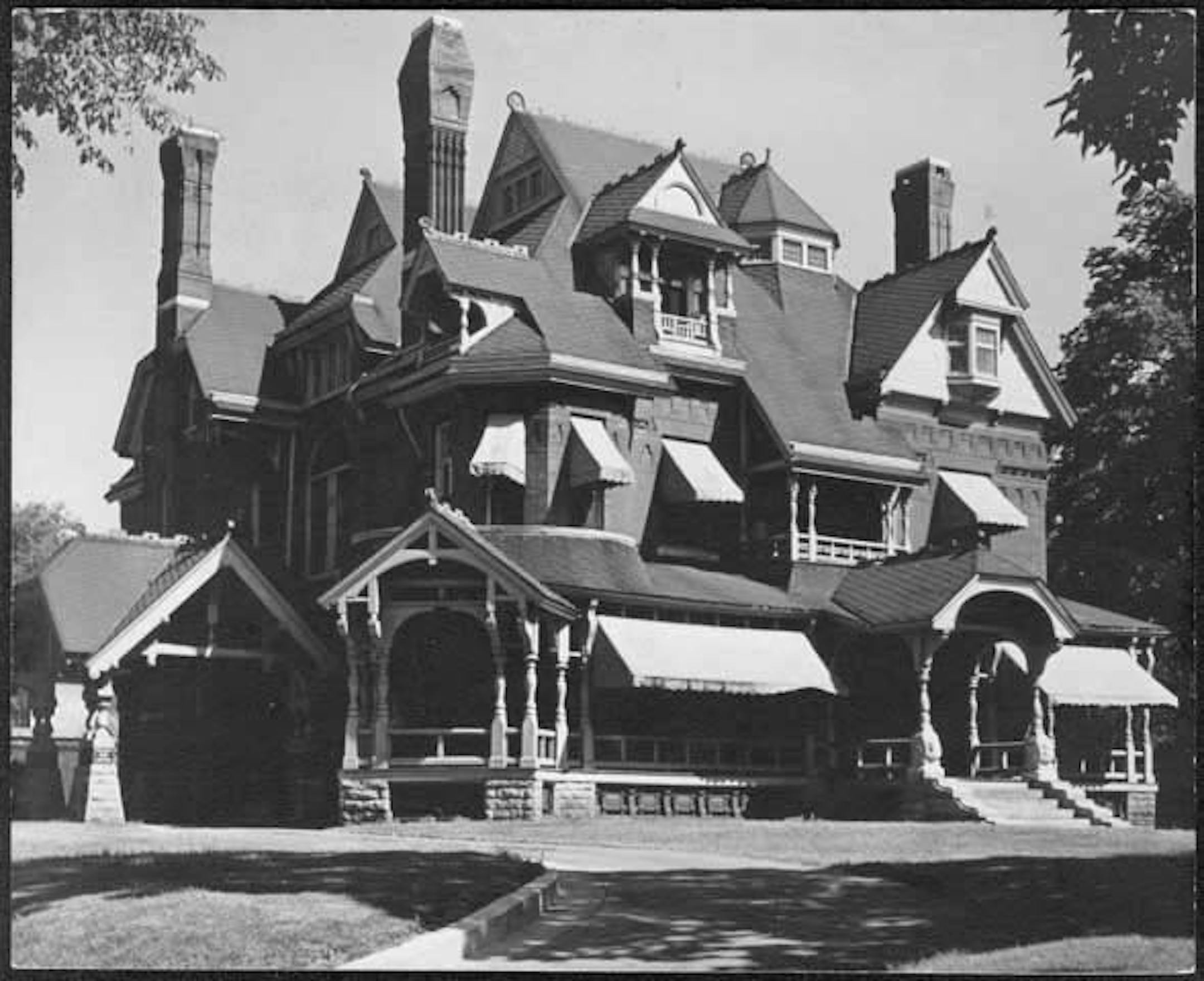
John Edson Bell was, by all accounts, a proper Victorian businessman. He arrived in Minneapolis from New York state in the 1850s and, during the following decades, accumulated a tidy fortune as a merchant, wholesaler and banker.
He also seems to have been quite a productive fellow. He fathered six children, the last born when he was 72 years old and married to his second wife, who was exactly half his age. But perhaps the best evidence that Bell had a bit of a wild side was the delightfully delirious Queen Anne-style mansion he built in 1885 at 24th Street and Park Avenue in Minneapolis.
Bell’s mansion, long gone, may well have been the city’s ultimate Victorian pile — a great ramble of a house sporting a mad abundance of gables, dormers, oriels, balconies and porches, all decorated with a lathe-and-jigsaw-produced festival of gingerbread trim.
The mansion was one of several Queen Anne extravaganzas built along Park in the mid-1880s, just as the avenue was blossoming into one of the city’s premier residential addresses.
Although the colorful, busy Queen Anne style is named after the early 18th-century English monarch, it actually has nothing to do with the Baroque architecture of that period. But it did have English sources, emerging from the work of Arts and Crafts architects there in the mid-19th century. It reached the United States by the 1870s, quickly spreading from the East Coast to the Midwest and beyond.
Bell was 50 years old when work began on his Queen Anne dream. At that time, he was head cashier of the Hennepin County Savings Bank, but would soon become its president. He was living then with his first wife, Mary, and their four children in a house he’d built around 1870 in downtown Minneapolis. But as the commercial core expanded, Bell made the move to Park Avenue in the 1880s, as did many other of the city’s business and professional elite.
Bell selected another native New Yorker, Charles Sedgwick, to design his new home, and it may well have been Sedgwick’s first big commission in Minneapolis, where he had established an office in 1884.
Sedgwick would go on to a long and notable career in Minneapolis, designing scores of houses, churches, and commercial and institutional buildings. His major surviving works include Westminster Presbyterian Church (1898) at 12th Street and Nicollet and the original portion (1902) of the former Dayton’s department store at 7th and Nicollet.


