
Teddy Roosevelt’s family urges GOP to protect Boundary Waters

In a rare letter to Republican senators, four descendants of the former president oppose mining near the Minnesota wilderness area.

The New York Times
February 16, 2026 at 1:42PM
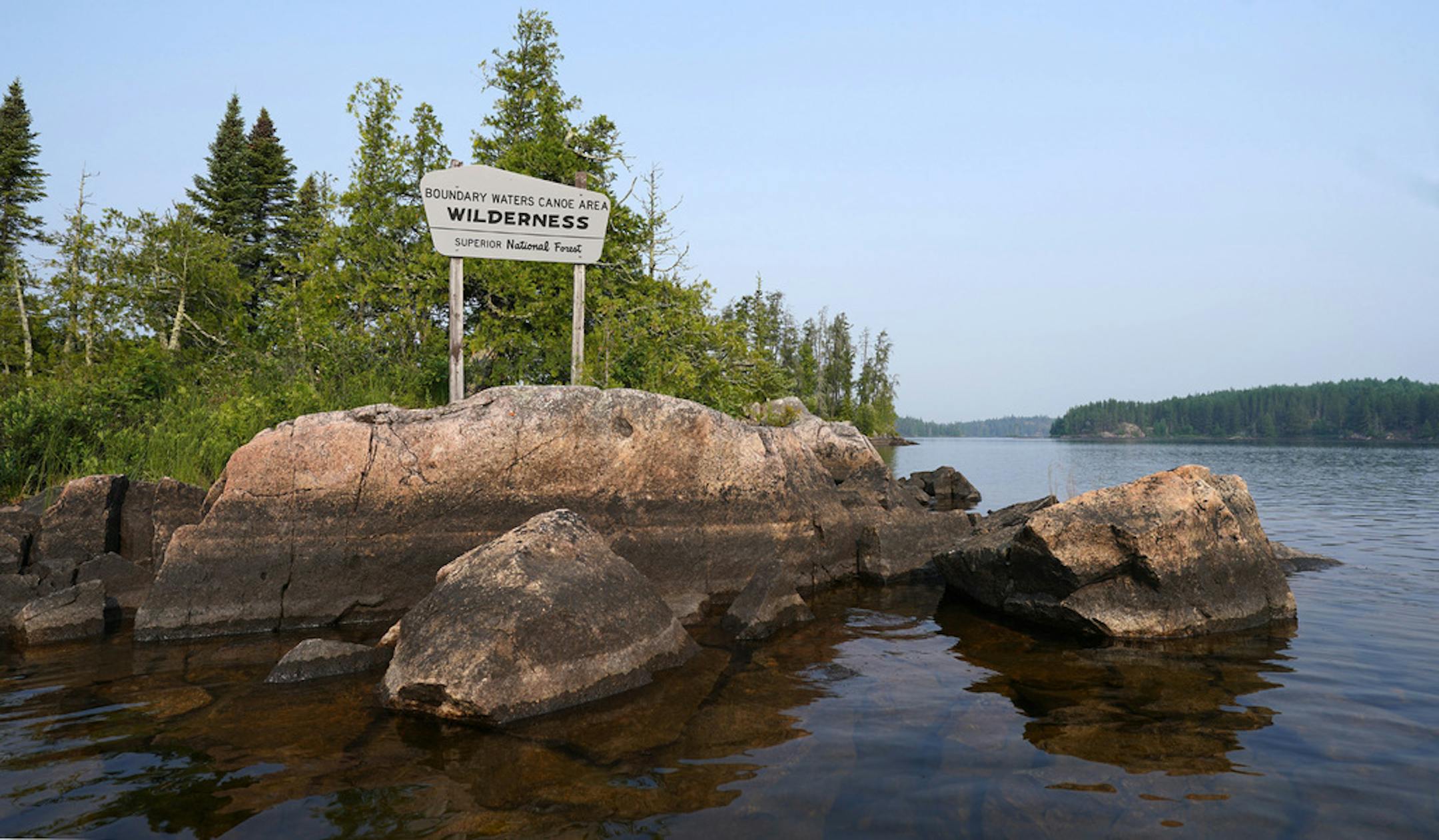
A sign in Seagull Lake marks an entrance to the Boundary Waters Canoe Area Wilderness. (Anthony Soufflé/The Minnesota Star Tribune)

WASHINGTON — Ted Roosevelt IV doesn’t like to put words in a dead man’s mouth. But he’s pretty sure that President Theodore Roosevelt, his great-grandfather, would have been “appalled” by an effort by House Republicans to allow mining near an expanse of wilderness in Minnesota.

So he and several relatives recently wrote to Republican senators, urging them against allowing mining upstream from the Boundary Waters Canoe Area Wilderness, a vast preserve of glacial lakes and boreal forests crisscrossed by canoe routes and hiking trails.

It was a remarkable rebuke of the Republican Party’s apparent retreat from the environmental ethos of Theodore Roosevelt, who protected around 230 million acres of public lands during his presidency.

“It’s not just this administration — it’s the GOP collectively that is not as concerned about conservation as it should be,” Ted Roosevelt IV, 83, said in a recent interview.

Roosevelt, a New York City-based investment banker and a lifelong moderate Republican, traveled to Washington last week to meet with senators and their staff members about Boundary Waters. His conservative credentials and his famous last name got him through the doors of several offices, although he declined to say which ones.

Off the top of his head, Roosevelt rattled off several conservation efforts by Republican presidents: Ulysses S. Grant established Yellowstone as the first national park. Abraham Lincoln protected Yosemite Valley by giving it to California as the first state park. And most recently, George W. Bush created a marine national monument in the Pacific Ocean southwest of Hawaii.

“I don’t see any Republican leadership on that scale today,” Roosevelt said.

President Donald Trump, who has indicated that he will sign the measure to allow mining near Boundary Waters, has sought to increase oil and gas drilling, mining and other industrial activities on public lands and waters across the country. His administration plans to permit new oil drilling in the Arctic National Wildlife Refuge in Alaska and across nearly 1.3 billion acres of U.S. coastal waters.

“There’s never been a president with zero interest in protecting the natural world until Donald Trump,” said Douglas Brinkley, a presidential historian at Rice University and the author of the book “The Wilderness Warrior: Theodore Roosevelt and the Crusade for America.”

The signers of the letter included two other great-grandsons of Theodore Roosevelt: Tweed Roosevelt, a businessperson and family historian; and Mark Roosevelt, a onetime Democratic nominee for governor of Massachusetts. Kermit Roosevelt III, a law professor and a great-great-grandson of the former president, also signed.

“T.R. was active in preserving our greatest wilderness terrain on both the East and West coasts — it became one of the greatest enduring legacies of his life,” the four Roosevelts wrote to senators.

“It is now time for all of you to get in the arena with him,” they wrote, a reference to a famous quote from the former president about the value of fighting valiantly for worthy causes.

The descendants added that they represented all three branches of Theodore Roosevelt’s family, stemming from his sons Archie, Kermit and Ted. “The four of us below have never collectively co-signed a letter together, which should give an indication of how strongly we support voting no on this,” they wrote.

Kermit Roosevelt III declined to comment for this article, saying in an email that he “would prefer just to let the letter speak for itself.” The other two Roosevelts did not immediately respond to requests for comment.

People might not associate Theodore Roosevelt, who was born in New York City and hunted bison across the American West, with wilderness in Minnesota. But he established the Superior National Forest, which encompasses 3 million acres in the state and includes Boundary Waters, in one of his final acts as president.

Boundary Waters has been at the center of a fierce dispute over a proposed copper and nickel mine for more than a decade. Twin Metals Minnesota, a subsidiary of Chilean mining company Antofagasta, wants to build the underground mine in Ely, just upstream from the wilderness area.

Conservationists have fought to block the project, saying its operations could contaminate the region’s interconnected lakes and streams with heavy metals and sulfuric acid. They scored a victory in 2023, when the Biden administration imposed a 20-year moratorium on mining across more than 225,000 acres of the Superior National Forest.

But the House this month passed a resolution from Rep. Pete Stauber, R-Minn., that would overturn the moratorium. Senate Republicans plan to pass the measure in the coming weeks with a simple majority vote, rather than the 60-vote threshold required for many types of legislation.

Since both senators from Minnesota are Democrats, it is unclear which Senate Republican would sponsor the measure. Representatives for Sen. John Thune, R-S.D., the majority leader, did not respond to a request for comment.

Representatives for Twin Metals Minnesota and Stauber also did not return requests for comment.

Ryan Callaghan, chief executive of Backcountry Hunters & Anglers, a nonprofit group that wants to preserve access to Boundary Waters for hunting and fishing, said he was grateful to have the Roosevelts on his side in the Senate fight. “That name sure carries weight with a lot of people,” he said.

In recent years, some scholars have written that Theodore Roosevelt’s views and attitude toward conservation were racist by modern standards. He called white people the “forward race” in a 1905 speech, and his creation of national parks often forcibly displaced Native Americans from lands that they had stewarded for generations.

But the 26th president continues to command broad respect among figures including the top Trump administration official responsible for overseeing public lands. Doug Burgum, the interior secretary, frequently invokes Theodore Roosevelt’s conservation legacy in speeches, social media posts and emails to Interior Department employees.

While serving as the governor of North Dakota, Burgum also championed the construction of the Theodore Roosevelt Presidential Library in Medora, North Dakota. The library is set to open July 4 to mark America’s 250th birthday, an occasion that the four Roosevelts highlighted in their letter.

“On Independence Day, three pillars of T.R.’s life will take central stage: leadership, conservation and citizenship,” they wrote. “It’s one thing for politicians to say they believe in these three pillars, and it’s quite another thing to act that way.”

about the writer

about the writer

Maxine Joselow

More from Outdoors

See More
card image
David Joles/The Minnesota Star Tribune

Undaunted by ice, the semi-aquatic furballs munch their way through winter eating roots and plants.

card image
card image