
‘A true wonder’: Apostle Islands ice caves to open for the first time in more than a decade

Lake Superior’s ice cover has grown from 39% to 53% in the past week, setting the stage for an increasingly rare spectacle.

The Minnesota Star Tribune
February 14, 2026 at 10:04PM
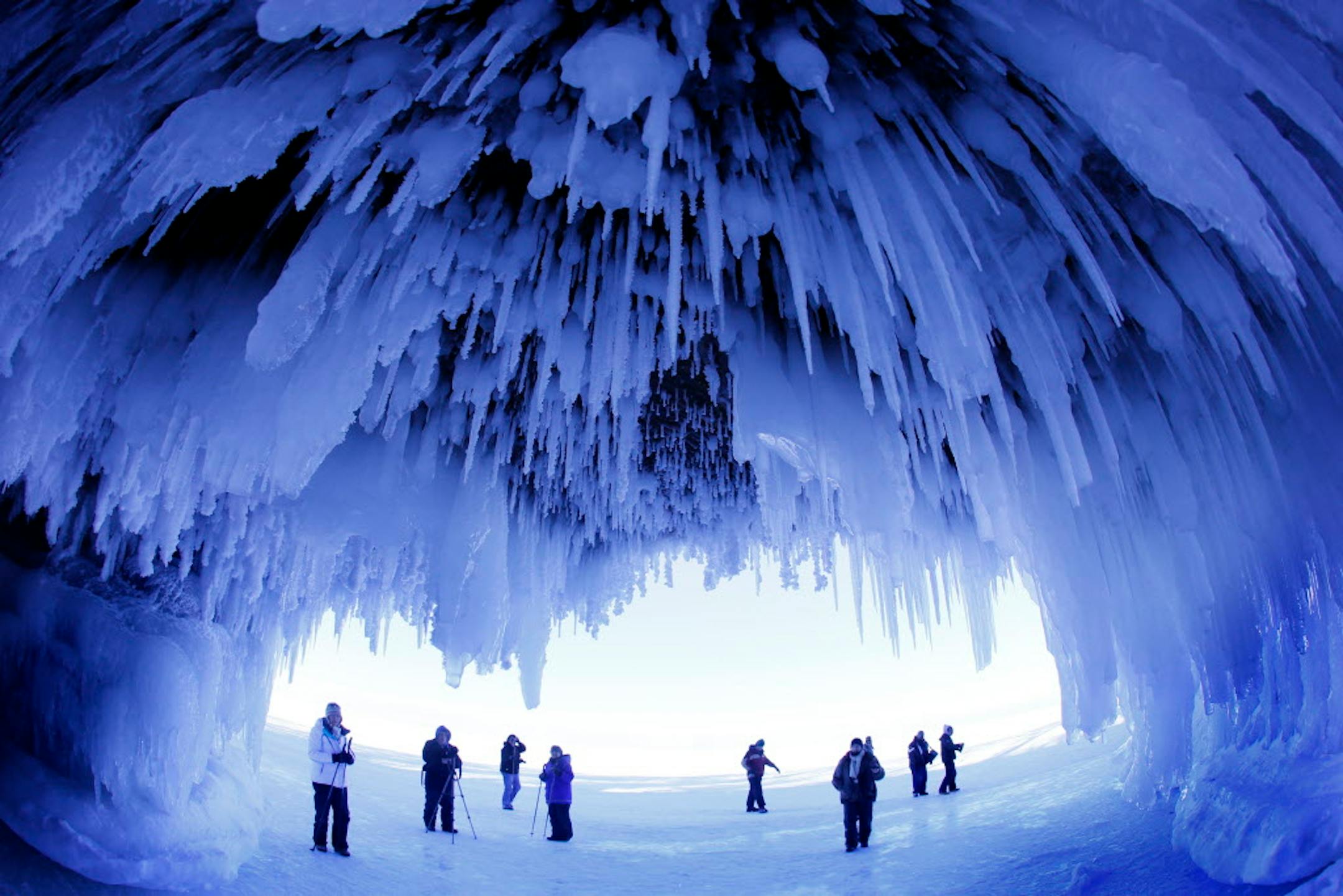
The Ice Caves of the Apostle Islands National Lakeshore along the south shore of Lake Superior shown in February 2014 in Cornucopia, Wisc. (Brian Peterson/The Minnesota Star Tribune)

Lake Superior’s famous ice caves will soon open, allowing visitors to behold their pillars of ice and curtains of icicles for the first time in more than a decade.

The National Park Service on Saturday announced its plans to open the attraction. The ice caves at Apostle Islands National Lakeshore along Wisconsin’s north shore will open the morning of Monday, Feb. 16. It costs $5 per person.

The ice caves are about a four-hour drive from the Twin Cities and about 90 minutes from Duluth.

Visitors must walk 2 to 6 miles on top of frozen Lake Superior from the Meyers Beach parking lot to access the caves. To assure safety, the ice shelf must extend miles from the shore so it can protect the area’s lake ice from open-water waves. Wind and waves can break up the ice in just hours, according to the National Park Service.

The NPS did not indicate how long they expect the caves to be open.

Since the turn of the century, the caves have been open to the public in 2004, 2008, 2009, 2014 and 2015 for a total of 210 days.

In 2014, the caves were open for two months when a record-breaking 138,000 people visited, according to NPS. When the formation was open for nine days in 2015, more than 38,000 people visited.

Much of the interest in 2014 and 2015 was driven by social media, said Mary Motiff, director of Bayfield County Tourism.
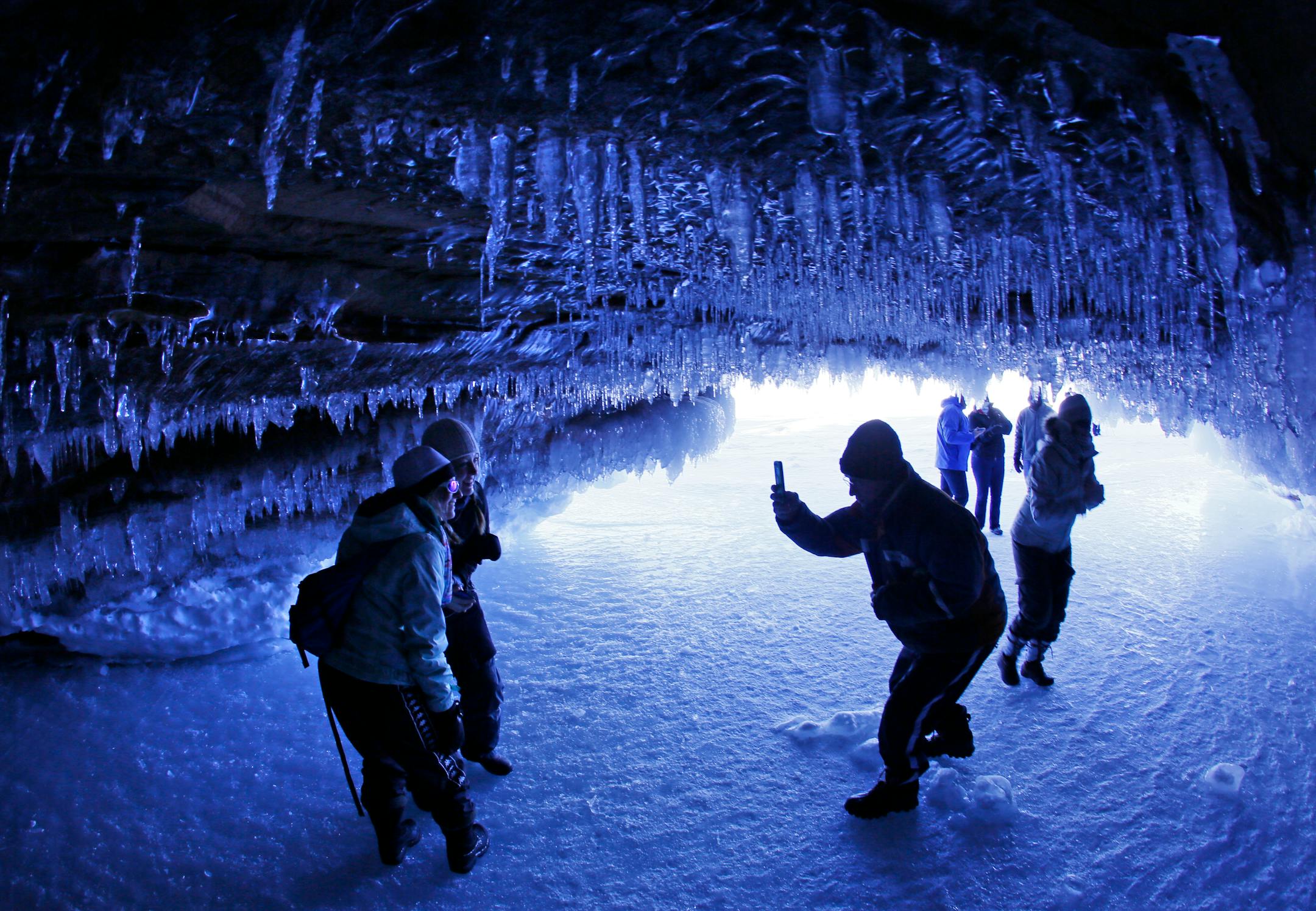
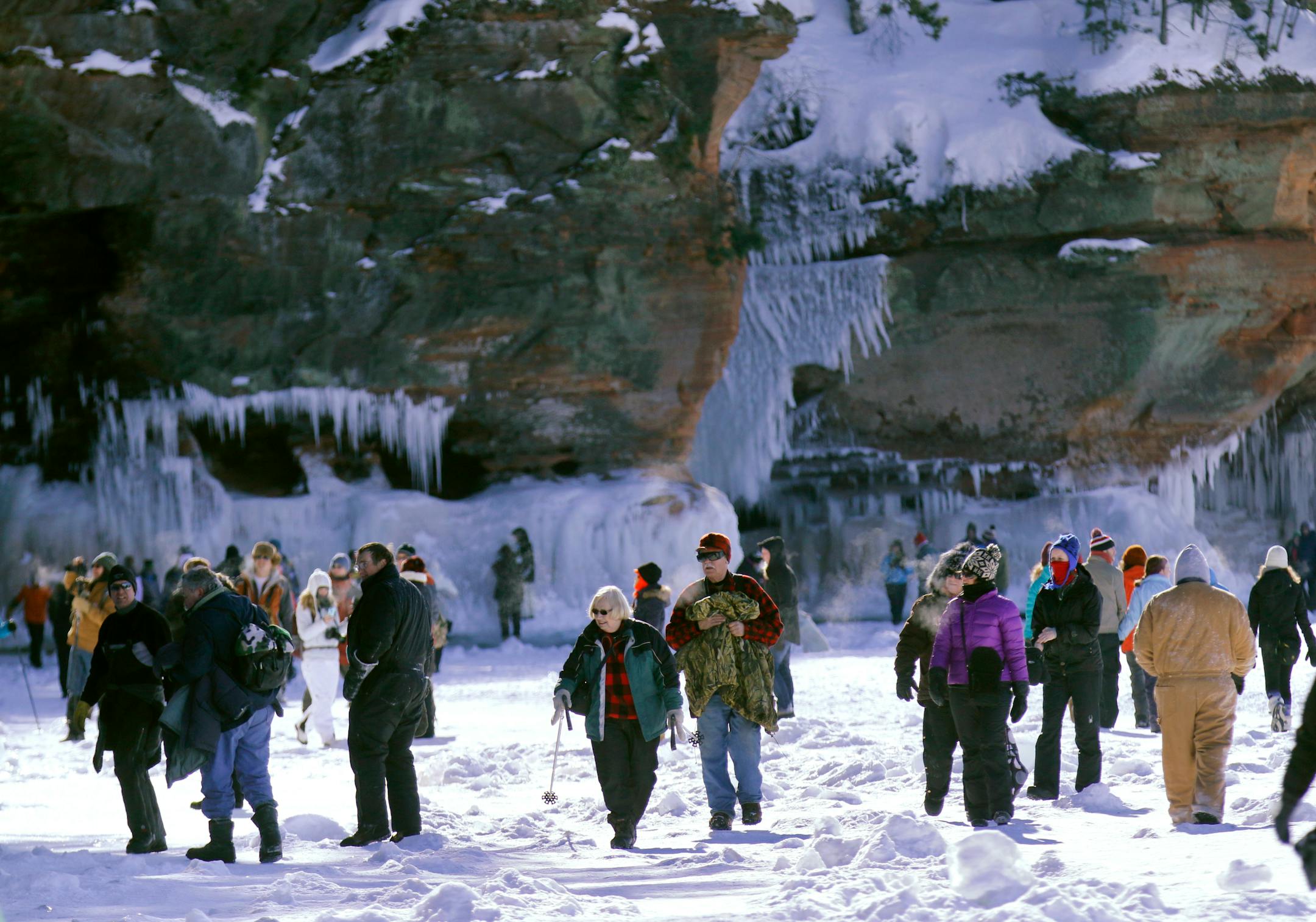
Visitors in 2014 made the trek along the frozen shore to witness and photograph the crystal wonders of the ice caves. (Brian Peterson/The Minnesota Star Tribune)

The opening of the ice caves has in the past been a boon for an area that usually attracts just a few thousand people in the winter months, according to an article from the Friends of the Apostle Islands National Lakeshore, a nonprofit dedicated to protecting the area.

There will be shuttles running from the town of Cornucopia, just west of the caves, about every 30 minutes from two parking lots, one at Cornucopia Beach and another at the town hall.

“It’s a big deal,” she said. “It’s one of those things where we have to check the conditions every day to confirm that we should keep [the shuttle] open.”

What was once a common sight has become all too rare because of climate change, said Jeff Rennicke, executive director of Friends of the Apostle Islands.

Rennicke remembers pulling his children over the lake ice on a sled and then eating lunch with them and his wife while gazing at the icicles dangling from the sandstone cliffs. They continued that tradition every year through the ’90s, he said.

“It’s the most beautiful set of ice caves,” Rennicke said. “It’s a true wonder of the world.”

Now the conditions have to perfectly align for people to see the caves. Those conditions include extreme and sustained cold paired with low to no wind to create ice stable enough to hold thousands of people, according to the park service.

Lake Superior is the second-fastest-warming lake on the planet. Water temperatures are increasing twice as fast as atmospheric temperatures, according to the park service. The average ice cover on Lake Superior has declined by nearly 80% between 1973 and 2010.

Over the past week, Lake Superior’s ice cover has grown from 39% to 53%, according to the National Oceanic and Atmospheric Administration.

“We don’t know how many people will come out; it depends on how long the caves will stay open,” Motiff said. “It looks like it will warm up this weekend, but after that, the weather may turn back.”

The ice caves attracted 138,000 visitors over a two-month period in 2014. (Brian Peterson/The Minnesota Star Tribune)
about the writer

about the writer

Alex Chhith

Reporter

Alex Chhith is a general assignment reporter for the Minnesota Star Tribune.

See Moreicon

More from Outdoors

See More
card image
Brian Peterson/The Minnesota Star Tribune

Lake Superior’s ice cover has grown from 39% to 53% in the past week, setting the stage for an increasingly rare spectacle.

card image