American downtowns vividly illustrate the impermanence of architecture.
In the Twin Cities, thousands of downtown buildings have come and gone over the years, some of them leading only the briefest of architectural lives. To be sure, there are Methuselahs such as the 131-year-old Lumber Exchange in Minneapolis and the 128-year-old Pioneer Building in St. Paul, but they fall into the realm of notable exceptions.
The average life span of downtown buildings in the Twin Cities is probably 50 years, which is about what it is in other American cities. In Chicago, described by one writer as “arguably the world capital of architectural obsolescence,” a study found that the mean age of downtown office buildings demolished from 1900 to 1930 was 32 years.
As downtown buildings have grown ever larger and higher, however, they may have ensured themselves longer lives than their predecessors. Huge downtown skyscrapers won’t last forever, but tearing them down is costly and complicated, and I’d be willing to bet that a building such as the IDS Center may well be around for a century or more.
The rapid churn of downtown buildings has been going on for a very long time.
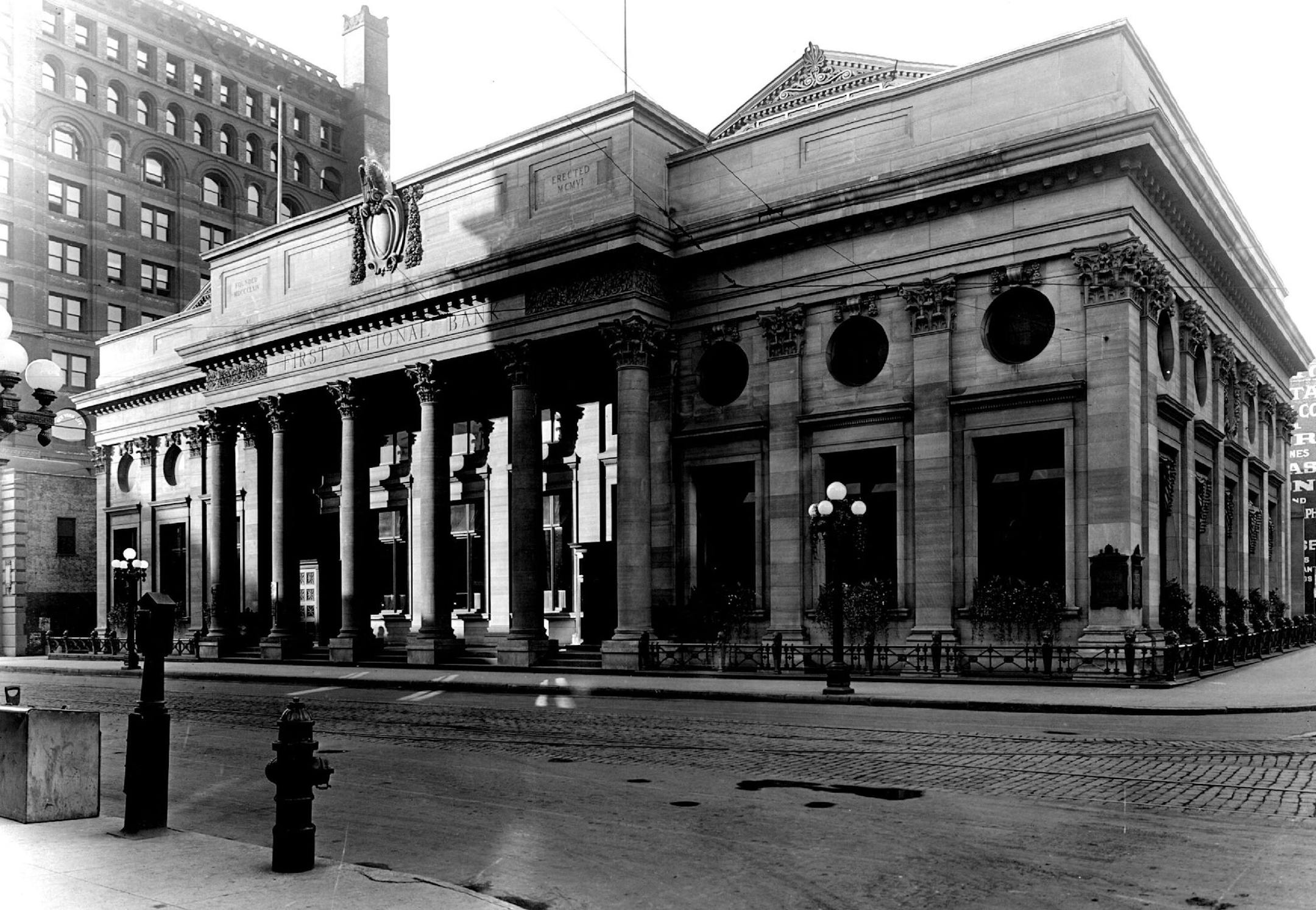
Take the case of the lovely little First National Bank Building constructed in 1906 at 5th Street and Marquette Avenue in Minneapolis. It was a well-ornamented classical design featuring stone walls, a columned portico, large ground-floor windows with distinctive circular windows above, and a decorative fence along the sidewalk. Within, there was a handsome skylit banking hall.
The bank certainly looked as if it might be around for a while. In fact, it stood for only eight years before being demolished to make way for the much larger First National Bank-Soo Line Building (now Soo Line City Apartments). Why the bank fell to the wrecker so quickly isn’t known, but it may simply have been a “placeholder,” designed to occupy the corner until First National could erect something much larger on the site.
Other short-lived downtown buildings come under the category of failed projects. One barely remembered building of this kind was the 13-story Radisson Center on 7th Street, where the Marriott City Center Hotel now stands. Built in 1969, Radisson Center was a merchandise mart linked by skyway to the Radisson Hotel across the street. The building, however, never flourished, and it was gone by 1981, giving it the shortest life of any tall building in the history of Minneapolis.