

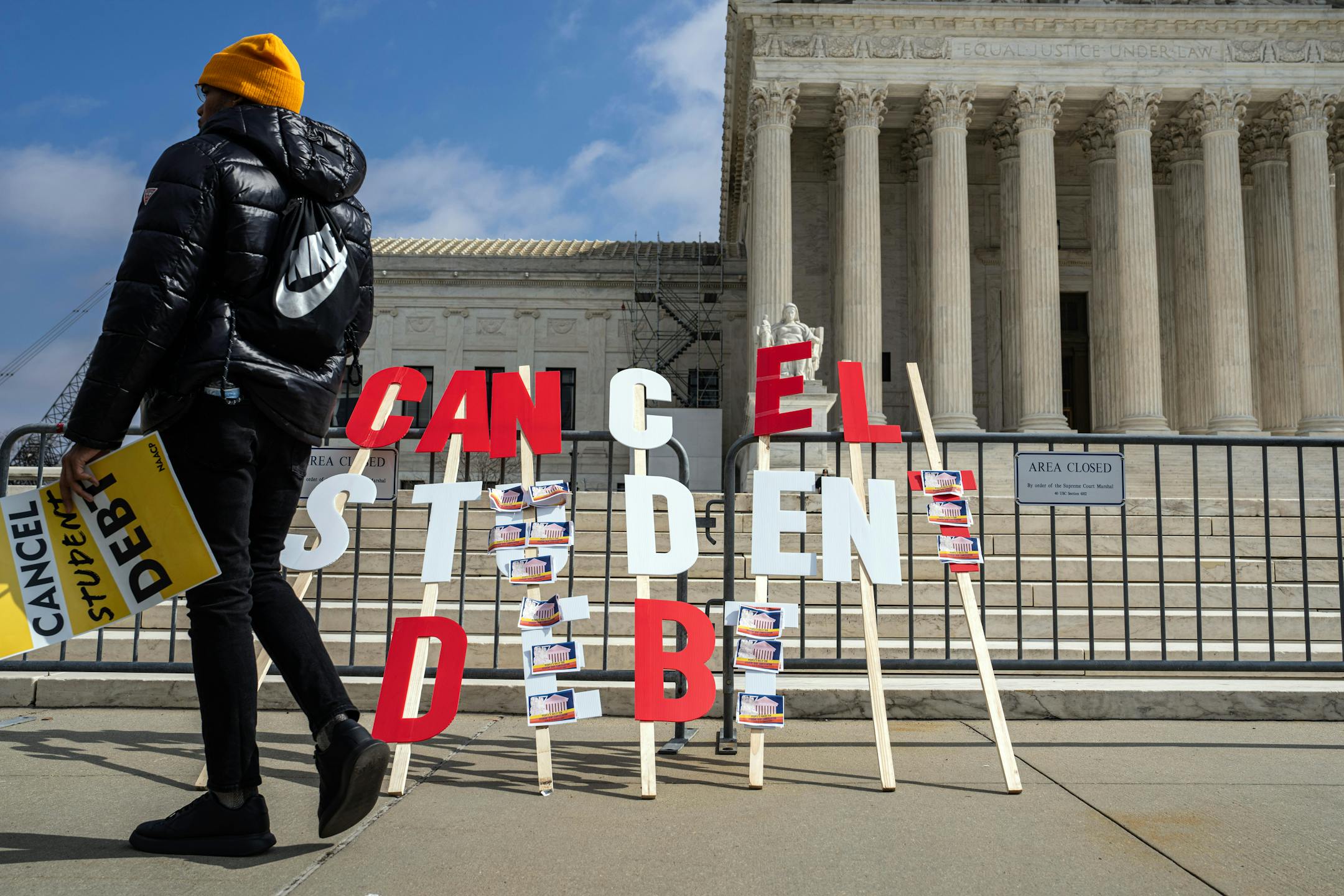
Opinion editor's note: Star Tribune Opinion publishes a mix of national and local commentaries online and in print each day. To contribute, click here.
•••
Oral arguments before the Supreme Court on Tuesday in a much-watched student loan forgiveness case, Biden v. Nebraska, pitted two of the conservative majority's beloved legal doctrines against one another.
The case for striking down President Joe Biden's program, which would forgive about $400 billion in federal student loan obligations, turns on the court's recently minted "major questions" doctrine. That doctrine, whose legal provenance is questionable and whose contours are still very much being worked out, holds that for "major" questions of "vast economic or political significance," the court requires a clear statement of congressional intent rather than deferring to executive branch interpretations of the law.
In this case, given the undeniably large price tag of the forgiveness, the justices could employ their novel doctrine to find that the secretary of education lacked the authority to forgive up to $20,000 in federal loan obligations per debtor.
The Biden administration did so under a provision of the Heroes Act authorizing the president to "waive or modify" "any provision" of the student loan program in the case of an emergency. The Trump administration used that provision to suspend loan repayment obligations at the height of the COVID contagion. The program at issue took the further step of broad forgiveness to realize Biden's campaign promise to reduce American student debt, which exceeds even our total credit card debt.
But the court's right wing has a dilemma. It became clear during the arguments that perhaps the strongest point in the Biden administration's favor concerns legal standing, another matter close to the conservatives' hearts. The court has insisted on strictly policing the constitutional requirement that the federal judiciary may hear only those cases in which the plaintiff has sustained an "injury in fact" — a concrete, particular harm.
Here that restriction is very much in play. Biden v. Nebraska was brought by six Republican attorneys general who oppose student loan forgiveness for political reasons. That's fine, but they still need to demonstrate an injury in fact. And none of the states seems to have sustained any sort of injury from student loan forgiveness: What's it to them if the federal government doesn't want its $20,000 back from any given borrower?


