Washington: 50 years after Edmund Fitzgerald wreck, story endures despite ballad’s myths

A Michigan documentarian reflects on how Gordon Lightfoot’s song both preserved and distorted the doomed ship’s history.

Columnist Icon
The Minnesota Star Tribune
November 10, 2025 at 9:23PM
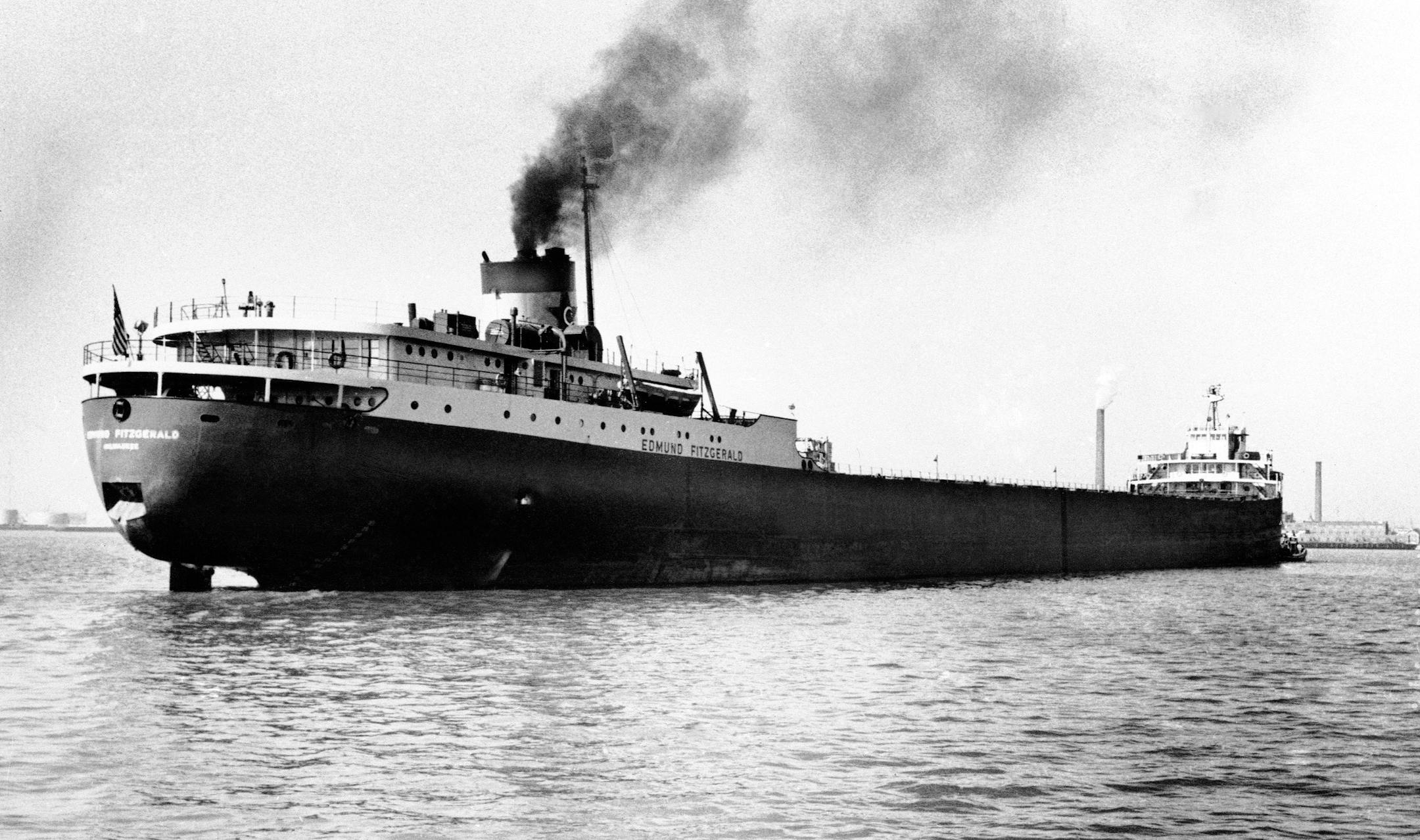
A 1959 photo shows the Great Lakes freighter Edmund Fitzgerald, which disappeared Nov. 10, 1975, in a storm on Lake Superior. (The Associated Press)

Opinion editor’s note: Strib Voices publishes a mix of material from 8 contributing columnists, along with other commentary online and in print each day. To contribute, click here.

•••

If you’re singing along to Gordon Lightfoot’s “The Wreck of the Edmund Fitzgerald” on Monday’s 50th anniversary of the Lake Superior tragedy, consider changing a few verses. Instead of:

“The ship was the pride of the American side,

coming back from some mill in Wisconsin”

Try singing:

“… coming back from Superior, Wisconsin.”

Not only is it more geographically precise — the ship loaded at Superior’s towering ore docks, not “some mill” — it’s just as easy to sing. The meter is virtually the same.

Lightfoot’s haunting ballad may be one of the most successful musical accounts ever of a historical event. That’s true even if the singer-songwriter got a few things wrong, says Ric Mixter, a Michigan-based journalist and documentarian who’s spent decades chronicling the Fitz — and even saw the wreck firsthand in a 1994 dive.

Ric Mixter, a Michigan-based journalist and documentarian who’s spent decades chronicling the Edmund Fitzgerald — and even saw the wreck firsthand in a 1994 dive. (Photo courtesy Ric Mixter) (Courtesy of Ric Mixter)

“I’m highly criticized at my lectures because I pick on Gordon,” said Mixter, whose latest Fitz book is “Tattletale Sounds: The Edmund Fitzgerald Investigations.”

“Eighty percent of that song is wrong — from the Chippewa legend that doesn’t exist” (it was appropriated from another tribe, he says), to the line “ ‘some mill in Wisconsin.’ There are no pelletizing mills in Wisconsin. It was not fully loaded and it was not going to Cleveland. It was partially loaded and going to Detroit.”

Ironically, Lightfoot said in a 2015 interview with NPR that he was inspired to write the song after being annoyed by an inaccuracy in a Newsweek article shortly after the Nov. 10, 1975, disaster — in which Edmund was spelled with an “O.” He also said the story gave short shrift to the 29 crew members who perished.

He wrote and recorded the song in little more than a month, long before investigations were complete or before technology even existed to reach the wreck at Superior’s depth. In that light, speculation — “They might have split up, or they might have capsized” — was poetically permissible. And certain moments, like imagined words between crewmen, were simply unknowable.

That makes one of Mixter’s criticisms feel a bit like nitpicking: his assertion that Bob Rafferty, a last-minute replacement as the ship’s cook, “never would have said, ‘Fellas, it’s been good to know you.’ ”


Disagreeing is Rafferty’s daughter, Pam Johnson.

“When I talked to Gordon Lightfoot, he and I discussed if my father would say those words, and I said, ‘Yes!’” she said in an interview posted at S.S. Edmund Fitzgerald Online.

Despite those differing interpretations, Mixter and Johnson have since become close friends. She’s joining him at one of his anniversary lectures this week.

Mixter, who acknowledges that if not for Lightfoot he wouldn’t be talking about shipwrecks at all, is also quick to praise what the songwriter got right.

“The lyric ‘Does anyone know where the love of God goes when the waves turn the minutes to hours?’ ” he quoted. “I can’t criticize that.”

Lyrics become more problematic, however, when they touch on sensitive issues. The song’s climax — “At 7 p.m. the main hatchway gave in” — paints a foreboding vision of impending doom. Yet from an investigator’s standpoint, that artistic flourish could suggest crew members failed to properly seal the holds and were partly responsible for their own deaths. Family members vigorously objected.

Once deepwater dives like Mixter’s became possible and other probes were completed, that theory was dispelled. The cause of the wreck was attributed instead to a massive wave — one witnessed by the nearby Arthur M. Anderson — that split the Fitz in two.

Respectful of the families, Lightfoot in 2010 changed the line to at 7 p.m. it grew dark, it was then … .” He sang it that way in performances until his death in 2023, though he kept the copyrighted, official version unchanged. He also altered the epilogue from “In a musty old hall in Detroit they prayed” to the more dignified “rustic old hall.”

Rustic could also have described Lightfoot’s voice in 2007, when I saw him at the Duluth Entertainment Convention Center, not long after his recovery from a tracheotomy.

With the auditorium just down the corridor from the facility’s Edmund Fitzgerald Hall, concertgoers were ecstatic at the opening chords of the song. (The only thing I recall coming close was the roar for James Taylor singing “and so was the turnpike from Stockbridge to Boston” at Tanglewood in western Massachusetts.)

The music was spot-on, and I don’t remember a single person complaining about his voice. If anything, it was the ultimate gift to be serenaded next to the Twin Ports bay where the Fitz last set sail.

Which was, you’ll recall, “coming back from Superior, Wisconsin.”

Robin Washington is a contributing columnist for the Minnesota Star Tribune. He is passionate about transportation (and invites readers to share their experiences with him), civil rights, history and northeastern Minnesota. He is a producer-host for Wisconsin Public Radio and splits his time between Duluth and St. Paul. He can be reached at robin@robinwashington.com.

about the writer

about the writer

Robin Washington

Contributing columnist

Robin Washington is a contributing columnist for the Minnesota Star Tribune. He is passionate about transportation, civil rights, history and northeastern Minnesota. He is a producer-host for Wisconsin Public Radio and splits his time between Duluth and St. Paul. He can be reached at robin@robinwashington.com.

See Moreicon