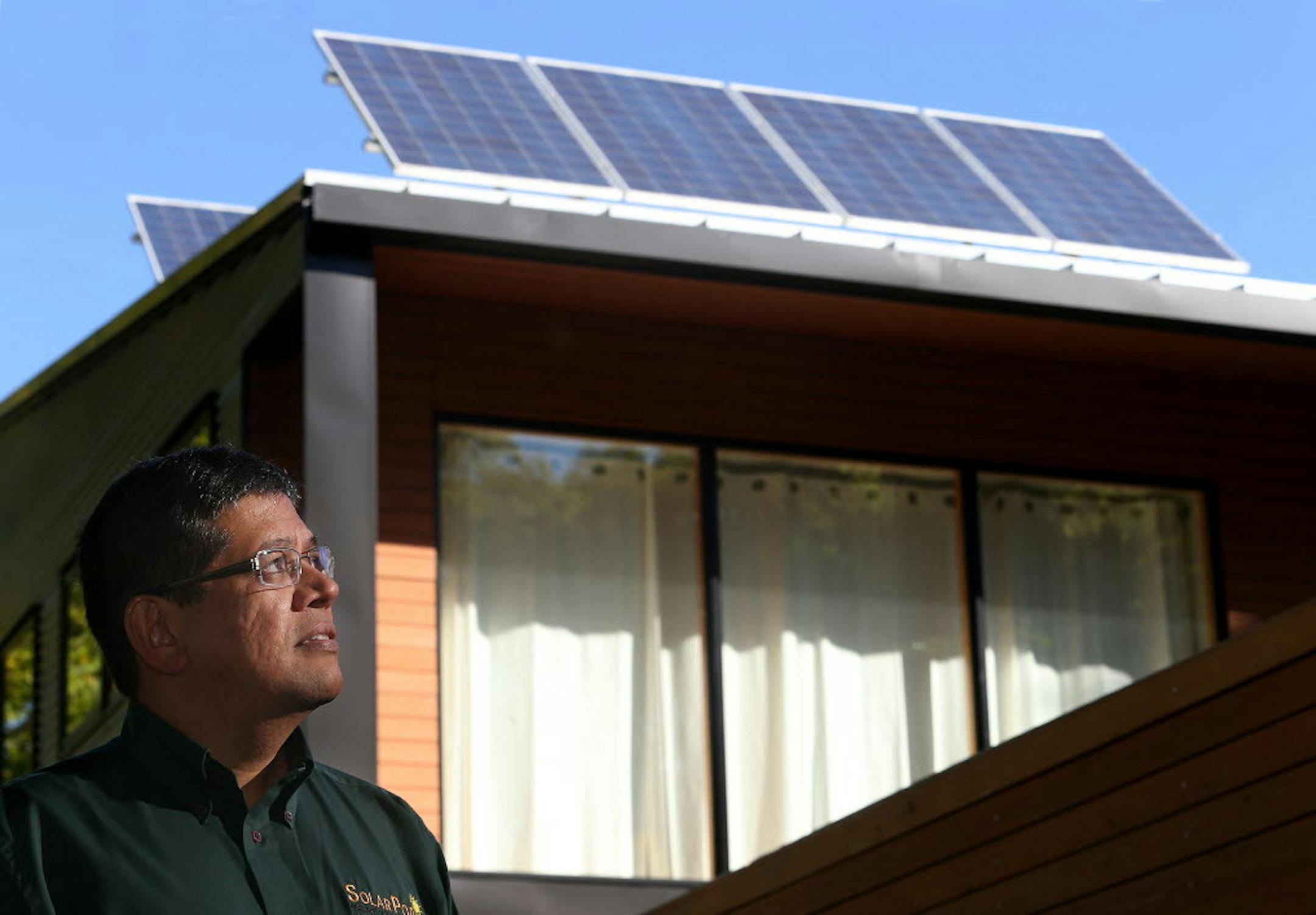
Mouli Vaidyanathan, engineer and solar-system entrepreneur, has hot words for the Minnesota Department of Commerce, which he believes is using a 2013 state law to protect two larger operators, Bloomington-based TenKsolar and the Minnesota operations of Washington-based Silicon Energy.
Vaidyanathan, owner of Solar Pod (www.MySolarPod.com), said he's sold about 100 "plug-and-play" solar systems outside Minnesota through retailers such as Menards and Northern Tool and Equipment. The average unit price has dropped from $4,000 to $3,200 over the past couple of years as volume rose and production costs dropped through local contract manufacturers. But he says he can't compete in Minnesota against higher-priced competitors who benefit from the generous state and Xcel Energy subsidies.
The Commerce Department and Xcel Energy haven't certified Solar Pod for their programs, Vaidyanathan said.
"We qualify as 'Made in Minnesota' because of the statement in both the 2010 and 2013 bills that says 'by interconnecting low-voltage direct current photo voltaic elements that produce the final useful photo voltaic output of the modules,' " Vaidyanathan said. "I do that production here.''
Between the federal and state tax breaks to buyers and utility company subsidies, a growing number of Minnesota residential and commercial customers have paid less than a third of the retail price for their systems, as government tries to spur production that helps drive down the cost of the emerging U.S. solar industry.
"The department strongly supports the growth of Minnesota's solar community and highly appreciates Mouli's entrepreneurship,'' said Anne O'Connor, communications director of the Minnesota Department of Commerce. "Unfortunately, in this situation, the statute clearly states that without the 'UL 1703' certification, products are ineligible for certification under this [rebate] program."
Vaidyanathan said the 2013 bill requires Underwriters Laboratory certification at Minnesota manufacturing facilities, even though the Solar World plant in Oregon, where he gets solar panels, already has UL certification. And he can't afford "duplicate certification" at the factory in Minnesota that assembles his solar pods. Thus, he asserts, the law effectively protects the two larger competitors.
"We built our company here and got the UL certification here," said Joel Cannon, CEO of 85-employee TenKsolar, which does about 15 percent of its business in Minnesota. "We were instrumental, and that law has been helpful to us. But the law was written so that you couldn't buy completed parts from factories outside Minnesota and screw them together in Minnesota and call them 'Made in Minnesota.' "