
Smudging, gardening and art: Students flourish in Indigenous STEAM camp

Minneapolis Public Schools’ six-week summer American Indian STEAM program immerses kids in Native American history and activism at Anishinabe Academy.

Sahan Journal
August 2, 2025 at 7:00PM
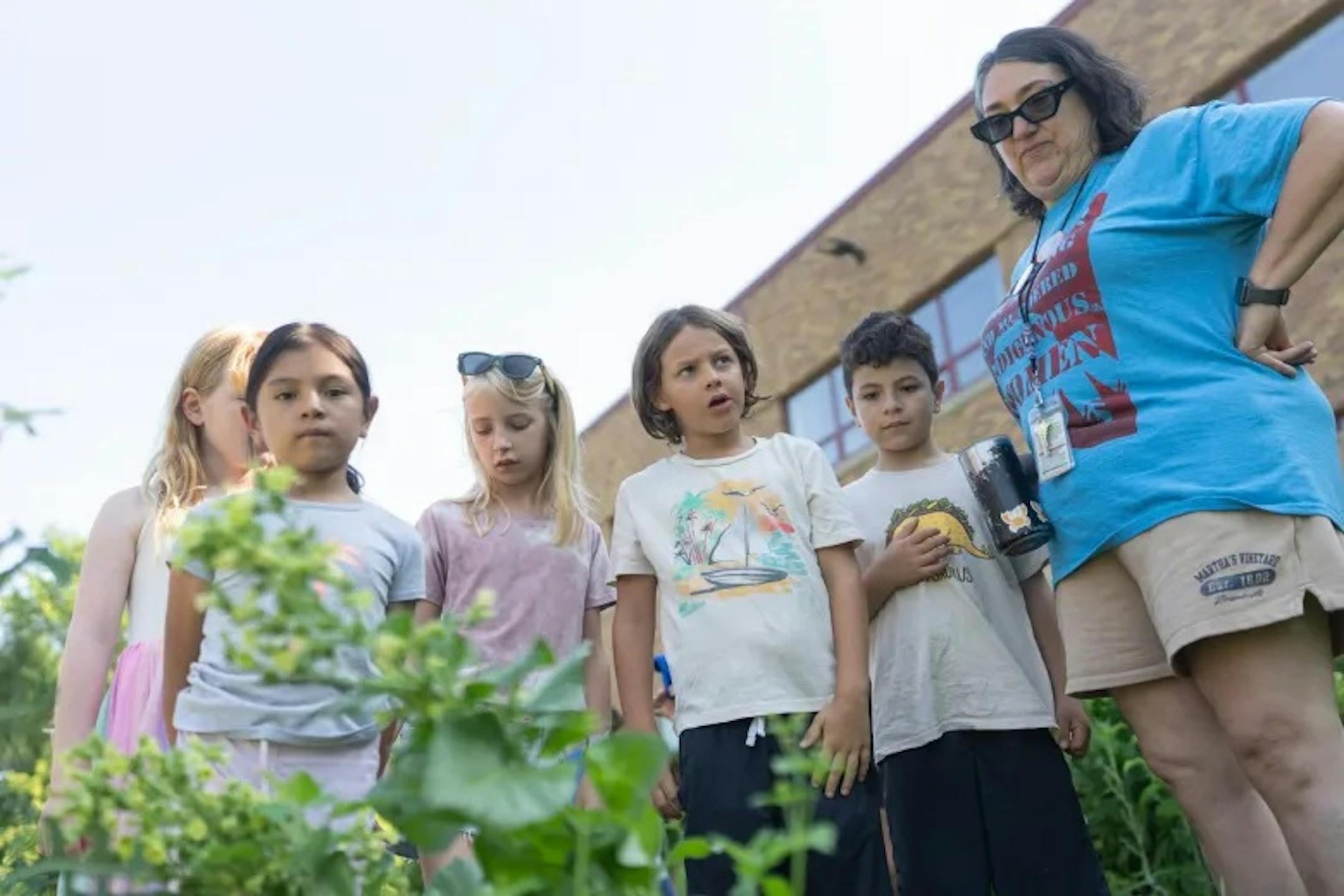
Siena Braun, right, shows her second- and third-grade students a flowering tobacco plant in the garden behind Anishinabe Academy in south Minneapolis. (Aaron Nesheim, Sahan Journal)

Siena Braun led her second- and third-grade summer students into the garden behind Anishinabe Academy in south Minneapolis. Squash tendrils climbed the trellises; tobacco plants bloomed; sweetgrass sagged under last night’s rain; and sage plants filled part of a raised bed.

“My lovely friends, do you have something you want to say about the sage over here?” Braun asked her students.

“Sage is medicine for all people, and sage is to make you calm and give you good feelings and thoughts,” said Marianna Salas Ahmad, a rising second-grader.

“It does calm me down and give me good feelings and thoughts,” Braun agreed. “We’ll dry it out. We use it for smudging up in the classroom.”

She waved to a group of students from another class, whizzing by on their bicycles along the adjoining Midtown Greenway. “Hi, guys! Boozhoo!”

Minneapolis Public Schools’ summer American Indian STEAM program — science, technology, engineering, arts and math — immerses kids in Native American history, contributions to society and activism over the course of six weeks. The program started virtually in 2020, when many parents were able to participate with their kids at home.

“They were asking, ‘Could we sit in too and learn from you too?’” said Braun, a member of the Fond du Lac Band of Lake Superior Chippewa, who co-wrote the summer curriculum.

The program started out at Pillsbury Elementary School in northeast Minneapolis before moving to Anishinabe Academy, which during the school year educates elementary students with a Native-centered curriculum. Anishinabe Academy is housed in the same building as Sullivan STEAM School, a separate school serving pre-K through eighth-grade students, and hopes to have its own building in the future; the school board has been studying the issue.

The summer STEAM program retains loyal repeat students while attracting new ones every year. Nearly 50 students attend; about half are Native American. Every year the summer program has a different theme: this year, it’s water protection. The kids read about water, brainstormed different ways they use water, created art projects, and held a rally over the Greenway for water protection.

Another theme built into the program’s structure is self-reliance. One way that manifests is the biking class — a program also available to students during the school year.

“It gives them independence,” said teacher Kim Vickery. “It teaches them how to move around the city and not be afraid of exploring things, because these spaces are for them.”

The garden, which Vickery also runs, carries a similar message.

“It’s also teaching them self-sufficiency and that they can do this at home so they can grow some of their own food, because having access to fresh fruits and vegetables mostly can be challenging in this area,” she said.

During the last week of the program, kids were finishing up their final art projects. In one classroom, kids drew animals that lived in different Minnesota rivers and lakes. Eight-year-old Taijeya Greyeagle sketched a trout in Lake Superior.

“I wanted a salmon,” she said.

The class had discovered that salmon were not native to Lake Superior, explained her teacher, Sarah Engeldinger. So they drew trout instead.

Every year, regardless of the theme, students learn about the history of residential schools, designing their own orange T-shirts to wear for the annual commemorative day in September. They also learn about missing and murdered Indigenous relatives.

Under Braun’s supervision, kids were creating faceless dolls to represent community members who have disappeared or been killed. Nine-year-old Gracie Sanchez created a doll with pink ribbons, which she said was in memory of her grandmother, who died after being hit by a car. Gracie and her grandmother shared a love for the color pink.

“We used to go on walks together outside,” Gracie said.

During the school year, Braun teaches Native cultural arts and Ojibwe language at Anishinabe Academy. For her, teaching the summer program is deeply personal.

Prior to 1978, when Congress passed the Indian Child Welfare Act, three in 10 Native American children were taken from their families. One of those children was Braun. She was placed in foster care and adopted. Her birth mother tracked her down when she was 27.

“They called me one of the stolen kids,” she said. “I got taken at birth.”

She recalled her birth mother’s reaction to learning about her career: “She’s like, the one that got away is the one that’s teaching the language and culture to our kids,” Braun said.

Braun feels grateful for the parents who raised her, and believes that being adopted gave her the opportunity to finish college — unlike her siblings back on the reservation.

“It’s hard,” she said, her voice breaking. “Talking about it makes me sad, but also I’m proud that I could do that and make the kids feel so good. I want them to feel good about themselves and where they come from.”

About the partnership

This story comes to you from Sahan Journal, a nonprofit newsroom dedicated to covering Minnesota’s immigrants and communities of color. Sign up for a free newsletter to receive Sahan’s stories in your inbox.

about the writer

about the writer

Becky Z. Dernbach