
Smaller Timberwolves lineup shows its versatility in big fourth quarter vs. Spurs

The Wolves went on a 25-7 spurt to start the fourth quarter without either Rudy Gobert or Anthony Edwards on the floor.

The Minnesota Star Tribune
December 1, 2025 at 3:13PM
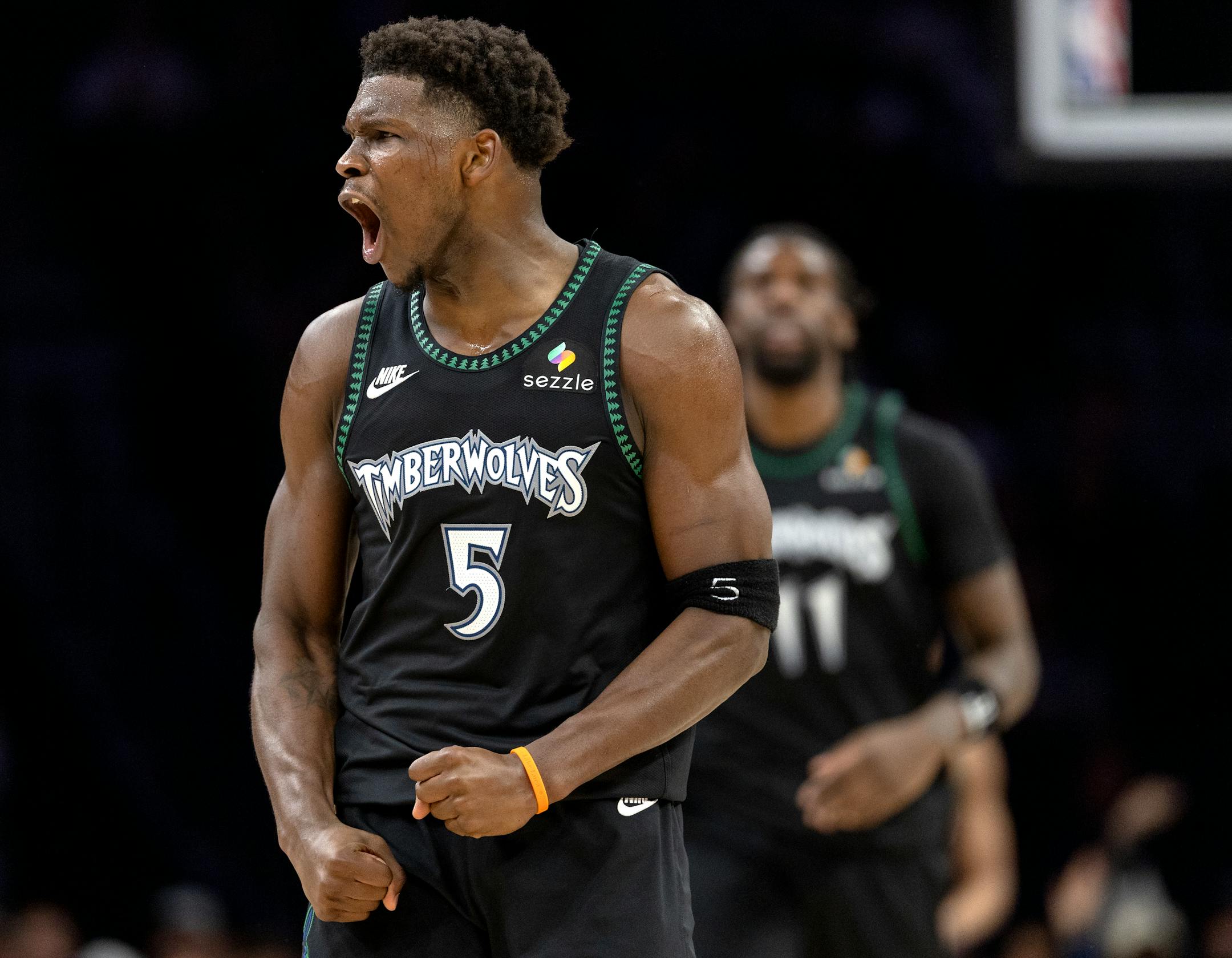
Wolves star Anthony Edwards celebrates a three-pointer against the Spurs in the third quarter at Target Center on Sunday. (Carlos Gonzalez/The Minnesota Star Tribune)

If there were a blueprint for the Timberwolves to follow the rest of the season, that they are capable of high-level play no matter the personnel on the floor, coach Chris Finch should pull up film of the first six-plus minutes of the fourth quarter from Sunday night’s 125-112 victory over the Spurs.

The Wolves entered the quarter trailing 93-89 at Target Center, and their defense was allowing San Antonio to get whatever it wanted inside the three-point line; the Spurs were 31-for-41 from two-point range and had 52 points in the paint.

Finch made a decision that might seem counterintuitive for a team struggling to find its defense: He took four-time Defensive Player of the Year Rudy Gobert off the floor.

Also, Anthony Edwards, the team’s best offensive player, went out for his usual rest to start the fourth quarter. What followed was perhaps the best stretch of basketball for the Wolves on both ends of the floor.

“We’re a hard team to beat when we’re all involved, and it shows,” Naz Reid said. “If we could do that more consistently, we’re going to be a really, really hard team to beat.”

The Wolves outscored the Spurs 25-7 over the next 6:38 and, for the first time in a while, they coasted to a victory.

The lineup on the floor for most of that stretch was Julius Randle, Reid, Jaden McDaniels, Mike Conley and Donte DiVincenzo, a smaller lineup the Wolves could deploy since the Spurs were without 7-foot-4 Victor Wembanyama (calf). Edwards, who scored 32 points and set the franchise record for most 30-point games, would replace Conley at the 6:31 mark.

“When the ball’s popping like that, everybody’s got a positive mindset and aggressive mindset, that’s how good things happen,” DiVincenzo said.

ADVERTISEMENT

Randle was brilliant in orchestrating the offense. He finished with 22 points, six rebounds and 12 assists, seven of those coming in the fourth. He found cutters, like when he hit DiVincenzo (18 points) for a reverse layup. He found open shooters, whether out of a crowd he drew inside, or just by making the next pass.

“I just try to make the play that’s in front of me, not fight the game,” Randle said. “That’s what coach has been telling me the past few games. I’ve been fighting it a little bit. Not fighting the game, making the play that’s in front of me. It’s easy from there.”

A burgeoning pick-and-roll chemistry Randle has found with Conley has unlocked more of the playmaking in his game, and Randle said they are “two guys who are just on the same page” when it comes to reading and reacting to what the defense is doing in that action.

The Wolves also got key minutes from Reid, who scored eight of his 15 points in the fourth, and McDaniels, who was 3-for-10 to open the night, but hit his last three shots to close the game with 13 points.

Finch said the Wolves’ inclination to cut more has helped unlock their offense, and he credited assistant Pablo Prigioni for making that more of an emphasis in the team’s game plan.

That comes with a cost for players because cuts don’t always lead to points. They are often sacrificial in nature and move the defense around to open it up for someone else. On one play, DiVincenzo cut to the middle of the floor and got the ball from Randle, who swung it to Reid, who found Conley for an open three in the right corner.

“You just have to give yourself up. I think that’s it,” DiVincenzo said. “... [You find] it’s Julius, then next it’s Naz, and then you find Mike in the corner. Those are rhythm shots and those are daggers. I think they called timeout, and then we’re coming to the bench and everybody’s fired up.”

On defense, the Wolves made a tactical change — they went to a zone defense with McDaniels in the middle. For the first time all game, they found a defensive formula that worked. That prevented the Spurs from manipulating matchups the way they could in man-to-man, Finch said.

“We tend to be more active in the zone sometimes than we are in man-to-man. It’s kind of crazy, but it’s kind of part of our personality at the moment,” Finch said.

When Edwards went back in, the Wolves didn’t miss a beat on either end of the floor, and they were able to cruise after a week of stressful finishes. Gobert got to rest, and the Wolves learned just how versatile they can be on both ends of the floor, regardless of who’s out there.

“We got a bunch of guys who could start the game,” Reid said. “I think another version of selfless is knowing time and situation. If one person is going, I’m going to respect that. … We’ve been here long enough to understand it and be happy for that next person.”

about the writer

about the writer

Chris Hine

Sports reporter

Chris Hine is the Timberwolves reporter at the Minnesota Star Tribune.

See Moreicon

More from Wolves

See More
card image
Matt Krohn/The Associated Press

The coach, who said he wanted to make a point with his antics, is a fiery competitor, even if it always doesn’t show.

card image
card image