
Latest move by chipmaker Skywater positions it as a leader in the next big computer technology

IonQ’s $1.8 billion acquisition of Skywater Technology will further position the Bloomington semiconductor firm to help companies develop quantum uses.

The Minnesota Star Tribune
January 30, 2026 at 12:00PM
Minnesota Senator Amy Klobuchar and Representative Dean Phillips took a tour of SkyWater Technology in Bloomington with CEO Tom Sonderman Tuesday morning. The visit was used to discuss U.S. manufacturing competitiveness and supply constraints in chip manufacturing.
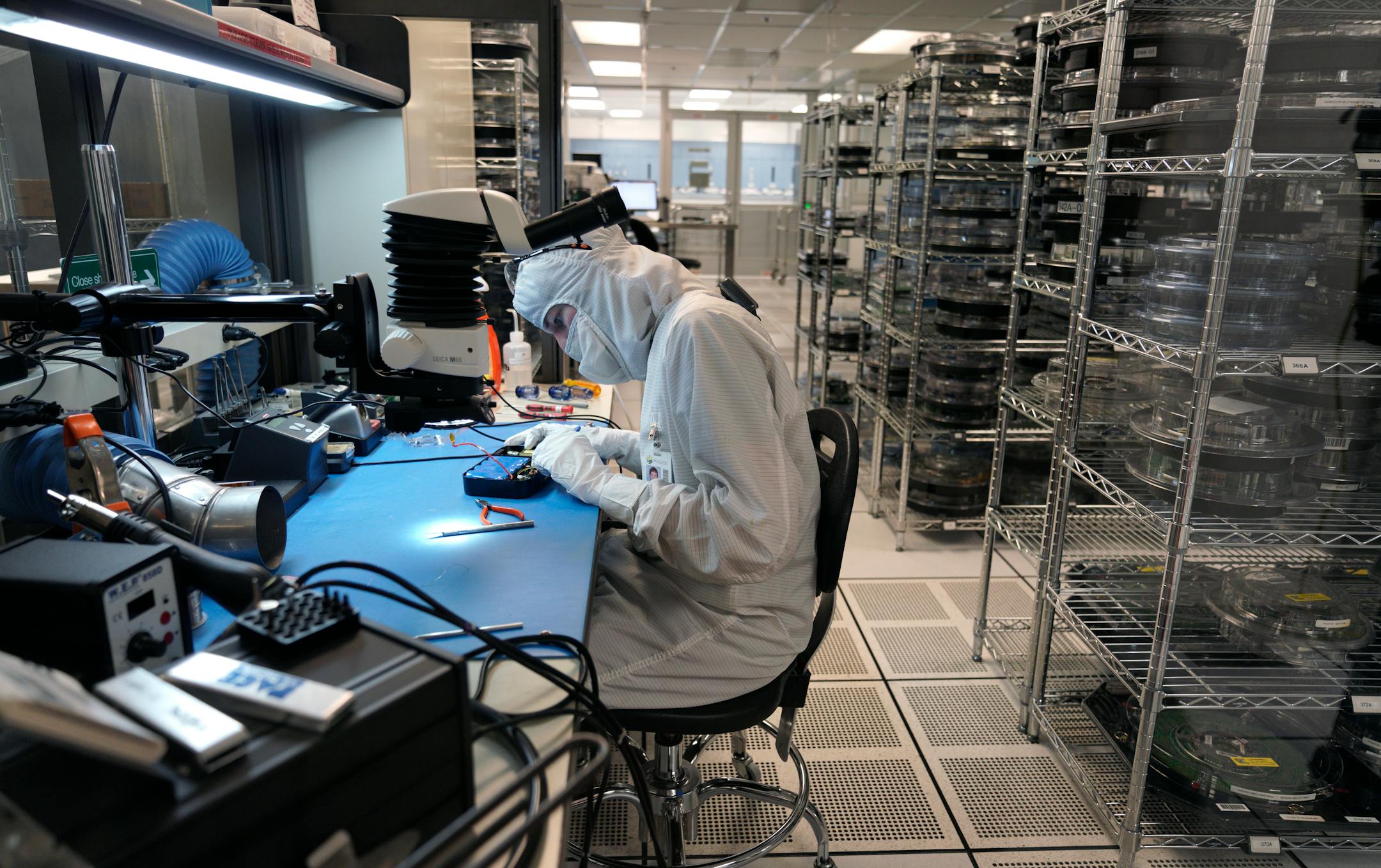
Skywater Technology, a semiconductor firm in Bloomington, is poised to be a leader in quantum computing field. (Brian Peterson/The Minnesota Star Tribune)

Skywater Technology’s latest move further cements its position as a U.S. leader in quantum, the next frontier in high-capacity computing.

Quantum computing is changing the way information is calculated, and in turn makes computer analysis faster — it is key to everything from artificial intelligence to cybersecurity and automotive and pharmaceutical research.

Both companies and nations are racing to be the first to build out the technology in a big way. Firms have established quantum computing can work, but engineering and technical challenges are tricky roadblocks to full-scale adoption.

In the fall, Skywater Technology bought Fab 5 in Texas, making it the largest pure-play semi-conductor chip foundry in the U.S.

Now, IonQ announced earlier this week it will acquire Skywater for $1.8 billion, which will help the Maryland company accelerate the development of its technology by partnering with Skywater.

With the deal, which is expected to close later this year, IonQ will secure U.S.-based ability to design, package and fabricate quantum semiconductor chips through Skywater.

The technology-as-a-service model of Skywater will allow IonQ to run various tests and prototypes in parallel, giving IonQ faster development times and a leg up on quantum competitors. Skywater will become an independent subsidiary of IonQ.

“We believe this deal creates an unusually robust competitive moat vs. peers,” wrote Craig Ellis, an analyst with B. Riley Securities. ”IonQ gains both manufacturing control and partner revenue streams, with SkyWater’s 10-year quantum development heritage bringing institutional knowledge competitors cannot quickly acquire."

A September 2025 study from Lawrence Berkeley National Labs and the National Energy Research Scientific Computing Center (NERSC), the experts in advanced-computing technologies, predicted quantum computing could reach commercial scale within five to 10 years.

Studying 10 quantum computing companies, the NERSC estimated “an exponential increase in quantum-computer performance over the next decade.”

Quantum computing represents the next stage in high-performance computing. It’s not necessarily a race for computation speed and power. Instead, quantum computing has the promise to make algorithms work better, reduce computational steps and more efficiently solve the most complex problems faster than existing options.

Classic computing is based on a series of 1s and 0s or bits. Quantum computing uses something call qubits and a lot of quantum physics.

The best way to imagine quantum is to think of a sphere with an arrow inside. The arrow pointing straight up is 1 and straight down is 0, but there are a whole continuum of positions within the sphere.

That’s quantum, said Vlad Pribiag, an associate professor at the University of Minnesota’s school of physics and astronomy who is an expert in quantum computing and superconducting.

“You can be anywhere on the sphere,” Pribiag said. “So every point has a meaning in the computation, and all points can be useful.”

Pribiag said quantum is the future, but there are still a lot problems to solve.

“It’s certainly not at that point of just tweaking a few things,” Pribiag said. “It’s very much research plus development, but it is definitely a fundamentally new way of thinking about computation.”

Many see keeping the development and manufacturing of quantum technology within the U.S. as a matter of national security.

“Great countries are great manufacturers,” said Thomas Sonderman, the chief executive of Skywater Technology in an interview. “We have to manufacture these technologies in the U.S.”

IonQ and Skywater are contrasting companies. IonQ is an early-stage technology company with about $100 million in annual revenue. It’s still a long way from profitability but has a market capitalization of $16.1 billion.

Skywater has a longer history and four times the annual revenue of IonQ. It has a market capitalization of $1.6 billion and was on a path to profitability before the sale. It has also attracted about $300 million in investments from the U.S. government at Skywater’s fabrication plants in Minnesota and Florida.

A variety of acquisitions by Skywater have helped build the company, including 10 in 2025 alone.

“The investment the U.S. government has made at Skywater over the last seven years really is the backdrop of why we became the right choice to be the manufacturer of choice for this domestic, secure manufacturing capability that IonQ and also many others will leverage,” Sonderman said.

Skywater became an independent company in 2017 and in 2021 completed an initial public offering that raised $112 million. But its Bloomington-based production facility has its roots back to the Control Data era, when Minnesota was at the forefront of supercomputer development.

“It’d be interesting to see if having this kind of formalized industrial presence on quantum in Minnesota will also translate into other research and development opportunities for the University or for other entities in the area,” Pribiag said.

about the writer

about the writer

Patrick Kennedy

Reporter

Business reporter Patrick Kennedy covers executive compensation and public companies. He has reported on the Minnesota business community for more than 25 years.

See Moreicon

More from Business

See More
card image
the_mandarinman Instagram

The father-son business sells hard-to-find Kishu fruit direct to consumers from the family’s Chino Hills, Calif., farm.

Minnesota Senator Amy Klobuchar and Representative Dean Phillips took a tour of SkyWater Technology in Bloomington with CEO Tom Sonderman Tuesday morning. The visit was used to discuss U.S. manufacturing competitiveness and supply constraints in chip manufacturing.
card image
