
Shutdown’s end spares North Dakota wildlife science center from massive staff cuts, for now

Minnesota partners feared loss of key research on migratory birds, wolf behavior, pollinator impact and more.

The Minnesota Star Tribune
November 14, 2025 at 11:30AM
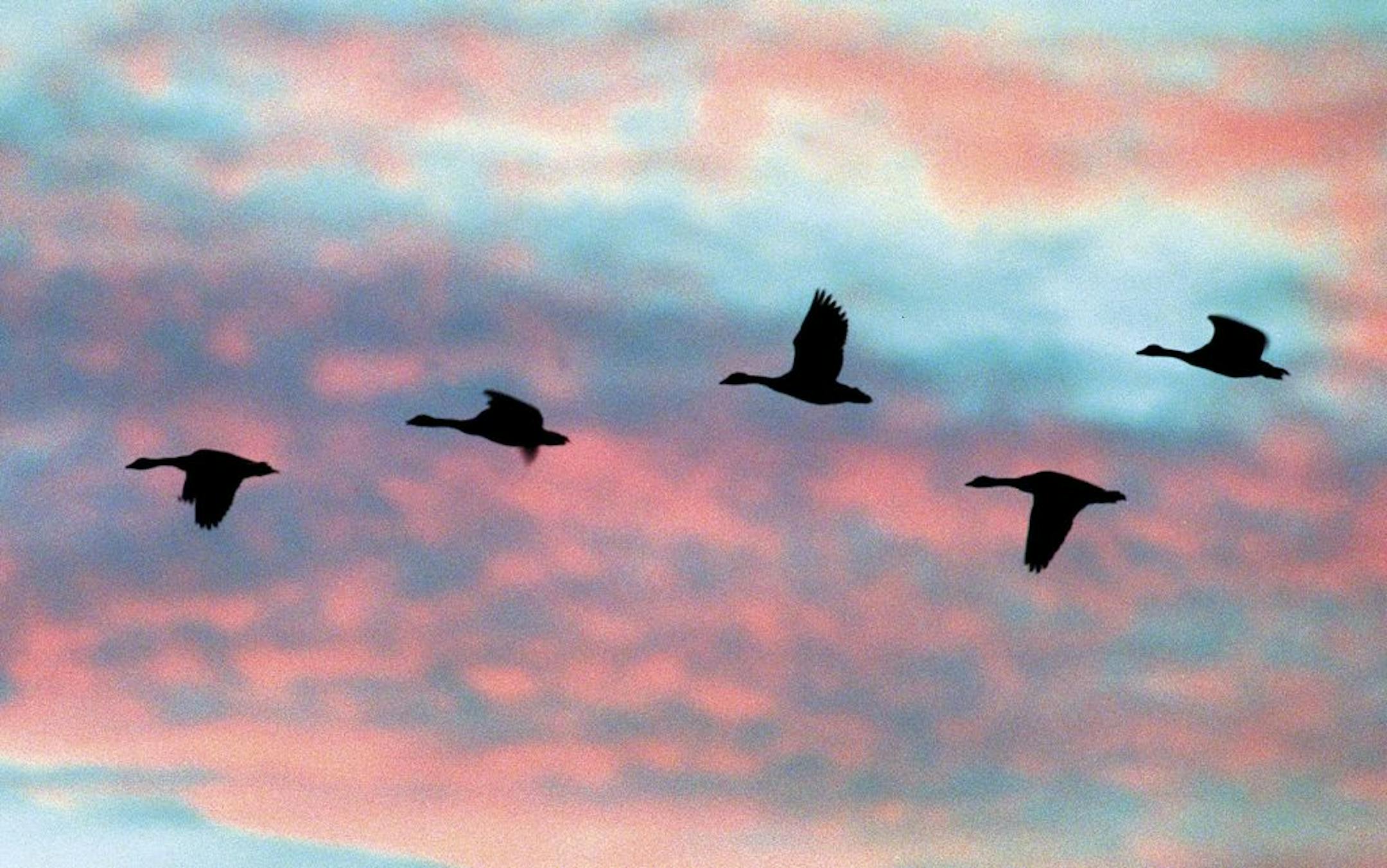
Canada geese take wing Friday, Nov. 27, 1998, at Goose Pond Sanctuary in Columbia County, Wis. The migrating waterfowl, which have been at the Madison Audubon Society pond for about five weeks, stay until the water freezes. The geese then fly eight hours to their winter home in southern Illinois.
Wetland ecology and habitat that supports waterfowl are among foundational areas of research by the Northern Prairie Wildlife Research Center. (Steve Apps/Wisconsin State Journal)

The end of the federal government shutdown spared a national wildlife research center that was targeted for massive job cuts.

Yet the science hub with close Minnesota ties faces an uncertain future as its parent agency is redirected toward energy, mining and other Trump administration priorities.

Over the last 60 years, scientists at the Northern Prairie Wildlife Research Center in Jamestown, N.D., have researched ways to protect and manage habitat. In recent months, some Minnesota partners, former scientists and wildlife specialists had feared the research would end.

The center lost at least 10 U.S. Geological Survey scientists last winter during the Trump administration’s federal workforce cuts, according to retired scientist Gary Krapu, who said he remains close to his former colleagues.

Then, during the shutdown, the Trump administration prepared to cut three-quarters of the staff, or 28 of 40 jobs, among thousands more jobs across land management agencies.

“The word came down that ‘We are going to close the center and you aren’t going to be able to get any support,’” said Krapu of the message last winter from Elon Musk’s Department of Government Efficiency. “It’s been quite a circus the last six months.”

While the federal government is reopening, the center’s future still looks murky. The funding measure that reopened the government also canceled the attempted layoffs at places like Northern Prairie, but only through January. Also, the 2026 fiscal year’s budget proposal for the USGS reduces funding and deprioritizes wildlife and climate change-related study.

The Department of Interior (DOI), which manages USGS as well as the National Park and Fish & Wildlife services, didn’t respond to emailed questions about Northern Prairie’s status.
A scientist at the Nature Conservancy, a conservation group and Northern Prairie partner, is hoping the center stays around.

“Anyone doing conservation relies on this science and what is going to work,” said Marissa Ahlering, science director for North and South Dakota and Minnesota.

‘It’s really important’

When the center began in 1965, scientists focused on restoring duck populations in the prairie pothole region, whose shallow wetlands had been converted to agriculture across the Upper Midwest.

In the decades since, the center’s reach has evolved. It has helped establish baseline data on the lives of breeding grassland birds; created methods to inventory the nation’s wetlands; investigated wildlife diseases, like chronic wasting; and informed government agencies that set duck harvest bag limits that affect Minnesota hunters.

Ahlering said Northern Prairie’s recent study of degraded pollinator forage and its negative impact on wild bees and honeybees helps her group understand how to improve habitat.

The center’s partners also include the Minnesota Department of Natural Resources and the University of Minnesota.

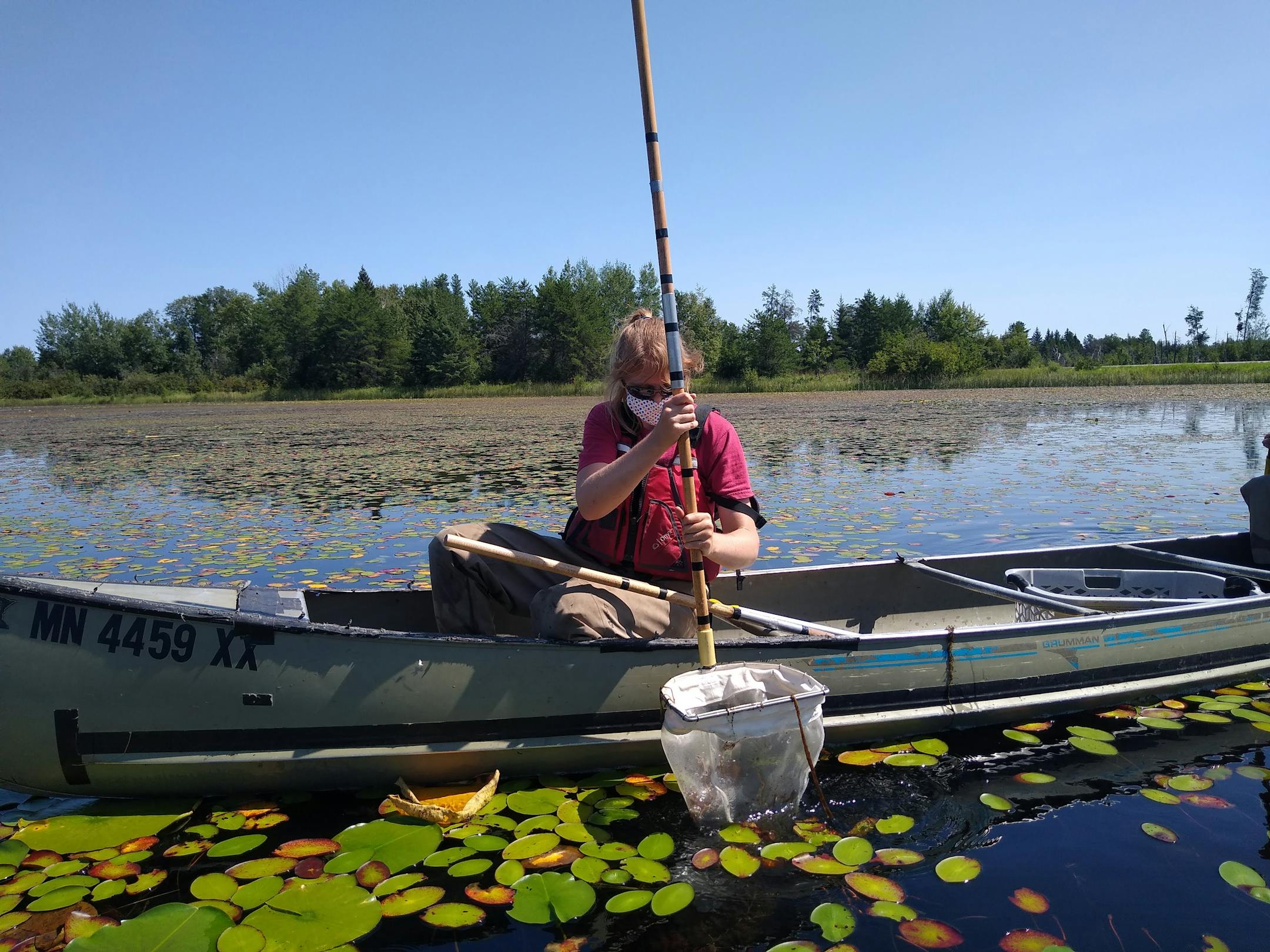
DNR zoologist Megan Fitzpatrick and her team surveyed wetlands across western Minnesota to study shrimp-like aquatic invertebrates, a significant food source for ducks. Their decline has been linked to a drop in lesser scaup populations, aka bluebills, that migrate by the tens of thousands through Minnesota. Duck hunts also have suffered.

Researcher Megan Fitzpatrick uses a dip net, which measures amphipod abundance in wetlands, during a study of the aquatic invertebrates, a key waterfowl food source. (Courtesy of Megan Fitzpatrick)

Collaborating with Northern Prairie biologist Michael Anteau was instrumental, she said. His expertise on freshwater shrimp steered Fitzpatrick’s recommendations for managers on ways to reduce pesticides and bolster plant diversity to help protect invertebrates’ habitat — and ducks.

Threats to center research are awful news, she said. “That would be a huge loss to wildlife in the prairie region.”

The center also has Minnesotans on staff: Dave Mech, who has studied wolf populations and behavior for decades, is a senior researcher who joined the staff in 1990. Also affiliated with the University of Minnesota, Mech has tracked wolves in the Superior National Forest and Yellowstone National Park and those roaming Ellesmere Island in the Canadian Arctic.

Next moves unclear

Trump’s 2026 fiscal year budget proposal alters USGS’s focus. The president’s request “eliminates programs that provide grants to universities, duplicate other federal research and focus on social agendas (e.g. climate change),” according to an Office of Management and Budget document detailing funding changes. The recommendation also says that the agency will focus on energy and critical minerals.

A main USGS target is the Ecosystem Mission Area. It’s a biological research program that includes 16 centers, including Northern Prairie and the Great Lakes Science Center in Ann Arbor, Mich., which also faced job cuts during the shutdown. Trump’s proposal cuts all funding for the program, which received about $293 million this fiscal year.

Both Senate and House budget proposals for next year are overall more favorable to DOI.

“We are not out of the woods,” Krapu said. “Things could change at any time.”

Northern Prairie employees already were rattled last winter by attempts to cut the workforce, a longtime North Dakota wildlife specialist said.

Greg Link, a former assistant wildlife division chief in the state’s Fish and Game Department, said fewer Northern Prairie scientists than normal arrived at an annual gathering in February of the Wildlife Society. Under a spending freeze, they were on their own expense.

“They were fretting at that time already,” he said. “I know with the shutdown some of those positions have been on the chopping block.”

His agency relied on Northern Prairie scientists’ data to help manage natural resources, Link said.

Northern Prairie scientists studied the impact of wind energy facilities on grassland bird species, which the National Audubon Society says are among the fastest birds in decline. The center found that the facilities displaced 53% of grassland birds into potentially more hostile environments.

Link’s wildlife division then worked with energy companies on new development to limit their impact.

“That research was instrumental. We don’t have these experts [at the agency],” Link said. “We look to Northern Prairie. We look to Fish and Wildlife Service. We look to universities. They are our go-to scientists on these species.”

Doug Johnson, of White Bear Township, retired in 2015 after a 45-year career as a Northern Prairie research statistician. He said the mission fanned out from migratory waterfowl because the state of natural resources demanded it.

He considers what could be lost if the center’s research is diminished.

“You are driving out scientists who care about learning about the environment and how we can manage it so we survive," Johnson said. “It is too easy to say, ‘Well, I don’t care about ducks,’ but can it be habitat for humans? In ecology, everything is connected to everything else.”

about the writer

about the writer

Bob Timmons

Outdoors reporter

Bob Timmons covers news across Minnesota's outdoors, from natural resources to recreation to wildlife.

See Moreicon

More from Outdoors

See More
card image
DENNIS ANDERSON/The Minnesota Star Tribune

A good (or bad) dog can keep you out of the hoosegow, signal trouble ahead and settle a score that needs settling.

card image
card image