


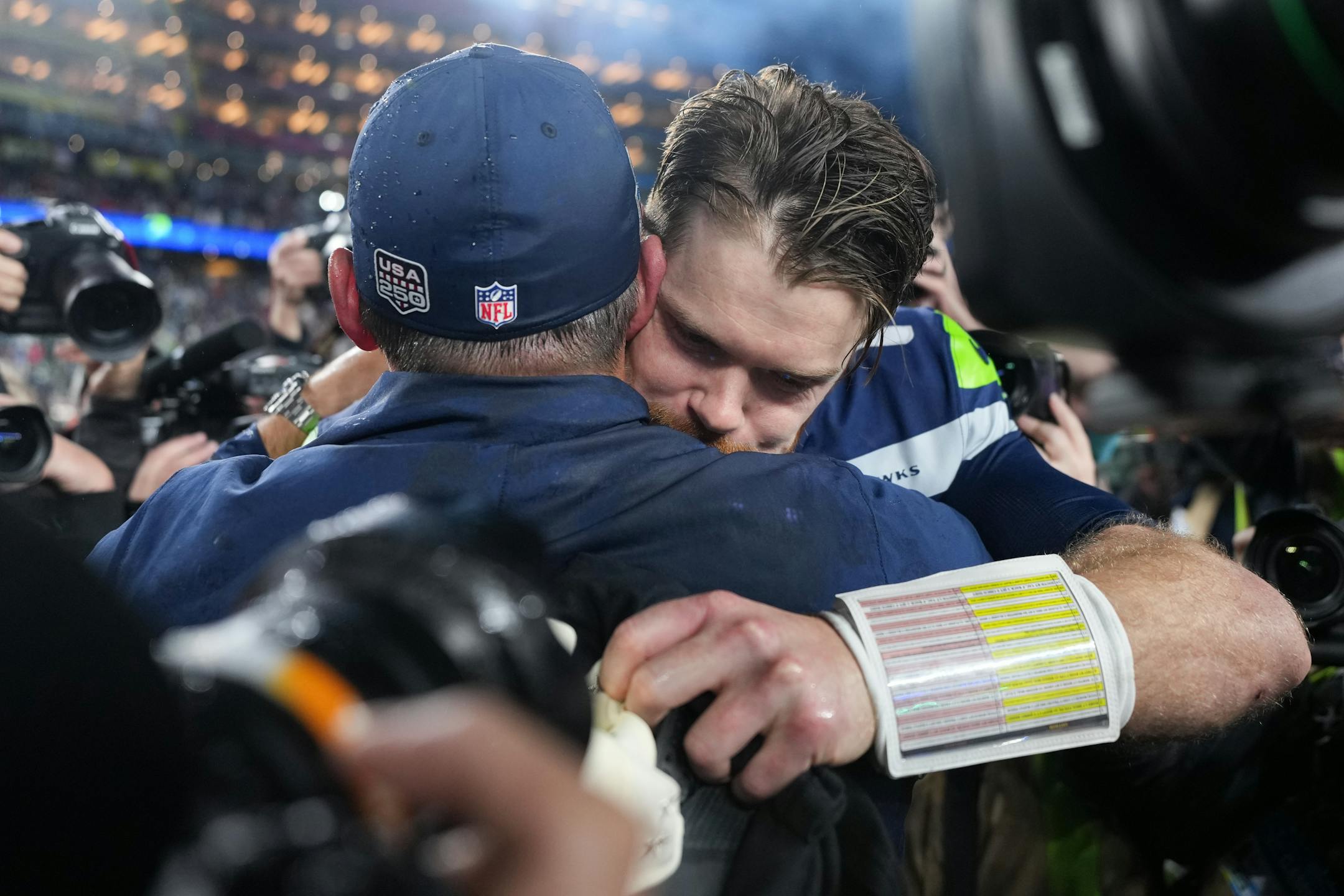
The ultimate irony about Sam Darnold’s journey from the scrap heap to a Super Bowl title is that even in his current form he’s not supposed to be the kind of quarterback that leads a team to a championship.
His performance the last couple of seasons — 14-win regular seasons with the Vikings and now the Seahawks — showed him to be a decidedly above-average quarterback.
The tried-and-true formula since the NFL instituted a rookie salary scale in 2011 has been this: To win the Super Bowl, you either need to have a Hall of Fame-caliber QB (like Tom Brady or Patrick Mahomes) or a productive young QB taking up a fraction of your salary cap, enabling you to build a monster roster around him (like Russell Wilson in his early Seahawks days).
Any veteran getting big money without elite production, like Kirk Cousins, would doom you to a ceiling lower than a championship.
As Patrick Reusse and I talked about on Monday’s Daily Delivery podcast, though, Darnold flipped that narrative in helping Seattle to a 29-13 win over New England on Sunday, Feb. 8.
Let’s dive into that idea and other Super Bowl thoughts at the start of today’s 10 things to know:
- Darnold’s three-year, $100.5 million contract with Seattle was backloaded so that the cap hit this year was only $13.4 million. That mitigated some of the issues, at least for a year, of trying to win with a QB like Darnold. With that relatively low hit, the Seahawks could still make offseason upgrades and field a dominant defense that ultimately carried the load in the Super Bowl.
- But Darnold’s performance throughout the season was more steady than elevating. He finished 19th in regular-season Total QBR. He produced some true clunkers down the stretch, but Seattle’s overall dominance carried the way. And he played arguably his best game of the season when it mattered most, a 346-yard, three-TD game to beat the Rams in the NFC title game. A lot of the year, Darnold was a game manager. In the Super Bowl, he completed just 50% of his passes. He also didn’t turn the ball over at all in the postseason.
- The Vikings tried to follow the formula of riding a young QB on a cheap contract. They let Darnold walk in free agency, and we’ll be relitigating the decision for years because J.J. McCarthy clearly wasn’t ready to play. The Patriots did the same thing with Drake Maye, who had a fantastic season, and it brought them within one win of a title. So it does and can still work.
- But this year was odd. Experience seemed to matter more than ever at quarterback in the biggest moments. Defenses gained the upper hand on offenses in critical moments. It was a pretty nondescript season, which is a polite way of saying “boring.” Darnold was an apt Super Bowl-winning QB for the nature of the season. Redemption and steadiness won the day over flashiness or preconceived notions.
- And yes, what about the Vikings? Veterans Harrison Smith and Blake Cashman are quoted extensively throughout this Tyler Dunne story on Darnold. It’s not so much second-guessing or hindsight as it is wistfulness that comes out in the voices of those two veterans in the piece. What might the 2025 Vikings have looked like with Darnold here? That’s the question we’ll never answer, but anyone with eyes can at least say “much better than they were.”
- Add a name to the Vikings’ offseason QB hunt: Derek Carr, the 34-year-old who is considering a return to the NFL after sitting out a season with injuries. Carr is a four-time Pro Bowler.
- Expectations for the 2026 Vikings are low. ESPN has them No. 23 in their early power poll.
- I’ll have plenty of Vikings talk on Tuesday’s podcast when the Star Tribune’s Ben Goessling is expected to be my guest.
- Bad Bunny’s Super Bowl halftime show? It was pure joy, and you didn’t have to love it (or understand Spanish) to see it.
- Is Chris Finch’s job on the line after a tumultuous weekend for the Wolves and a pair of bad losses? That might be a stretch, but let’s say these next two home games before the all-star break (Atlanta and Portland) feel pretty important.


