

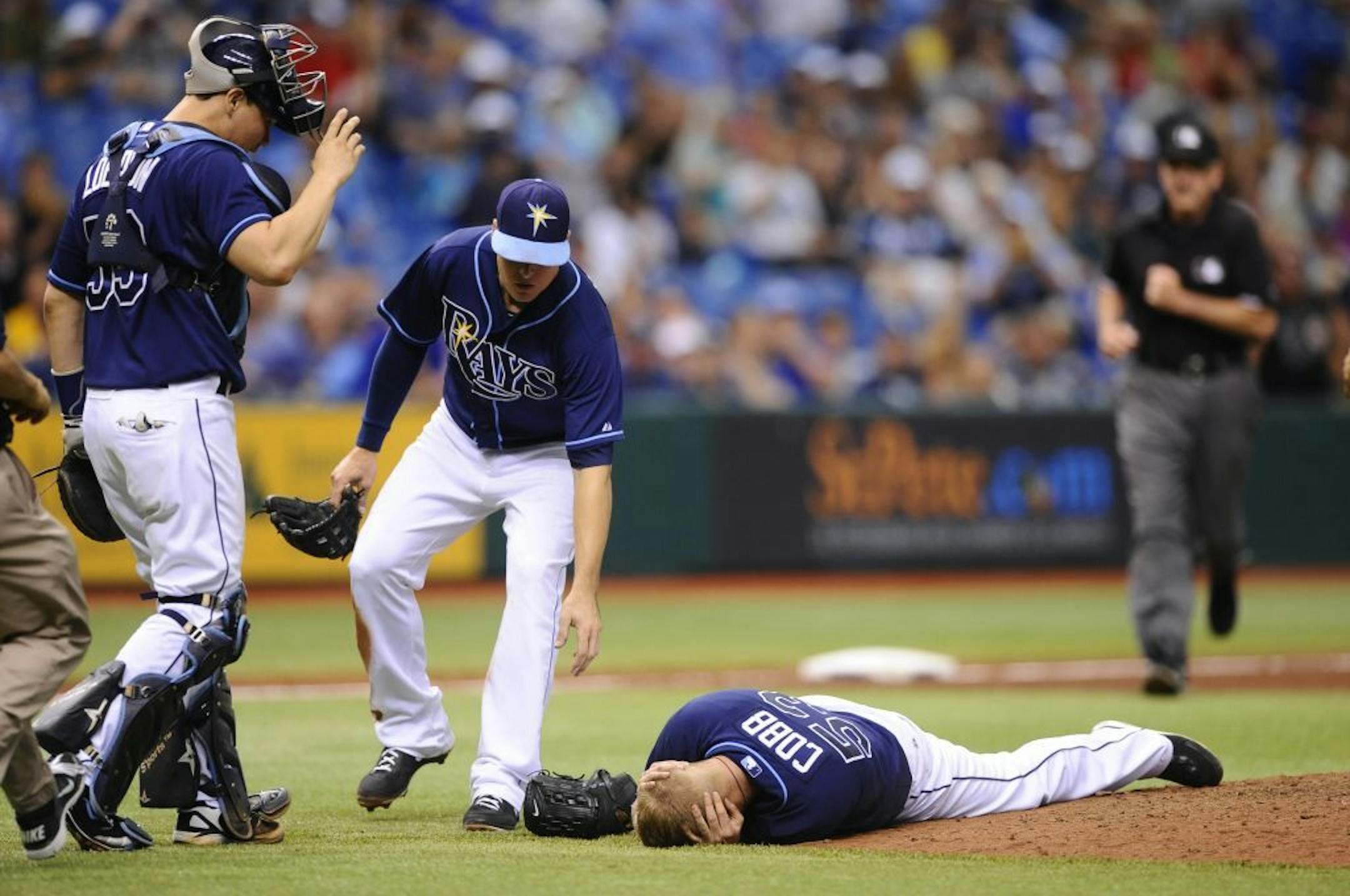
Scott Diamond hasn't seen a replay of Tampa Bay pitcher Alex Cobb being drilled in the head by a line drive this past weekend. Nor does he want to watch it. Or hear that sickening thud of the ball ricocheting off Cobb's head.
The Twins lefthander doesn't need any reminder of the danger that lurks every time he releases a pitch.
"Just hearing about it is enough for me," he said.
Unfortunately, that occupational hazard has become a sobering story line again for Major League Baseball after Cobb became the second pitcher in the past five weeks to take a line drive to the head. Combined with a terrifying incident last season, these cases underscore the risk that pitchers face and the need for MLB to identify safety measures that might decrease that risk.
"When it happens, it's a frightening moment," Twins starter P.J. Walters said, "but it's something we deal with."
That sentiment echoed throughout the Twins clubhouse Tuesday in conversations about two recent incidents and what, if anything, baseball can and should do to protect pitchers.
Cobb suffered what the Rays termed a "mild concussion" when he was struck in the ear. Toronto's J.A. Happ suffered a skull fracture after being hit by a liner in early May. Those two survived relatively unscathed compared to Brandon McCarthy, who faced life-threatening brain injuries after being hit by a line drive while pitching for Oakland last September. He underwent surgery after suffering an epidural hemorrhage and skull fracture, and he endured a seizure earlier this month probably brought on by his injuries.
These incidents remain uncommon — MLB estimates that one in every 250,000 pitches results in a pitcher being hit in the head — but each one has the potential to be catastrophic. The ball that hit Cobb reportedly was traveling 102 miles per hour.


