
Republicans threaten return to Musk’s chainsaw strategy to government

Rather than sticking to an easy strategy, Republicans are threatening a risky strategy of mass firings of federal workers because of the government shutdown.

The Washington Post
October 4, 2025 at 9:06PM
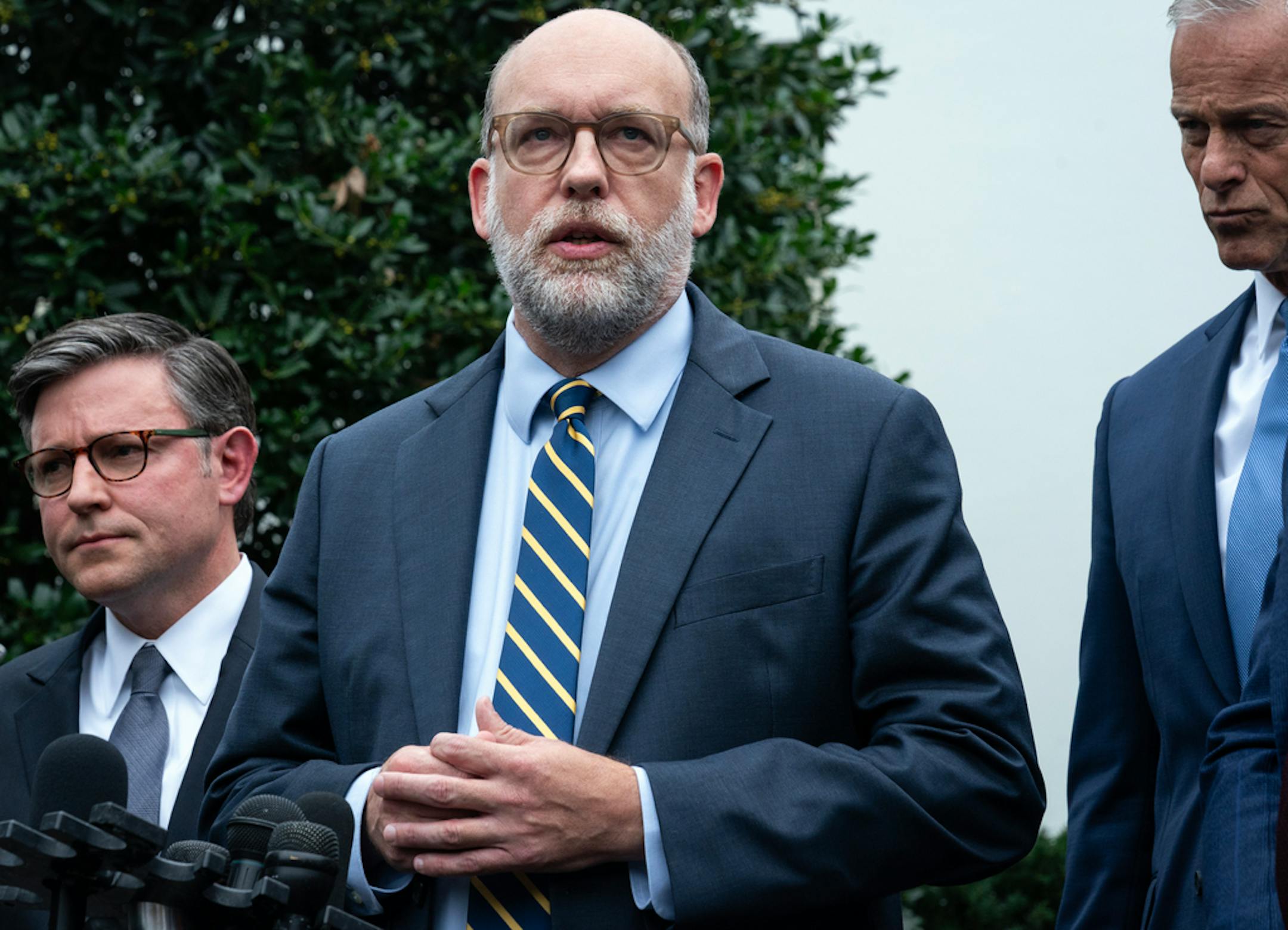
Director of the United States Office of Management Russell Vought addresses the press on September 29,2025 in Washington, D.C. (Maxine Wallace/The Washington Post)

Sen. Mike Rounds (R-South Dakota) said if the government shutdown continues, mass layoffs and cuts to programs favored by Democrats will probably follow.

Russell Vought, the director of the Office of Management and Budget, promised as much in a late September letter advising federal agency chiefs to prepare for staff reductions.

And Vought has already enacted billions of dollars in cuts to infrastructure programs in New York City and Chicago, while also placing holds on green energy programs in 16 states that have not voted for Donald Trump in three presidential elections.

Rounds said he keeps warning Democrats that much more is coming.

“We don’t know what’s going to happen. I’ve had no communication with anybody, but I can sure read the tea leaves. And if I can read them, I think our Democrat colleagues can read it,” the senior member of the Appropriations Committee told reporters Thursday.

The administration’s threats — and cuts — are a return to form: They are an updated version of the Elon Musk-led U.S. DOGE Service, which the world’s richest man led as it shuttered some agencies and downsized the federal workforce.

The political impact of DOGE, which stands for Department of Government Efficiency, was brutal. Only 35 percent of Americans approved of the job Musk was doing in April, and only about 40 percent of voters believed waste and fraud had been reduced. Trump’s shutdown strategy could prove to be equally as politically perilous.

It has been easy for Republicans to blame Senate Minority Leader Charles E. Schumer and his fellow Democrats in the chamber for the shutdown so far. Congressional Republicans have offered a straightforward message — that Democrats are filibustering a simple bill, lacking any partisan policies, that would extend funding until just before Thanksgiving.

A Washington Post poll conducted on the first day of the shutdown found voters blamed Trump and Republicans more than Democrats, but past trends indicate that Republicans should gain the edge if they stick to a simple, “we-just-want-to-open-the-government” message.

Trump is complicating that effort, however, by using the shutdown to exact political retribution. And that makes it much harder for Republicans to blame the damage wrought by the shutdown on Democrats.

With Vought, Trump is also giving Democrats a figure to villainize, much as the party did with Musk earlier this year.

The actions of Vought, who is a relative unknown to most voters, should be more difficult to turn against Republicans than those of Musk, who basked in the public glow and wielded a chainsaw onstage at a conservative conference to demonstrate the indiscriminate nature of his cuts.

But Trump has gone out of his way to hype Vought’s work in a way that raises the stakes for Republicans during this shutdown.

Trump posted on social media Friday a seemingly AI-generated video that featured Vought as “the reaper” carrying a scythe to be used against federal workers and Democrats. That came a day after Trump posted that he was meeting with the budget director to determine which agencies Democrats like and whether to make permanent cuts to them.

Vought has used his social media accounts to highlight some of his initial targets, boasting about nixing funds for projects in New York, home to House Minority Leader Hakeem Jeffries (D) and Schumer.

There’s no precedent for this type of action in any government shutdowns, or partial shutdowns, over the last 30 years. No president has engaged in mass layoffs of federal workers because of a shutdown, including Trump himself during two such moments in his first term.

But Trump, House Speaker Mike Johnson (R-Louisiana) and other Republicans have asserted that Vought holds near-omnipotent powers to do what he pleases during a shutdown.

“Because [Democrats have] decided to vote to shut the government down, they have now effectively turned off the legislative branch,” Johnson told reporters Thursday. “So in that situation, when Congress turns off the funding and the funding runs out, it is up to the commander in chief.”

The federal courts will probably get a say in these actions, and as Emily Davies and Hannah Natanson of the Washington Post reported, some senior administration officials warned top agency leaders that the mass firings would be illegal.

Regardless of the legal outlines, this GOP strategy carries plenty of political risk.

“We, as Republicans, have never had so much moral high ground on a government funding bill in our lives,” Sen. Kevin Cramer (North Dakota) told Semafor, warning that the OMB director’s strategy could backfire. “I just don’t see why we would squander it, which I think is the risk of being aggressive with executive power.”

If Trump green-lights a really aggressive approach by Vought, it could create plenty of friendly fire on fellow Republicans.

While the administration’s spending cuts have largely fallen on Democratic areas, they also affect states where Republicans remain competitive — such as Minnesota, home to House Majority Whip Tom Emmer (R), and New Hampshire, home to Gov. Kelly Ayotte (R).

House Democrats released a list of nearly 150 districts that will be hit by the funding cuts, including 28 held by Republicans, many of whom are in swing seats that will determine the majority in next year’s election.

And the deeper Vought goes into cutting programs, the more likely he is to hurt voters who are part of the modern Republican coalition.

Exit polls showed Trump narrowly won voters who make less than $50,000 in 2024, making him the first Republican presidential candidate this century to win that income bracket.

Jeffries said that, in an Oval Office meeting Monday, he tried to convey that the health care cuts in the massive domestic policy bill Trump signed in July will hit deepest in poor, rural areas of Deep South states that overwhelmingly supported Trump.

“That is the reality. It’s hurting everybody, but it’s certainly hurting people who voted for him,” Jeffries said.

In a story about proposed Medicaid cuts, one hospital health care executive told The Post the GOP plan would “cripple” rural hospitals like his in Kansas’s Reno County — a place that gave Trump 66 percent of its votes in 2024.

Rounds maintains that Democrats have more to lose than Republicans, adding that the “first things at risk” are programs that Democrats like.

“I think it’s going to bite them harder than it does us,” Rounds said.

Rounds said he wants to get out of the shutdown and avoid looming deep cuts to federal workers, but the usually mild-mannered conservative said Democrats have to give in or else Vought will take “things south real quick.”

“You would think that they would recognize that,” he said.

But Jeffries seems to have reached a different conclusion. He and other Democrats are holding fast on their demand that health care policy be included in any deal to reopen the government, and he thinks that Vought’s actions will hurt Republicans.

“The cruelty that they might unleash on everyday Americans, using the pretense of a shutdown, is only going to backfire against them,” he said.

about the writer

about the writer

Paul Kane

The Washington Post

More from Politics

See More
card image
Tierney L. Cross/The New York Times

After the arrest of a man charged with placing two pipe bombs outside the headquarters of the Republican and Democratic national parties on Jan. 5, 2021, the warning from the Trump administration was clear: If you come to the nation's capital to attack citizens and institutions of democracy, you will be held accountable.

card image
card image