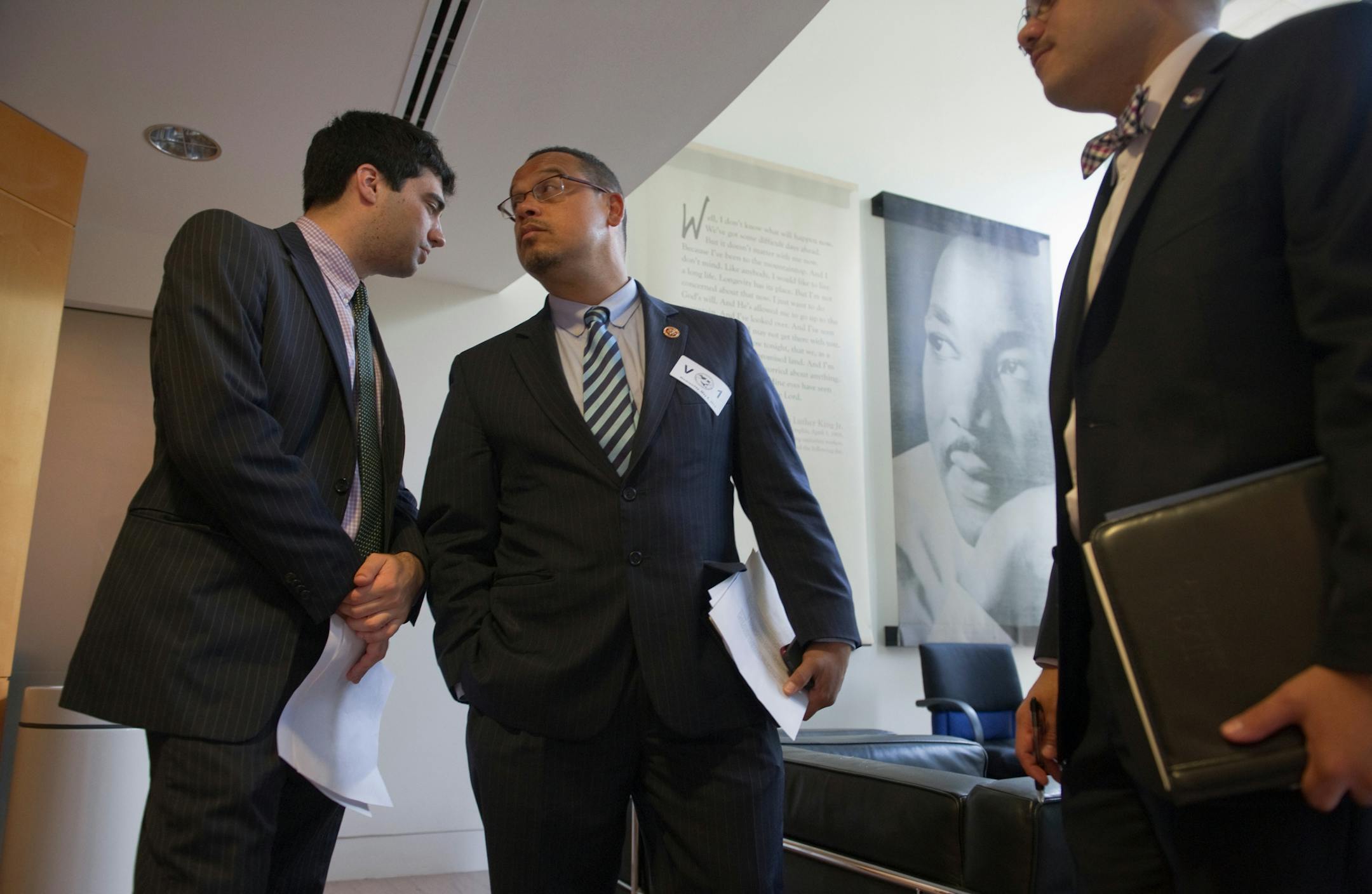
WASHINGTON – In 2008, when Democratic firebrand Keith Ellison was deciding how to vote on an $800 billion bank bailout, one of the first calls he made was to ex-Minnesota Gov. Arne Carlson, a Republican.
Since 2006, Carlson and others have staged quarterly meetings of a financial services roundtable that facilitates frank, private discussions about business issues between Ellison and representatives of Minnesota's investment and banking sectors.
Ellison trusts roundtable members to provide a point of view he may not agree with but needs to hear, a perspective he often does not get talking to the progressive Minneapolis constituency he represents in the U.S. House of Representatives. His talk with Carlson in 2008 helped persuade Ellison to vote for the bank bailout.
"He'll get out a notebook and pen and start asking questions," said current roundtable leader Stephen Lewis, board chairman of Columbia Funds. "I have been very impressed how he wants to learn."
Ellison is schooling himself on economic matters for a reason. What he really wants is to lead a serious national economic movement with what he describes as a workable common-sense message for corporate America.
To better position himself at the Capitol, Ellison gave up other committee assignments to sit on the powerful House Financial Services Committee and its Capital Markets Subcommittee. If America will empower its rank-and-file workers with good jobs without regard to race or religion, he said, many other issues disappear.
Known for occasionally sparring with conservative talk show hosts, notably Sean Hannity of Fox News over automatic federal budget cuts, Ellison aims to provide a populist counterpoint to the conservative vision that commands the majority in the House. It's a mission that should complement the politics of his district, which includes Minneapolis and is the state's most ethnically diverse and Democratic-leaning.
"If you're talking about a sustainable company that can rely on a decent margin of profit over the course of years and years, then your destiny is tied to the viability of the American middle class," Ellison said. "And you cannot take so much advantage of that class of workers that they cannot afford to buy your product unless they borrow money to do so."