
Readers Write: Minneapolis police, Lutsen Lodge, housing costs

Yes, the Police Department is over budget — because of recruiting success, plus seven mass shootings in the city this year.

The Minnesota Star Tribune
December 13, 2025 at 7:28PM
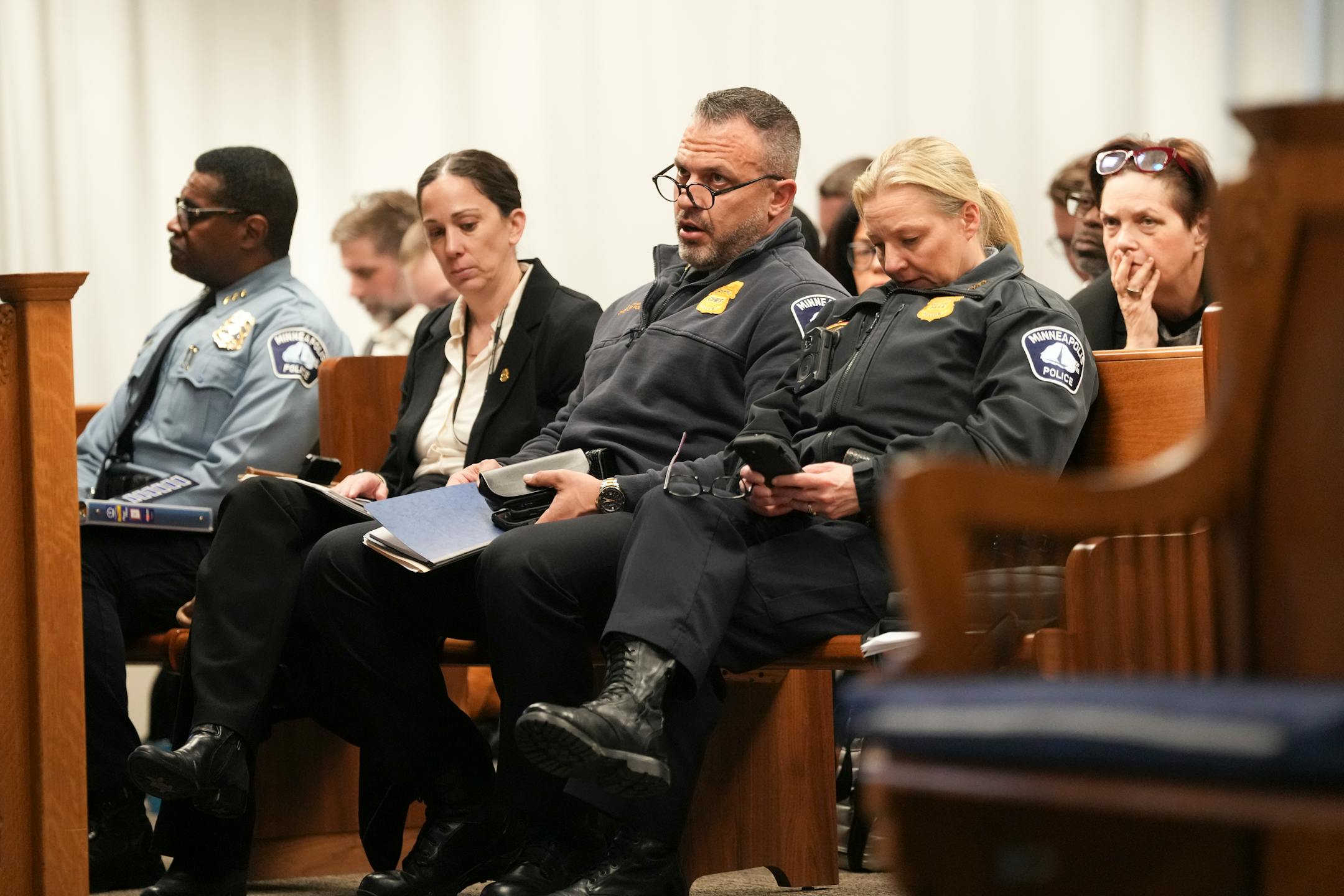
Minneapolis Police Chief Brian O’Hara, center, sits with his chief of staff Leslie Silletti, center left, Assistant Chief of Operations Katie Blackwell, right, and Assistant Chief of Community Trust Christopher Gaiters, far left, during a Dec. 8 City Council budget meeting. (Renée Jones Schneider/The Minnesota Star Tribune)

Opinion editor’s note: Strib Voices publishes letters from readers online and in print each day. To contribute, click here.

••• —

I was seriously disappointed by the headline of the article “Minneapolis Police Dept. goes over budget by $19.6M” (Dec. 6). It clearly implied wrongdoing by the MPD, and that was not the case at all. Reasons the budget went over included bonuses paid to recruit new officers, their salaries while being trained and bonuses to retain current officers. Plus a huge amount of overtime because the MPD has been seriously understaffed for almost five years. Simply put, Chief Brian O’Hara’s recruiting and retaining efforts were a resounding success! That along with the fact that there were seven mass shootings in Minneapolis in 2025. How can mass shootings be planned or budgeted for? Should the MPD have told the Annunciation victims, “Sorry, we’re going over budget. We can’t help you”?

I don’t understand why the Minnesota Star Tribune chose to sensationalize this budget matter in such a negative way. No one expected so many recruits to jump on board! This is a good thing for the city! Perhaps a better headline would be “O’Hara’s efforts to rebuild the force were such a resounding success that it blew the budget.” Sub-headline: “Seven mass shootings contributed to overspending.”

The article mentions the Harleys that Council Member Aisha Chughtai criticized were purchased with forfeiture money. The money did not come out of the budget. Forfeiture funds are found money that cannot be used for budget line items. They can be used to purchase tools to support the department. If they are not used appropriately the funds are lost. Going into her fifth year on the City Council, why does Chughtai not understand how these things work?

To those running the show at the Star Tribune, this 40-plus-year subscriber wants to say this: I expect more from you. The headline used for that article was pure sensationalism. Please don’t turn into the National Enquirer.

Teresa Maki, Minnetonka

•••

That the chief should have to justify the $19 million over-budget spending to the City Council is both laughable and profusely ironic. The City Council is ultimately responsible for the dearth of Minneapolis police officers after proposing to defund the department amid the George Floyd imbroglio. Council members should be praising the chief for pulling off the miracle of finding candidates to work for a city that tried to get rid of them.

Richard Greelis, Bloomington

The writer is a retired Bloomington police officer.

•••

In response to the Star Tribune article, “911 call centers begin to embed social workers,” I strongly support the growing shift toward embedding social workers directly in 911 call centers. According to the article, Minneapolis, Ramsey County and Washington County are implementing or expanding programs that place trained social-service professionals on the front lines of emergency communication. This is exactly the kind of public safety innovation Minnesota needs.

911 calls involving mental health, homelessness and substance use rarely require a law-enforcement response. As the article notes, Minneapolis’ new embedded social worker, Melanie Yang, now assists callers facing eviction or navigating mental-health crises or issues that “might not necessarily be appropriate for police or EMS.” According to the National Alliance on Mental Illness, “1 in 5 American adults experiences a mental health condition each year,” meaning these calls are far from rare. Handling them with the wrong type of responder can worsen the situation.

The article also quotes Nancie Pass, director of Ramsey County’s Emergency Communication Center, who argues that traditional police responses can escalate mental-health–related calls, while social workers provide a “human-centered approach.” This perspective mirrors findings from the U.S. Department of Justice indicating that trained mental-health responders reduce the likelihood of force in crisis situation.

Minnesotans deserve emergency responses grounded in expertise, de-escalation and dignity. According to the article, these pilot programs are already proving effective in connecting residents with real solutions instead of sending them into unnecessary law-enforcement encounters. Minnesota should expand this model in all counties to ensure that people in crisis receive the right help at the right time.

Milo Komatsu, Inver Grove Heights

LUTSEN LODGE

This former insurance guy says ‘hmm . . . ’

The only mystery as to the destruction of the Lutsen Resort Lodge was that it took almost two years to charge the obviously desperate owner with arson (“Lutsen Resort owner charged in 2024 arson,” Dec. 5). As a 34-year career insurance underwriter, I was educated in the signs of arson and this tragedy had them all: a tinderbox frame building, use of flammable accelerant, firefighters needing to pump water from the lake, severe financial problems, property insurance recently increased over actual value, creditors demanding payment, etc. This will likely serve as a classic case of expected arson for many years to follow.

But wait, not so fast! Suddenly the defense has obscured those charges with doubts that could well leave this tragedy another Minnesota mystery for all time (“Cause of Lutsen Resort fire remains unclear,” Dec. 7). Despite motive, opportunity and some evidence, proving the owner responsible in some way, shape or form may still prove elusive.

Many have fond memories of visits to Lutsen dating back 140 years. My first wife and I spent some honeymoon time there in 1972; I recall the tiny room, cold April indoor swimming pool, awesome lake views and excellent restaurant. The building may be gone but the fond memories continue in the hearts and minds of so many visitors past.

Michael Tillemans, Minneapolis

HOUSING

This problem won’t solve itself, lawmakers

Minnesota’s homeownership rate has been on the decline, and according to CBS Minnesota, this drop from 75% to 71% (the largest in 40 years) should be quite alarming to anyone who cares about economic stability and generational opportunity. The percentage change recorded over the last four decades does not indicate a temporary turnaround but rather a complex housing issue that local authorities have been slow to solve.

The Housing Affordability Institute points out that Minnesota lacks almost 100,000 housing units, of which around two-thirds are in the metropolitan area. Thus, when the demand is so far beyond supply as it is now, prices go up, and people who want to buy a home for the first time get excluded. This is one reason why the National Association of Realtors says the median age of a first-time homebuyer is 40 years old and the highest ever recorded.

The thing that makes this problem most irritating is that the solutions are virtually certain. The “Yes to Homes” agenda included bipartisan proposals, such as easing the building of starter homes by cutting red tape, allowing townhouses and duplexes and getting rid of costly aesthetic and parking requirements, that are practical moves that would increase supply without compromising community character. Urban Institute and many other organizations’ research findings are consistent with the statement that affordability improves where local governments allow different housing types.

As a student at Gustavus Adolphus College, I can only express my concerns about what this pattern would mean for the young people in Minnesota who plan to live a stable life in this state. In the past, owning a home has been a steppingstone to wealth creation and community involvement. If it is still important for Minnesota to be a place where, for example, newly married couples could settle down, then the lawmakers have no other choice but to act.

Housing affordability is a problem that will not solve itself. If the intervention comes too late, it will be even more difficult for the next generation to overcome the challenge of housing ‍‌‍‍‌affordability.

Martine Nduwayezu, St. Peter, Minn.

about the writer

about the writer

More from Readers Write

See More
card image
Renée Jones Schneider/The Minnesota Star Tribune

Yes, the Police Department is over budget — because of recruiting success, plus seven mass shootings in the city this year.