
Readers Write: Jonathan Ross, ICE and the law, Minnesota fraud allegations

An “experienced” agent wouldn’t have done this.

The Minnesota Star Tribune
January 13, 2026 at 12:00AM
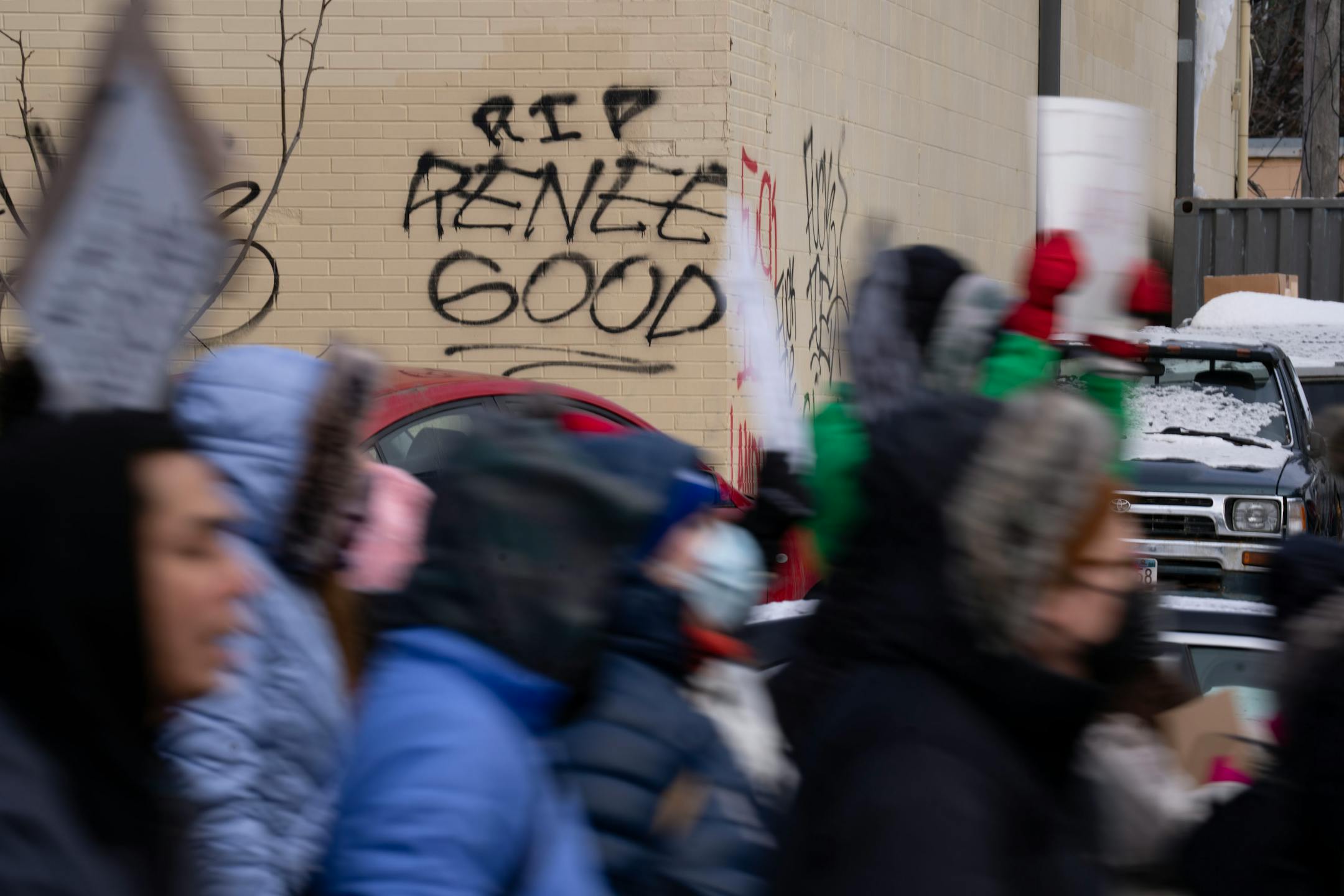
Thousands of protesters march down Lake Street in Minneapolis Jan. 10 as part of an anti-ICE protest following the killing of Renee Good by ICE agent Jonathan Ross. (Alex Kormann/The Minnesota Star Tribune)

Opinion editor’s note: Strib Voices publishes letters from readers online and in print each day. To contribute, click here.

•••

Jonathan Ross has been described by Homeland Security Secretary Kristi Noem as an “experienced” agent. Public reporting indicates that Ross was previously injured after being dragged by a vehicle during an arrest attempt on June 17, 2025. That history makes the tactical decisions at issue here especially troubling.

Modern law-enforcement training and use-of-force doctrine are clear: Officers are instructed to avoid positioning themselves in the direct path of a suspect vehicle. Vehicles are treated as potential deadly weapons, and agencies have repeatedly emphasized this guidance in response to past incidents in which officers were killed, injured or compelled to use lethal force under circumstances that could have been avoided through sound tactics.

Against this backdrop, it is difficult to reconcile the description of Ross as an experienced agent with a decision to place himself directly in front of a vehicle that could reasonably be expected to move in an effort to evade arrest. Such positioning predictably creates a dangerous, high-stakes confrontation in which the risk of serious injury or death — either to the officer, the suspect or bystanders — is substantially increased.

Experience in law enforcement is intended to reduce foreseeable risks, not amplify them. Prior involvement in a vehicle-related injury should heighten an officer’s awareness of these dangers, not diminish it. When established training principles are disregarded, the resulting peril is neither accidental nor unforeseeable; it is the product of choices that contradict well-known standards of safe and responsible policing.

These facts raise serious questions about tactical judgment, adherence to training and supervisory oversight. They demand careful scrutiny, not deference to labels such as “experienced,” and not after-the-fact justifications for circumstances that modern policing doctrine exists precisely to prevent.

Gerald Simonich, Bloomington

•••

It may be obvious, but no commentator or article has mentioned it, so I will. I appreciated the detail provided in the Jan. 11 Minnesota Star Tribune article “A close examination of the shooting of Renee Good.” The key was the shot fired from near the front of the vehicle that is said to have “hit the bottom corner of the driver’s side windshield.” I take that to mean that this was not a fatal shot — if so, whether the shooter, an Immigration and Customs Enforcement agent, had the reasonable belief that his life was in danger should not be judged from the circumstances of that shot. Then, there are two more shots, fired as the vehicle was passing by the shooter and aimed into the open driver’s side window. These appear to be the fatal shots, and the question should be whether the shooter, now free of being hit by the vehicle and standing by the driver’s side as it passed, could claim to have a reasonable belief that his life was in danger, by a vehicle that was moving away from him. Hopefully, any investigation of the shooting will focus on those two shots and the reasonable belief of the shooter when they were fired.

Sam Hanson, Minneapolis

The writer is a retired associate justice of the Minnesota Supreme Court.

•••

I hope that the investigation into the fatal shooting of Good will answer some questions about the shooter. It has been reported that he was injured on the job last year when he reached into a vehicle that drove off. Did he receive remedial training on how to act safely in situations like that? Were my tax dollars wasted on ineffective training? Or were my tax dollars going to a supervisor who fraudulently didn’t order that training? If Noem was correct and the officer “followed his training,” we’ve got a much bigger problem — we’ve been invaded by more than 2,000 ICE agents with bad training.

Diane Rosenwald, Plymouth

THE LAW

Like it or not, ICE presence is legal

I am writing to inform and educate Minneapolis Mayor Jacob Frey and Gov. Tim Walz about the Supremacy Clause of the United States Constitution.

The Supremacy Clause (Article VI, Clause 2 of the U.S. Constitution) establishes that the Constitution, federal laws made in pursuance of it, and treaties are the “supreme Law of the Land,” taking precedence over any conflicting state laws, meaning state judges must uphold federal law even if state constitutions or laws say otherwise, underpinning federal preemption. It makes federal authority paramount in areas where the federal government legislates, ensuring national uniformity and the enforcement of federal powers, though it doesn’t allow the federal government to veto state laws directly, but rather supersedes them when conflicts arise, often through court interpretation.

In summary: The federal Constitution and federal laws are superior to state constitutions and laws. State judges and officials are bound by this federal supremacy.

Why are federal ICE officers in Minnesota enforcing federal immigration laws? Because that is their jurisdiction. Immigration is a federal issue, not a state issue. Is ICE legally in Minnesota? Yes. Do they have the right to conduct investigations and take into custody people they have reason to believe have violated U.S. immigration laws? Yes.

This is why it looks so completely idiotic for the mayor of Minneapolis to tell ICE “get the f--- out of Minneapolis,” and for the governor of Minnesota to be remarkably obstinate and unhelpful to ICE’s stated goal of getting those without legal status out of Minnesota. ICE has every constitutional right to be here doing their job. I for one am glad they are getting rid of bad guys. They are making Minnesota safer.

David Arundel, Mound

•••

In a lengthy display of compassion and empathy, the authors of a Jan. 10 commentary lament the impact of ICE operations on their “immigrant friends, neighbors and family members” (“A year of steps that led to this week’s events in Minneapolis,” Strib Voices).

To date, ICE has detained “more than 400 Minnesota illegal aliens,” according to the Department of Homeland Security, many with lapsed final orders of removal (some more than 20 years old). One example is Somvang Phrachansiry of Laos, whose prior convictions include assault with a dangerous weapon and criminal sexual conduct (final order of removal in 2001).

The authors claim that “ICE’s presence is not making our communities safer.” This claim presumably includes ICE detention of Phrachansiry and other such “immigrant friends,” whose continued illegal presence in Minnesota would (in their view) not compromise public safety.

Peter Abarbanel, Apple Valley

•••

A Jan. 10 letter writer expressed support for peaceful protests and correctly states that there is a line between peaceful and nonpeaceful civil disobedience. He warns readers to understand the difference between peaceful protesting and obstructing law enforcement. Fair enough. However, there are also laws about speeding in a car. If I drive my car at 57 mph in a 55 mph zone I am breaking the law. Does this unlawful act warrant being shot by a law enforcement officer?

Proportional response.

Neil Robinson, Plymouth

FRAUD ALLEGATIONS

Shouldn’t you know these things?

U.S. Small Business Administrator Kelly Loeffler recently wrote on social media that the SBA will join White House efforts to freeze federal assistance to the citizens of Minnesota due to alleged mismanagement of federal funds managed by the state. Specifically, the Star Tribune reported Loeffler planned to halt $5.5 million annually that assist our state’s small businesses. She blames an alleged nationwide fraud on one of the SBA’s many programs active in every state, the PPP pandemic relief loan program. Loeffler states, “Minnesota cannot be trusted to administer federal tax dollars.”

Does Loeffler not understand that it is the federal SBA directly and not the state of Minnesota that manages this program nationwide? If a Trump administration Cabinet member is going to sling blame for program administration problems, they may want to make sure they have their facts straight before shutting off federal resources to Minnesota. And if this SBA-managed program did experience some fraud problems nationwide (even though the program is widely credited with saving small business in America), why blame the state of Minnesota that has little or no involvement in SBA programs?

John Kimball, Lino Lakes

The writer is a retired director of SBA lending at a local bank.

•••

Something is terribly wrong. I was deputy director for the local Small Business Administration office and retired 15 years ago. Already the agency was centralizing loan decisions. If all loans are made centrally by the agency, how can they only find fault with Minnesota loans if it isn’t political? It is just unfair to damage Minnesota business owners because the administration doesn’t like liberal Minnesota.

Mel Aanerud, Ham Lake

about the writer

about the writer