
Readers Write: Homelessness, Bill of Rights, traffic stops, Charlie Kirk

It’s not lack of housing. It’s drugs.

The Minnesota Star Tribune
September 23, 2025 at 12:00AM
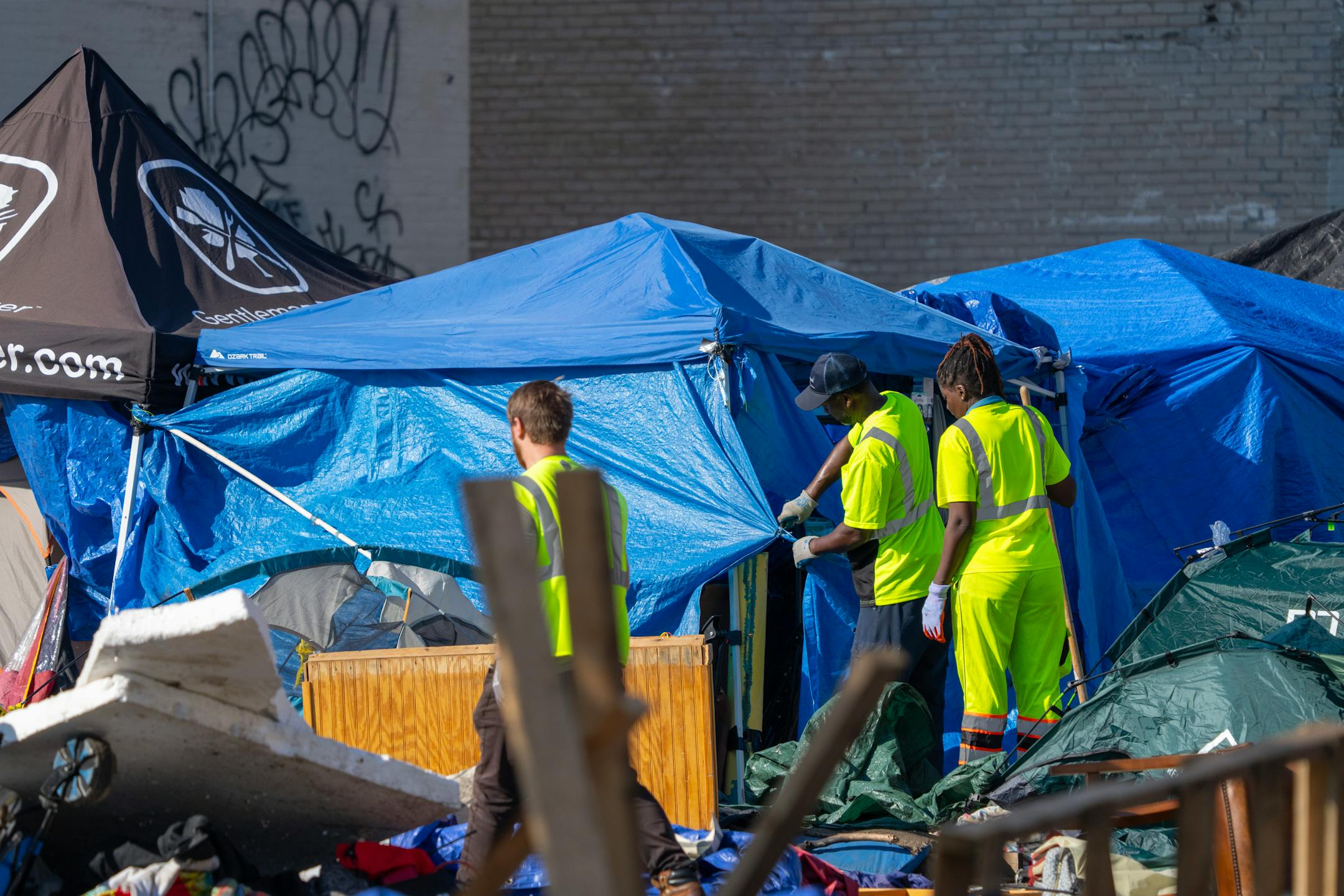
Workers for the city of Minneapolis clear a homeless encampment near E. Lake Street and 28th Avenue S. on Sep. 16. (Alex Kormann/The Minnesota Star Tribune)

Opinion editor’s note: Strib Voices publishes letters from readers online and in print each day. To contribute, click here.

•••

The Minnesota Star Tribune needs to stop calling the problem that Minneapolis has “homelessness” and “homeless encampments” (“Neighbors’ fears foretold Lake St. violence,” Sept. 22). Minneapolis does not have a homelessness problem. It has a problem that a small number of people with addictions come together to buy and do drugs. Drug dealers make millions. Surrounding properties are inundated with theft and violence. Then these people die, either through overdoses or homicides in fights over drugs.

When the Star Tribune calls this problem “homelessness,” it leads to the wrong solutions. The obvious solution to homelessness is to provide housing. In the last half of 2024, the city offered housing to 169 people in camps. Nine took it. But as long as the Star Tribune keeps calling it “homelessness,” the city’s solution will be housing.

The Star Tribune needs to start calling this what it is. Open-air drug camps — places where people come to shoot up, inhale drugs and buy drugs. If the Star Tribune called it what it is, the city’s response would be involuntary commitment to treatment for those who cannot take care of themselves and aggressively arresting drug dealers.

But this won’t happen until the Star Tribune stops being part of the problem and calls these things what they are: drug camps.

Carol Becker, Minneapolis

•••

Recent local news articles about the dangers of tent encampments, including letters in Readers Write have noted the frequent presence of discarded hypodermic needles and syringes used for injecting drugs. People who live nearby, and those who are involved in cleaning up sites, have noted how often they encounter those syringes, including being accidentally stuck by a needle. A recent commentary even described an accidental stick to a small child!

As a registered nurse, I have looked for published warnings about what to do in case a person experiences a needle stick but have not seen that information in this newspaper.

Please be extremely careful if handling discarded syringes! Keep in mind that gloves do not protect against accidental needle sticks, which can easily penetrate cloth, latex or rubber. And if anyone experiences a needle stick, they must quickly see a health care provider who, in most cases, will order some lab testing and necessary follow-up, usually at six and 12 months after the needle puncture. Very serious illnesses can easily be spread by accidental needle sticks, and timely medical care is essential in preventing a bad outcome.

Also be very careful when handling trash bags filled with discarded materials from in and around these encampments. They certainly will contain used syringes.

Christine Lewis, Minneapolis

BILL OF RIGHTS

No selective legitimacy

If the First Amendment can suddenly be “on the table,” then why is the Second treated as untouchable? President Donald Trump has threatened the press, calling critical coverage “illegal,” while many Republican leaders remain silent. This is a direct attack on the foundation of our democracy. The First Amendment protects every American’s right to speak, protest, worship and hold power accountable. If that can be compromised, then no right is safe.

Meanwhile, the Second Amendment is treated as sacred, even as children are shot in classrooms, churches and grocery stores. Kids are literally being killed while praying — and the response from politicians is silence, “thoughts and prayers” or excuses. Where is the urgency to protect them? Where is the courage to enact even the most basic gun safety reforms?

We cannot claim one amendment is expendable while pretending another is holy. Either we defend the Constitution consistently, or we admit this hypocrisy for what it is: authoritarianism dressed up as patriotism. Minnesotans deserve leaders who protect both our freedoms and our children’s lives.

Lisa Zollars, Wyoming, Minn.

TRAFFIC STOPS

That’s not what collaboration means

As reported in the Minnesota Star Tribune, Hennepin County is implementing a policy that would limit felony charges stemming from traffic stops (“New Hennepin County traffic stop policy under fire,” Sept. 20). Law enforcement officers objected to the policy and from that article are these two pieces of reporting:

“[Hennepin County Attorney Mary] Moriarty’s office said engaging with law enforcement in advance previously has led to ‘leaks and coordinated efforts to undermine collaborative work.’

“Her office said it purposefully announced the policy a month ahead of the Oct. 15 implementation date so that it can ‘meaningfully engage with all stakeholders,’ including law enforcement and community partners.”

Meaningful engagement and collaborative work should be at the beginning of major decisions that involve community partners. I realize that Moriarty will not be running for office when her term is up. I think I speak for many when I say, “Mary, you will not be missed!”

Teresa Maki, Minnetonka

•••

Does Moriarty realize that Oklahoma City bomber Timothy McVeigh was caught through a traffic violation?

Jim Piga, Mendota Heights

CHARLIE KIRK

He shouldn’t be dead. And he was toxic.

Thank you Nekima Levy Armstrong and the Star Tribune for the commentary regarding Charlie Kirk (“The truth about Charlie Kirk’s legacy,” Strib Voices, Sept. 20). He should not have been killed. His rhetoric hurt many people and, like our president, he stoked division in our country, and that should be acknowledged.

The simple truth is that free speech is being stifled by our current government. The Star Tribune was brave enough to print the truth.

Sue Schwartz, Minneapolis

•••

Levy Armstrong’s opinion piece about Kirk was measured and appropriate. I want to thank her for that. I would add to her piece that Kirk apparently helped to cause tremendous damage to the country and the world by use of clever but misguided arguments designed to encourage young voters to vote Trump. Republicans and Trump understandably applaud Kirk’s help.

Kirk’s discourse was legal but unwise. Now millions of people here and abroad are suffering and will continue to suffer the consequences of Trump’s election. That will be part of what Kirk helped to create. History will tell that tale.

Thomas Wexler, Edina

•••

Enough! The toxic mudslinging in the aftermath of Kirk’s assassination has got to stop. Whether we admired Kirk or disdained him, let us agree that his death was a horrific tragedy and should never have happened. It serves no useful purpose to lay the blame for Kirk’s assassination on anyone other than the perpetrator. It’s time to focus our attention instead on bringing our nation together, not tearing it apart.

In his Second Inaugural Address shortly before the end of the Civil War, President Abraham Lincoln said: “With malice toward none; with charity for all; with firmness in the right, as God gives us to see the right, let us strive on to finish the work we are in; to bind up the nation’s wounds ... to do all which may achieve and cherish a just and a lasting peace, among ourselves, and with all nations.”

May that be our prayer as well.

The Rev. Alan Bray, St. Peter, Minn.

•••

We could all take a lesson from Erika Kirk. On Sunday, at her husband’s memorial service, she forgave his killer. If she could do that, couldn’t we forgive those with whom we disagree, however vehemently? Couldn’t we find ways to get past our fear, anger and condemnation, to find ways we could work together for the good of us all? Couldn’t we get creative and inspired to listen to the other side and find a path forward, without using whatever power we have to control the other — to diminish the other side, to trade insults, to take revenge? What if we tried forgiving those who have hurt us, without giving up our convictions? Perhaps then we could be free to work on solutions, though imperfect, but real.

Gay Clapp, Minneapolis

about the writer

about the writer