
Readers Write: Education, the Trump administration, income inequality, TV shows

Bureaucratic bloat in public education is a real problem — and students are paying the price.

The Minnesota Star Tribune
July 29, 2025 at 10:30PM
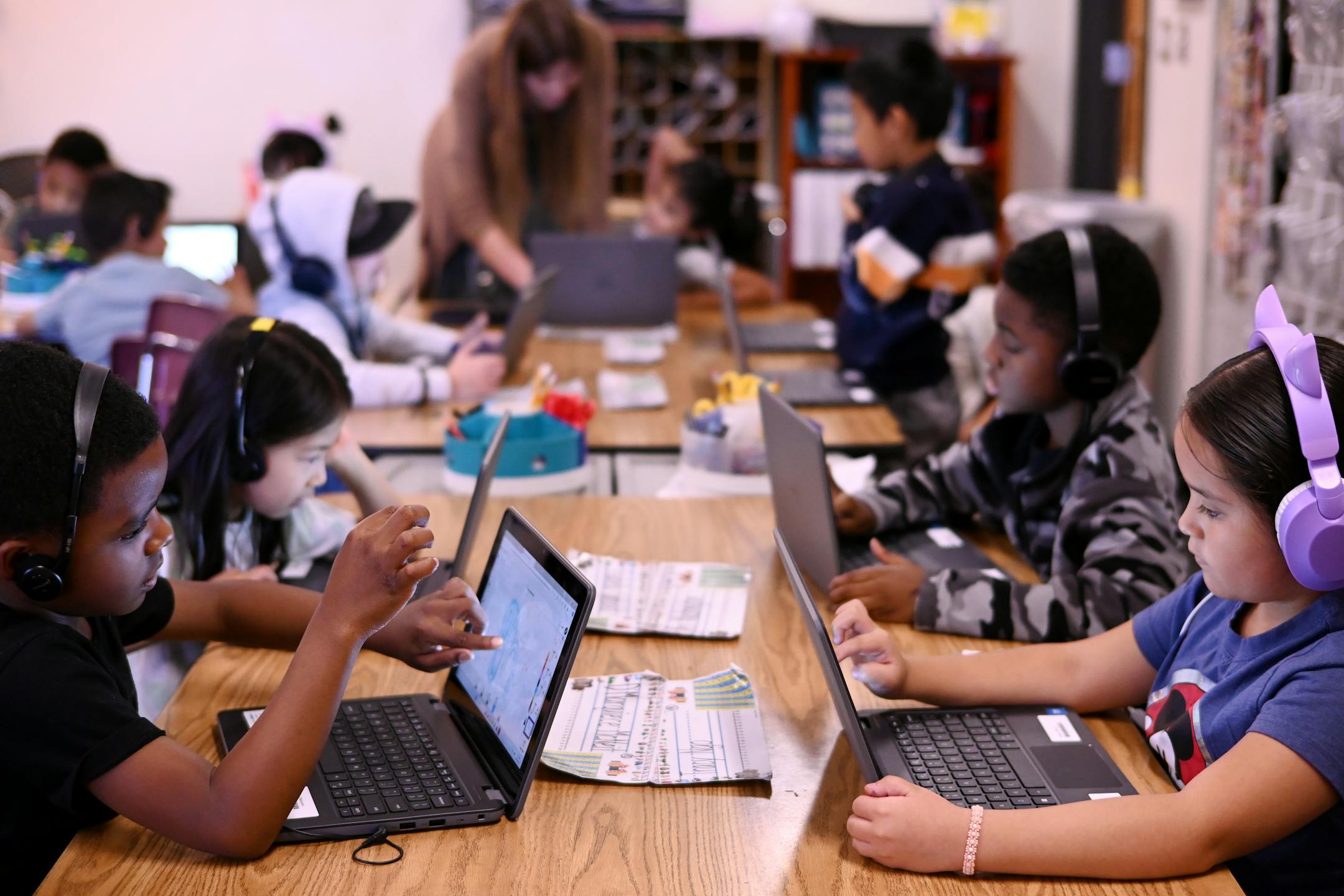
First-graders are in the reading class at Ponderosa Elementary School in Aurora, Colo in October 2024. (Hyoung Chang)

Opinion editor’s note: Strib Voices publishes letters from readers online and in print each day. To contribute, click here.

•••

Since the late 1960s, the U.S. has been dumping billions into public K-12 education. Yet year after year, we’re told schools are “underfunded” and need more. Meanwhile, teacher salaries barely move, classrooms stay overcrowded and students’ performance continues to slide.

So, where the heck is the money going? Spoiler: Not to the teachers and definitely not to the kids. Over the last few decades, the biggest growth in public education hasn’t been in classrooms. It’s been in bureaucracy. Between 1992 and 2009, student enrollment went up by 17%, but staffing exploded by 46%. Some districts now have more non-teaching staff than teachers. Job titles like “equity consultant” or “instructional coordinator” now eat up budget lines once reserved for textbooks or building maintenance.

We spend more per student than almost any other country in the world, yet American students sit middle of the pack in math, reading and science. In districts like New York City and D.C., it can cost over $20,000 per student and the results are still disappointing. The problem isn’t funding, it’s mismanagement. School districts throw cash at Public Relations departments, bloated middle management, tech that doesn’t work and “diversity training” that’s more about appearances than impact. Meanwhile, teachers are left scrambling to buy basic supplies out of their own pockets.

It’s time to stop pretending the system just needs more money. What it needs is accountability. Every district should have to publish exactly how education dollars are spent, and if most of it isn’t getting to the classroom, something is broken. Until we fix the bloated machinery eating our schools alive, no funding increase will ever be enough.

Rick Fraser, Prescott, Wis.

•••

In this time of political tumult and reduced funding, education will suffer more than it has in recent years.

What the world needs is reliance on humanity. Respectful interactions between people of all ages who hold different points of view. That’s why I concur with “Teaching: Oh, the humanity, part 2” by retired teacher Dick Schwartz (July 27).

As a former high school teacher, it’s not so much that students met “famous” people; it’s that someone such as former Star Tribune opinion columnist Katherine Kersten listened to them. That she recognized their ability to think for themselves and, I would add, to ask smart questions.

In the 1990s, while I taught at Mount Desert Island High School in Maine, I took students for an annual intellectually challenging weekend to Boston. Lucky me, my mentor was the late Boston University historian, Howard Zinn, author of “A People’s History of the United States.” He met with us in a private seminar at the Holiday Inn near his home.

One year a student asked, “Is it really you?”

Zinn replied, “Oh come on, I’m just an old Jewish grandfather.” They jumped in, framing astute questions for the “famous” professor, a caring human being. Twenty teenagers hugged Zinn when we left.

This summer, I bumped into a former student in Maine.

“I’ll never forget our seminar with Howard Zinn,” he said. “That was a life changing experience.”

What did our current incurious president say after winning the 2016 Nevada primary?

“I love the poorly educated.”

Sheila Wilensky, Minneapolis

•••

If we want to address the problem of student loans, the first place to go is the interest rates. Way too many students have paid off their loans two and three times over, yet are still underwater with those usurious interest rates. An educated populace is good for us all, so these interest rates should be as low as possible. Banks can borrow money at a quarter of a percent interest, so how is it reasonable to possibly charge students 7% or more?

Steve Hoffmann, Anoka

THE TRUMP ADMINISTRATION

Too little, too late

What utter hypocrisy! President Donald Trump has finally asked that something be done to help the starving people of Gaza. This from the man who has fully supported Israel Prime Minister Benjamin Netanyahu’s complete annihilation of Gaza. This from the man whose administration has shut down United States Agency for International Development, discounted vaccinations, sabotaged SNAP, undermined Medicaid and gutted FEMA. Trump’s expression of concern for the people of Gaza is too little, too late. A sound bite from his golf cart in Scotland is a feeble attempt to make people think that he actually cares.

Alan Bray, St. Peter, Minn.

The writer is a retired pastor of the Evangelical Lutheran Church in America.

INCOME INEQUALITY

A hypothetical solution for your wallets

A recent letter writer makes some good points about income inequality and incentives to work hard (Readers Write, July 27). How about this for a partial solution to the problem? Once a person has an annual income of about $800,000, each dollar earned above that would be subject to an additional income tax of 5% (both state and federal). Every additional $800,000 would trigger a further tax of 1%. Government could use half of the extra funds to reduce taxes for low income individuals. This would stimulate the overall economy, and the other half could be used to reduce the national debt or be spent on a long list of things that would benefit the public.

Peter Erickson, St. Louis Park

•••

Differences in earnings are a key to our economic success? Maybe a little. The issue is our excess: Buying and selling $3 million apartments while people who work for a living struggle to find a safe place for their tents. Health care executives taking home millions while nurses struggle to pay for child care. Moderate greed may sometimes lead to progress, but so do a lot of other, more charitable motives. On the other hand “progress” is often destructive as heck, and excessive greed causes a great deal of destruction. That’s why social democrats are getting louder. And we should listen.

Phil Norcross, Roseville

TELEVISION

What’s on, what’s not

There is no accounting for taste. Adam Platt does not like Colbert’s jokes (“As a late-night entertainer, Stephen Colbert abdicated,” July 29), so let me introduce another lens. Humor is an antidote to violence; Trump violently bullies with headlines 24/7. Humor, a high form of intelligence, soothes late night stress; the body prefers to be happy. Self care is good for business after all. Licensed as entertainment, the Fox channel may not be your flavor of humor, Platt.

Barbara Vaile, Northfield

•••

I am writing in response to the recent op-ed published in the Minnesota Star Tribune regarding Leslie Fhima (“The cutthroat competition to get a rose ... in Leslie Fhima’s dance class,” July 25). As someone who has been taking her dance classes for over 15 years, I disagree with the picture painted in that article.

What was written was not just a critique; it was a personal attack and worse, a threat to the livelihood of a woman who has built her career through integrity, talent and an unwavering commitment to her community. The claims made do not reflect reality. They are misleading and deeply unfair.

I don’t know how or why the author conjured such an account, but I can speak from experience: Fhima’s classes are inclusive, empowering and filled with joy. The environment she creates is one of positivity, professionalism and respect. The op-ed was a disservice not just to her, but to the readers who rely on your paper for responsible journalism.

I urge the Minnesota Star Tribune to reflect on the standards by which you vet and publish such pieces. Truth should matter, especially when someone’s career and character are at stake.

Denise Amundson, Minneapolis

about the writer

about the writer