

Advertisement

Ramstad: Major legal battle simmering over Minnesota school segregation

Minnesota’s racial tensions now play out in immigration matters. But that will change as a landmark lawsuit moves through courts again.

Columnist Icon
The Minnesota Star Tribune
February 21, 2026 at 1:00PM
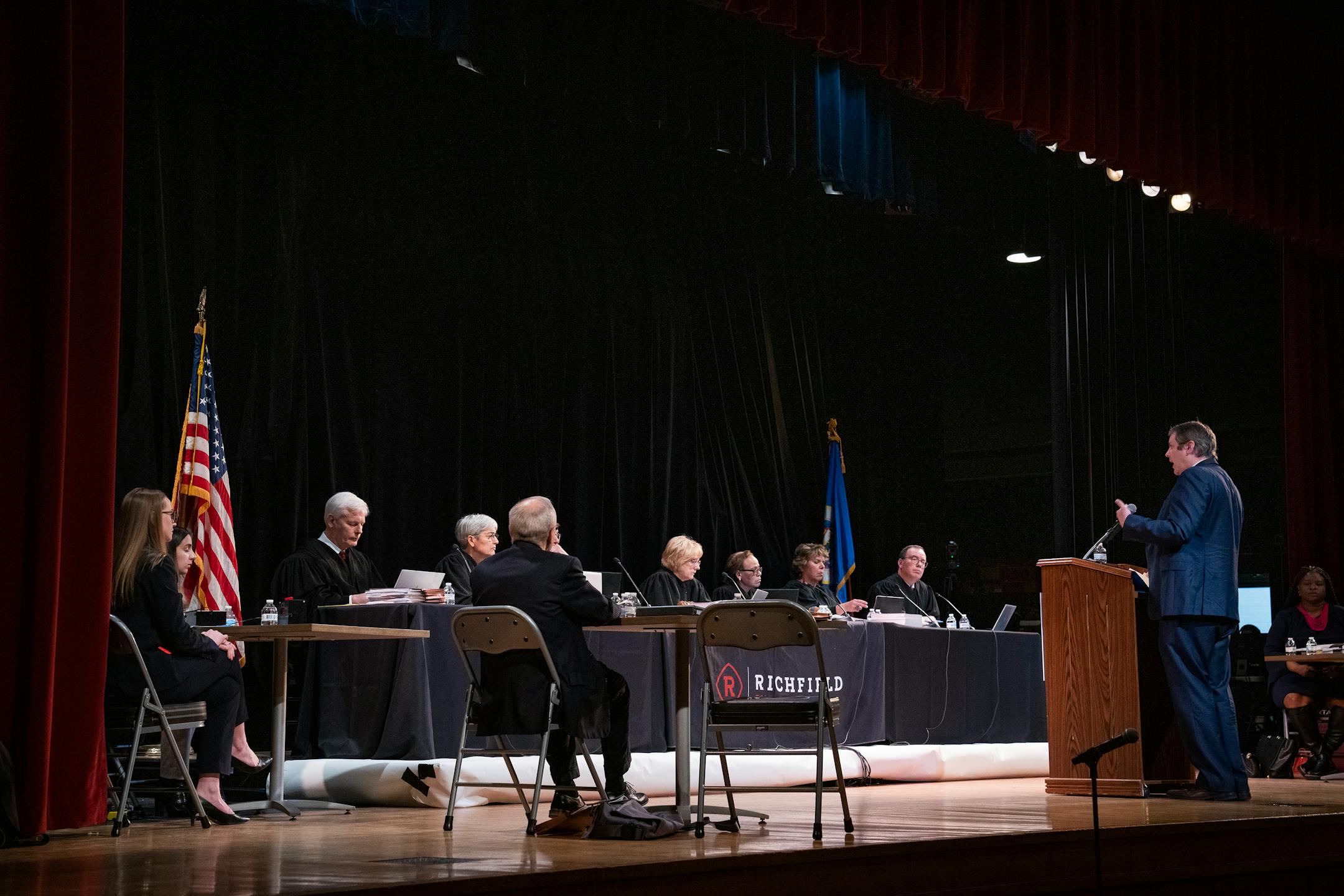
When the Cruz-Guzman case reached the Minnesota Supreme Court a second time, the court held a hearing at Richfield High School in May 2023. In this photo, attorney Richard Landon argues for the original plaintiffs, who contend the existence of segregated schools in the Twin Cities violates the state Constitution. (Leila Navidi/The Minnesota Star Tribune)
Advertisement

Controversies over social services fraud and immigration now dominate Minnesota politics, but a slow-moving court case affecting families across the state will steal the spotlight during the term of the next governor.

At issue: how Minnesota’s public schools are structured.

Some of the most prominent attorneys in the Twin Cities, including those in the state Attorney General’s Office, are conducting new depositions in a 12-year-old case over whether public schools in the Twin Cities have become so segregated by race that they violate the state Constitution.

The education clause in Minnesota’s Constitution says the state must “establish a general, uniform and thorough system of public schools and students have a right to receive an adequate education.”

But plaintiffs in a case known as Cruz-Guzman (named for a Minneapolis parent) say the increase of racial polarization in the Minneapolis and St. Paul public school systems means students are not getting an “adequate education.”

The question posed by the Cruz-Guzman case is a clash of market behaviors: When does the right to choose a school clash with the right of fair opportunity?

Or put another way: Has giving families the option to choose to enroll in schools that are not racially diverse turned out to violate the state Constitution?

The state of Minnesota is the named defendant, which means Attorney General Keith Ellison and his staff are leading the defense.

Advertisement

The case has drawn proponents of charter schools — many of whom cater to students along racial or ethnic lines — to file “friend of the court” briefs.

The outcome will influence Minnesota’s economy into the 2030s, 2040s and beyond.

I often express my belief in free markets and free trade in this column, which means philosophically I favor school choice. But I am amazed, in a bad way, at the racial polarization of schools in the Twin Cities.

Evidence using pre-pandemic data — the Cruz-Guzman suit began in 2015 — showed that about 1 in 5 Twin Cities area students attended a school in which the student body had fewer than 10% white students.

A few charter schools are the mirror opposite, with fewer than 10% students of color. In all, about 100 schools in the metro area are considered to be intensely segregated.

And so while I believe in school choice, here in the Twin Cities that market freedom has yielded schools that are siloed by race.

Advertisement

More important than school choice, it seems to me, is for students to learn in the environment they will need to succeed in when they join the workforce.

Critics of immigration twist themselves up over this. One moment they’re saying the problem with immigrants is they don’t integrate into American society fast enough, and the next they’re saying that they bring down test scores and reputations of their schools.

So do social justice warriors. One moment they’re talking about the need for school environments that affirm a racial or ethnic culture. And the next, they’re decrying the lack of opportunities for students with a limited exposure to life.

In December 2023, the Minnesota Supreme Court narrowed the focus of the case with a ruling that said plaintiffs don’t have to prove the state caused the segregation. Instead, justices said, “They must prove that racially imbalanced schools are a substantial factor in causing their children to receive an inadequate education.”

That sent the case back to state court in Minneapolis, where Judge Bruce Manning recently ruled plaintiffs couldn’t interview the state’s current education commissioner, nor some other recent commissioners. The sides met this past week to discuss how they plan to proceed ahead of a new trial expected later this year.

“We are all hopeful that this is going to be tried before this year is out,” said Dan Shulman, an attorney for the plaintiffs and a prominent figure in the Minnesota civil rights scene for decades.

Advertisement

He filed one school segregation suit against the state of Minnesota in the mid-1990s. It was settled in 2000 when a voluntary integration program was established between the two urban districts and those in some suburbs.

Since then, schools in the Twin Cities area have become more segregated. That’s largely due to the rise of charter schools, which were pioneered in Minnesota, as an alternative destination for public school students.

In September 2024, the Minnesota Star Tribune produced a series of articles about the woeful academic outcomes of the vast majority of charter schools in the Twin Cities. Often when the Star Tribune produces such watchdog journalism, legislators or state agencies take action. But nothing happened after that series.

I suspect legislators and the next governor will remain loath to tackle this difficult topic. Instead, the Cruz-Guzman case will likely wind through Manning’s court this year and next, an appeals court after that and probably be back in the Minnesota Supreme Court in 2028 or 2029.

Which makes it easy to predict that, by 2030, school choice and segregation will take over immigration as the battleground for Minnesota’s racial tensions and economic future.

about the writer

about the writer

Evan Ramstad

Columnist

Evan Ramstad is a Star Tribune business columnist.

See Moreicon

More from Business

See More
card image
Elizabeth Flores/The Minnesota Star Tribune

Waning consumer demand and volatile commodity prices have put pressure on poultry producers. Life-Science Innovations already owns other bird facilities throughout the state.

Todd Geselius, vice president of agriculture at the Southern Minnesota Beet Sugar Co-op, shows what a sugar beet looks like when it is harvested in the field on Sept. 9, 2015 in Renville, Minn. (Jim Gehrz/Minneapolis Star Tribune/TNS) ORG XMIT: 1175088 ORG XMIT: MIN1510142301350530
card image
Advertisement