Racial profiling concerns grow as ICE expands presence in Twin Cities

Advocates point to so-called “Kavanaugh stops,” brief immigration encounters based on appearance rather than evidence.

December 18, 2025 at 12:00PM
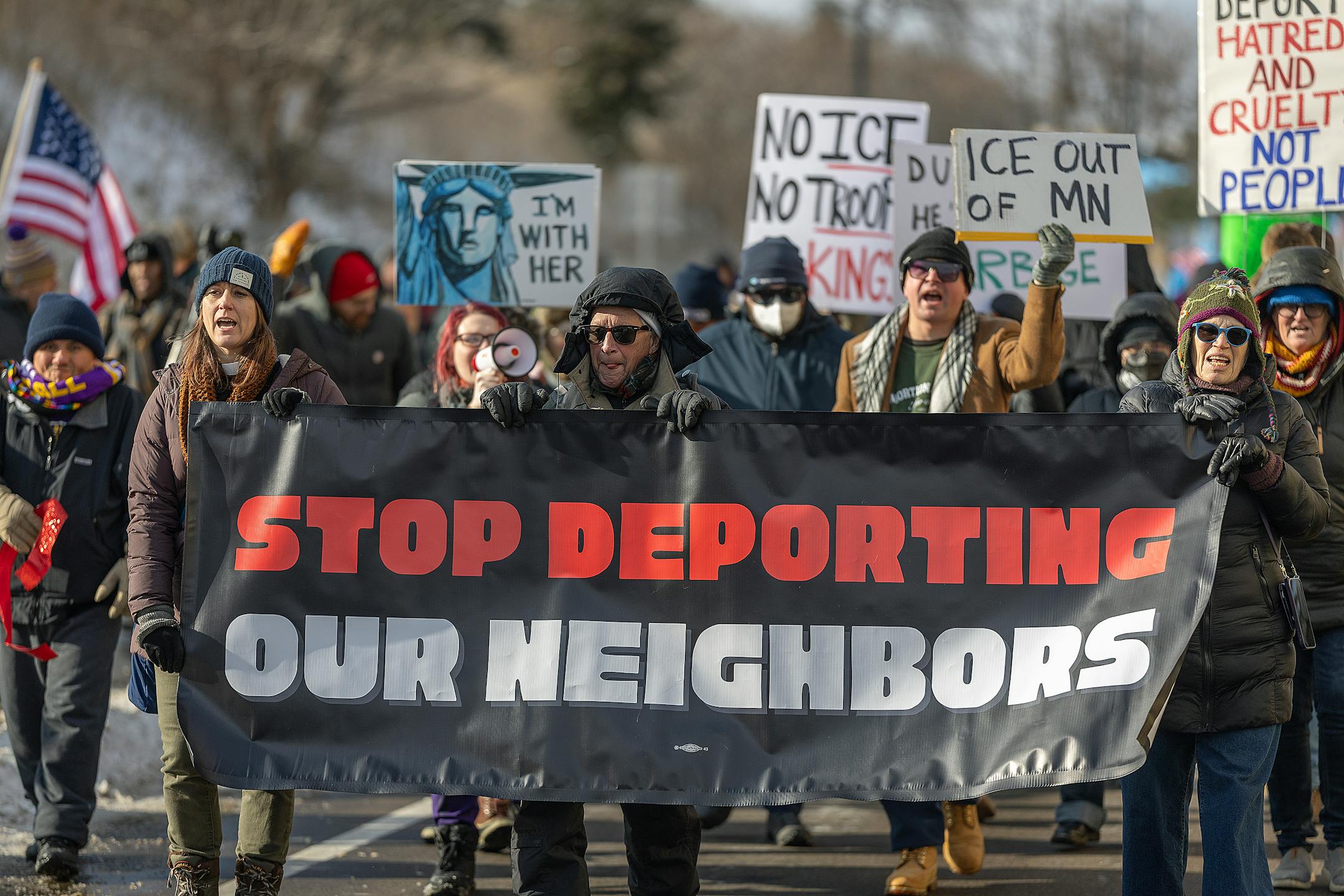
Marchers representing union workers and immigrants rights participate in a protest near Terminal 2 at Minneapolis-St. Paul International Airport on Dec. 3. (Elizabeth Flores/The Minnesota Star Tribune)

An 18-year-old Guyanese U.S. citizen had just finished a quick stop at a gas station near Hamline University in St. Paul when federal immigration agents approached him and demanded identification. His ID had expired, and the encounter quickly escalated into a tense standoff over proof of citizenship.

According to the student’s mother, whom the Minnesota Star Tribune is not identifying because of concerns about retaliation by immigration authorities, her son called from the parking lot and asked her to bring his birth certificate. She said agents allowed him to leave after she arrived and showed the document.

The stop was brief, but she said it left her family shaken.

The Dec. 12 encounter is among several in which U.S. citizens in the Twin Cities say they were stopped or detained by federal immigration agents despite asserting their citizenship. The actions come as federal immigration enforcement has intensified across the Twin Cities under Operation Metro Surge, a Department of Homeland Security initiative that has increased ICE’s visibility in public spaces.

Civil rights advocates say the surge is reshaping daily life in immigrant communities — including for U.S. citizens — and heightening fears of racial profiling.

“I think it’s the first time a population that’s overwhelmingly U.S. citizens are being harassed on U.S. streets,” said Jaylani Hussein, executive director of the Minnesota chapter of the Council on American-Islamic Relations. “It’s a dark day for America and a dark day for all of us.”
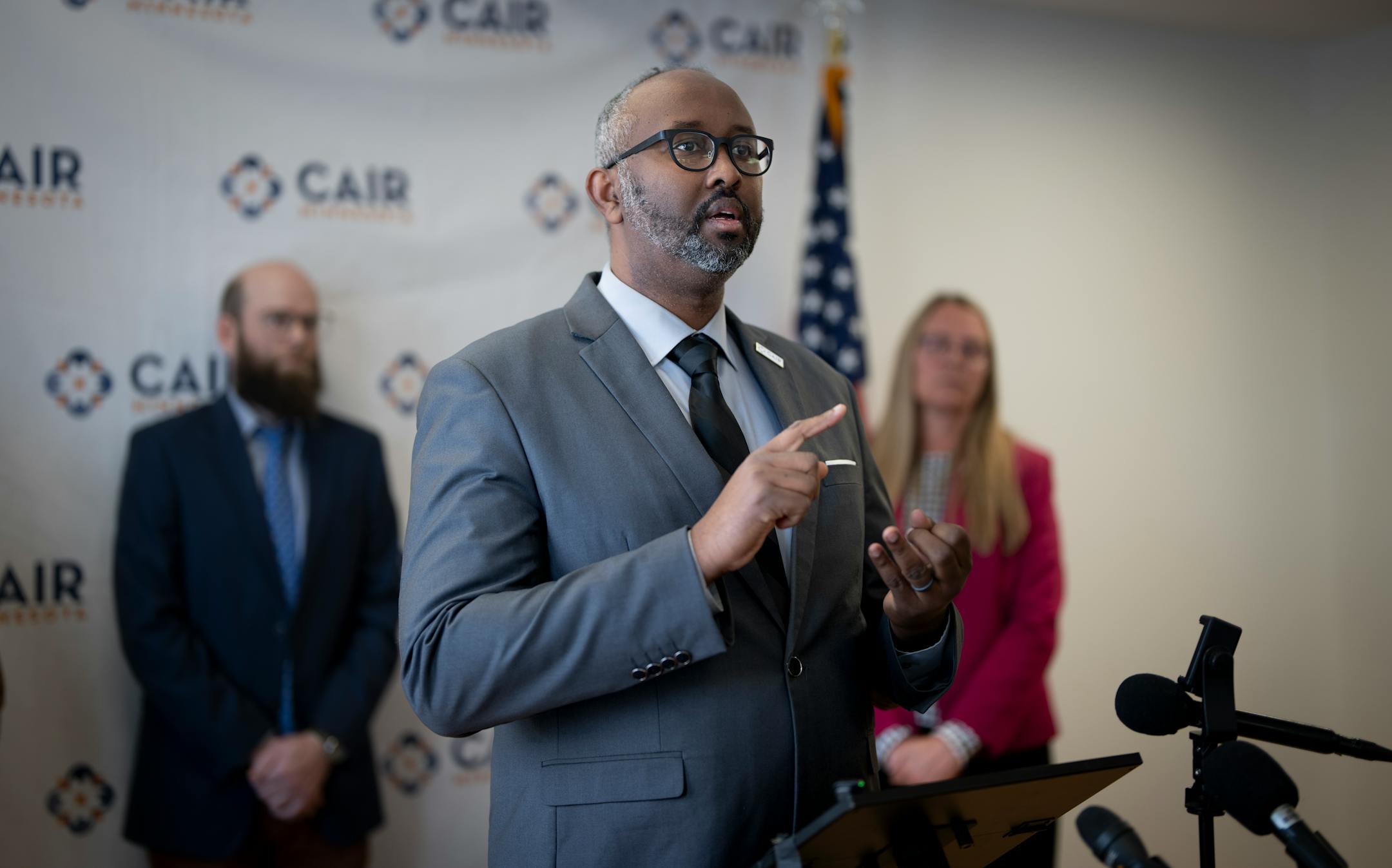
Jaylani Hussein, executive director of CAIR-MN, speaks about President Donald J. Trump’s threats to increase deportations of Somali’s in Minnesota at CAIR in Minneapolis on Dec. 3. (Renée Jones Schneider/The Minnesota Star Tribune)

Attorneys and advocates say the encounters are part of a growing national debate over how far federal agents can go in briefly stopping people based on their appearance, language or workplace. Critics say the practice has gained new momentum following a recent U.S. Supreme Court decision.

A week earlier, on Dec. 9, federal immigration agents tackled and detained Mubashir, a 20-year-old Somali-American man, in Minneapolis. Mubashir, who did not provide his last name for safety concerns, said at a news conference last week that he was held for about two hours despite repeatedly telling agents he was a U.S. citizen.

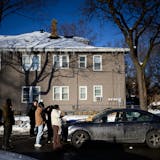
“What happened to me was unjust, uncalled for. I was simply on my lunch break,” Mubashir said.

Mubashir, 20, right, a Somali Minneapolis resident and U.S. citizen; Mayor Jacob Frey; and Police Chief Brian O’Hara watch a video of Mubashir's detainment by ICE agents during a news conference on Dec. 10 in Minneapolis. (Jerry Holt/The Minnesota Star Tribune)

U.S. Rep. Ilhan Omar said a similar encounter happened to her 20-year-old son over the weekend, when federal immigration officers pulled him over and asked him to prove his citizenship — a passport he “always carries” out of fear, she told WCCO. Omar said her son, who was born in the United States, has had multiple prior encounters with agents and accused ICE of racially profiling young Somali men.

In a Dec. 16 post on X, the Department of Homeland Security pushed back sharply, writing that “allegations that ICE engages in ‘racial profiling’ are disgusting, reckless and categorically FALSE. What makes someone a target for immigration enforcement is if they are illegally in the U.S. — NOT their skin color, race, or ethnicity.” The agency said its officers act under the Fourth Amendment and “use ‘reasonable suspicion’ to make arrests.”

ICE did not respond to requests for comment from the Minnesota Star Tribune.

A new term enters the immigration debate

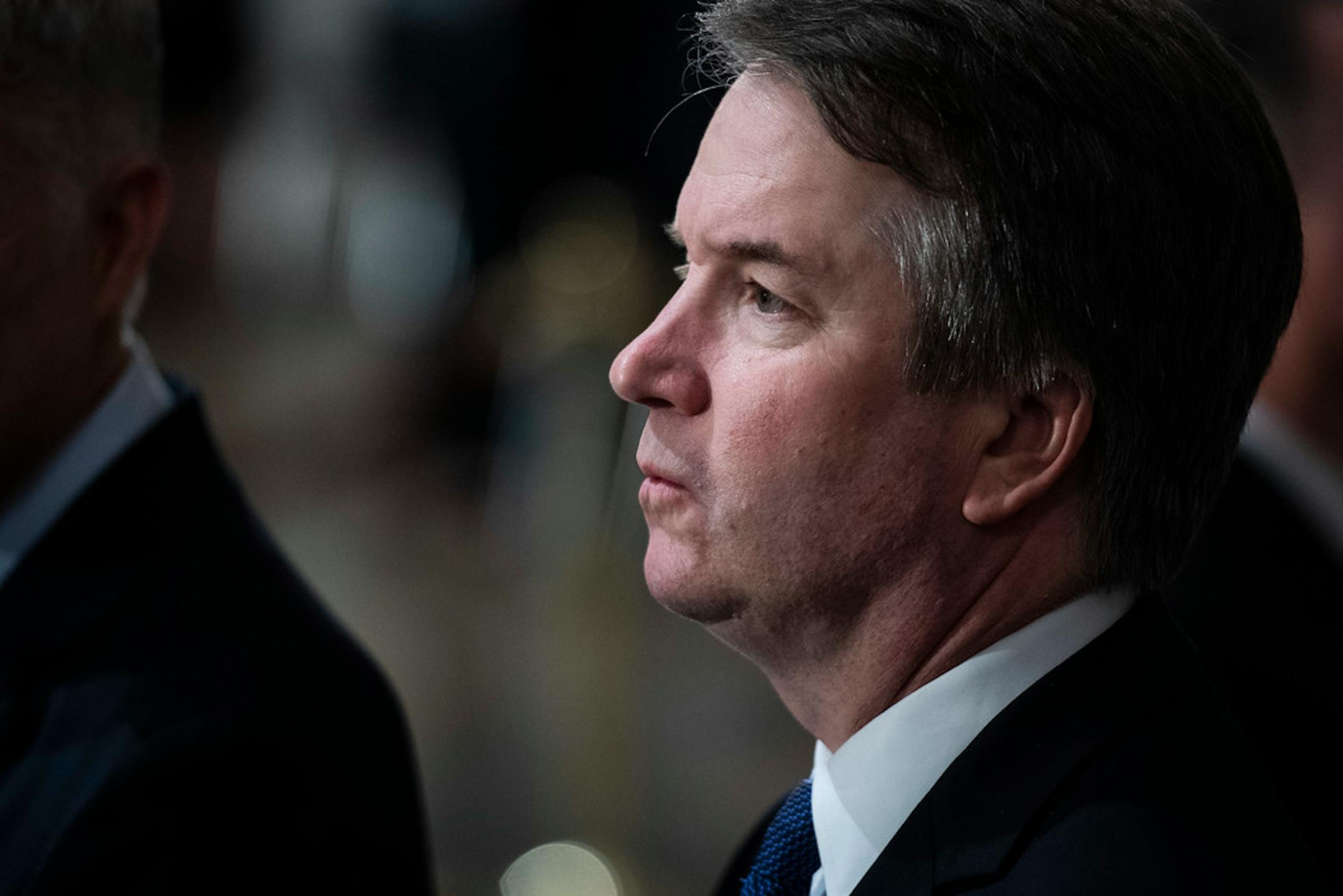
The term “Kavanaugh stop” refers to Justice Brett Kavanaugh, whose concurring opinion in a September Supreme Court case, Noem v. Vasquez Perdomo, has become a flash point as similar reports spread from Los Angeles to Minneapolis and St. Paul.

The September ruling temporarily lifted a lower-court injunction that had limited when immigration agents could conduct stops in the Los Angeles area while the case continues.

Although Kavanaugh wrote only for himself, attorneys say immigration officials across the country appear to be treating the opinion as if it were binding.

“These stops themselves seem to suggest that racial profiling is going on, or at least that the logic of ‘Kavanaugh stops’ is going on,” said University of Minnesota Law School professor Emmanuel Mauleón.

The underlying legal dispute centers on whether immigration officers can briefly detain people based on a combination of factors courts have traditionally viewed with skepticism.

In July, a federal district judge barred agents from stopping people based solely on apparent race or ethnicity; speaking Spanish or accented English; being at locations such as day-labor sites or bus stops; and appearing to work in jobs like construction or car washing. The judge found those factors alone did not meet the Fourth Amendment’s requirement for individualized reasonable suspicion.

The Ninth Circuit largely upheld that ruling. But on Sept. 8, the Supreme Court’s conservative majority agreed to temporarily lift the restrictions while the case proceeds, allowing immigration agents to resume the contested stops.

Kavanaugh issued a separate opinion arguing that officers must be able to consider factors such as ethnicity, language, location and type of work when assessing reasonable suspicion, and that limits on those considerations would “substantially hamper” immigration enforcement. He emphasized that such stops are typically brief and that lawful residents “promptly go free.”

The term “Kavanaugh stop” refers to Justice Brett Kavanaugh, whose concurring opinion in a September Supreme Court case has become a flash point in ICE's efforts. (Jabin Botsford/The Washington Post)

Lower courts, Mauleón said, had previously ruled that factors such as race, language and location alone were not enough to justify detaining someone.

“This is really a major turn in the doctrine if the Court were to adopt his position,” he said. “Because it would essentially be adopting the position that racial profiling, ethnic profiling, is reasonable under the Constitution, which no other court has said thus far.”

DOJ says order put officers in ‘straitjacket’

Federal officials have defended the enforcement tactics, arguing in court filings that the lower-court order blocking certain immigration stops “significantly interferes” with their ability to carry out large-scale operations.

In its petition to the U.S. Supreme Court, the Justice Department said the injunction imposed a “straitjacket” on immigration officers and “thwart[ed] enforcement of the immigration laws” across one of the country’s most populous regions.

The filing portrays the Los Angeles region — where the underlying case originated — as a critical hub for immigration enforcement and argues that officers must be allowed to draw on their training, experience and contextual clues when deciding whom to briefly detain.

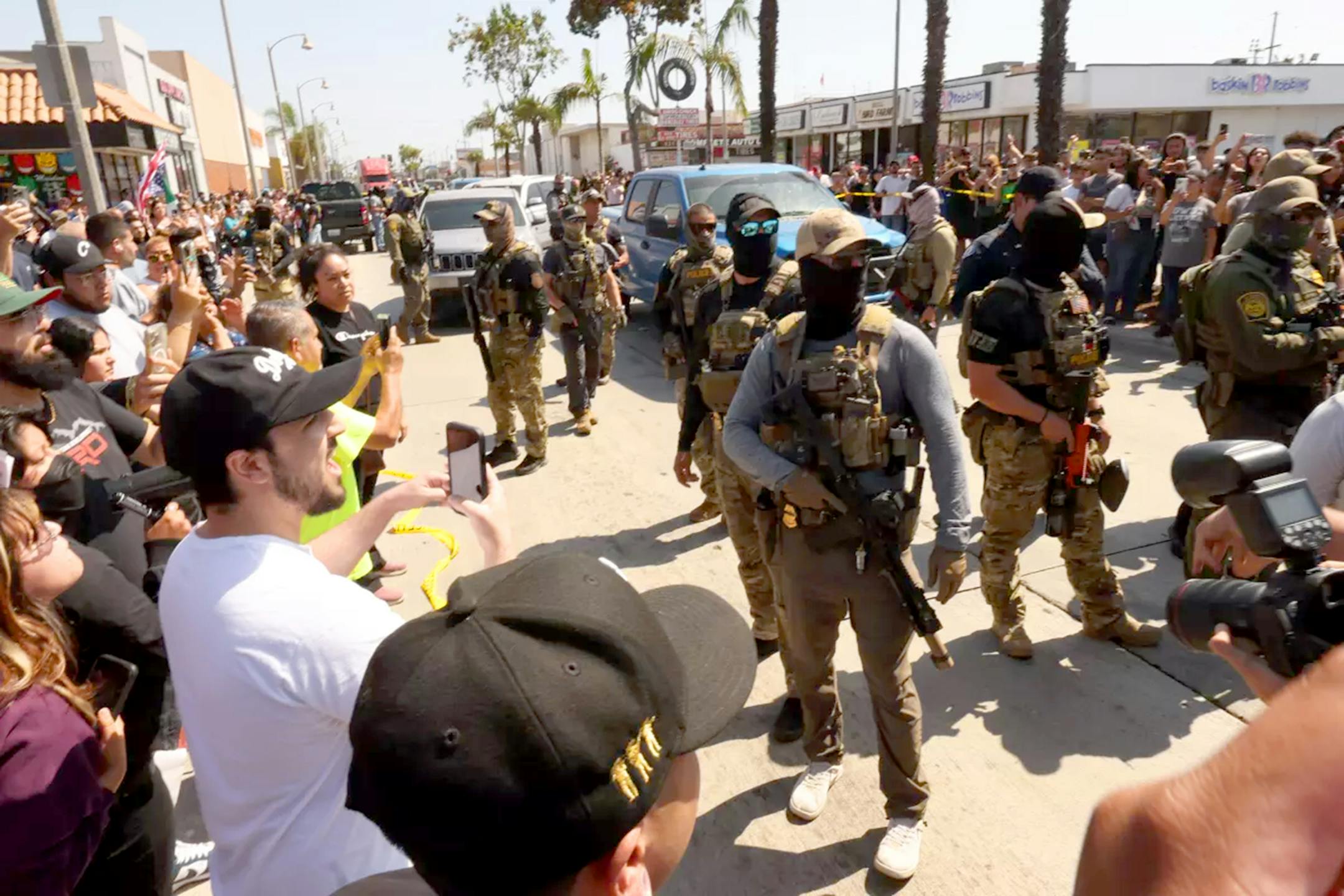
Residents surround ICE and Border Patrol agents in their neighborhood on Atlantic Boulevard in Bell, Calif., on June 20, 2025. (Genaro Molina)

The government wrote that even stops based on broader patterns or likelihoods were necessary in a district where, by its estimate, about one in ten residents is unlawfully present.

ICE, in recent statements, has said Operation Metro Surge is intended to remove “the worst of the worst criminal illegal aliens” from Minnesota communities and improve public safety. The agency, which has not provided a complete record of the individuals it has detained in Minnesota, has emphasized that many of those arrested have old removal orders or criminal convictions and that stepped-up operations are necessary to carry out federal mandates.

A framework critics say enables profiling

Critics say the real-world impact of the legal shift is already being felt.

To them, a “Kavanaugh stop” describes an encounter in which federal agents detain someone — often Latino or Black and working a low-wage job — and check their IDs or assertions of citizenship until they are satisfied, however long that takes.

Justice Sonia Sotomayor, joined by justices Elena Kagan and Ketanji Brown Jackson, argued in dissent that the Los Angeles tactics likely violated the Fourth Amendment, citing sworn statements of agents leaping from unmarked vehicles, racking rifles and detaining people without asking basic questions.

Although the case originated in California, advocates say similar dynamics are emerging in Minnesota.

“What we see in Minneapolis specifically is not an anomaly,” Mauleón said. “It’s a translation of this legal logic where we go from language being Spanish to Somali or accents in English.”

For many advocates, the recent stops of U.S. citizens underscore how quickly the enforcement surge is reshaping daily life.

Julia Decker, policy director at the Immigrant Law Center of Minnesota, said reports of brief stops have left many Minnesotans unsure how to protect themselves.

“Even when you know your rights and assert your rights, the agents of the federal government might violate your rights anyway,” Decker said.

She added that the surge has been marked by a lack of transparency.

“It is becoming almost impossible to get even a rough estimate of the magnitude of the problems because there is no sort of reporting on numbers of stops, arrests, detentions and people who are being taken away,” Decker said.

about the writers

about the writers

Emmy Martin

Business Intern

Emmy Martin is a business intern at the Minnesota Star Tribune.

See Moreicon

Sofia Barnett

Intern

Sofia Barnett is an intern for the Minnesota Star Tribune.

See Moreicon

Louis Krauss

Reporter

Louis Krauss is a general assignment reporter for the Star Tribune.

See Moreicon

More from News & Politics

See More
card image
Richard Tsong-Taatarii/The Minnesota Star Tribune

Court records show Gregory Holmes has a long and varied criminal history in Minnesota.

card image
card image