

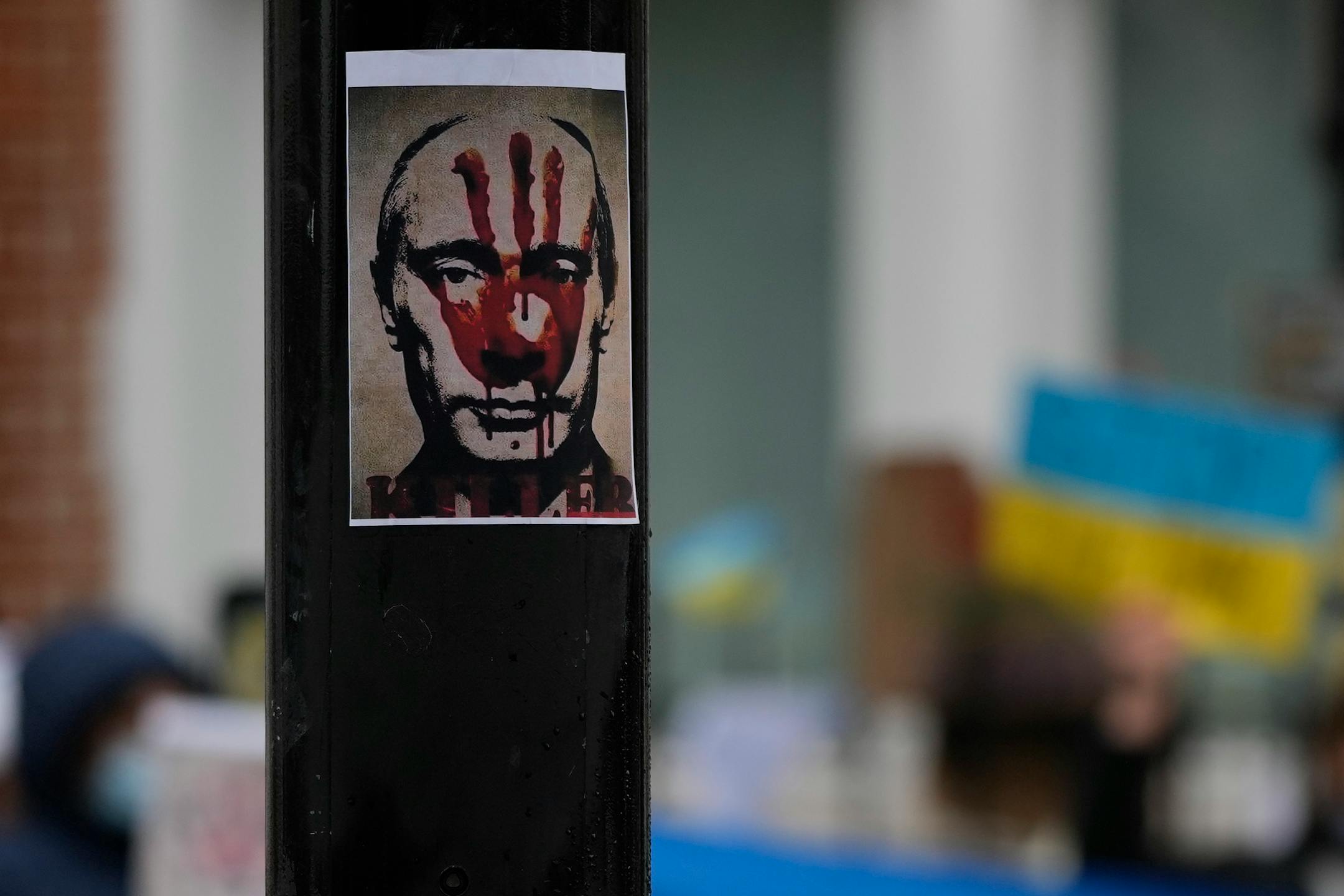
There was a time when Vladimir Putin seemed to see himself, not as the head of a re-created Soviet state, but as a czar — an omnipotent monarch ruling over a quiet, subservient, grateful populace.
"The monarch doesn't have to worry about whether or not he will be elected, or about petty political interests, or about how to influence the electorate," Putin said in "First Person," a biography published in 2000. "He can think about the destiny of people and not have to be distracted by trivialities."
When the biographer asked him whether the return of monarchy in Russia was possible, Putin answered: "You know, there's a lot that seems impossible and incredible, and then — bang!" Putin may liken himself to a czar, but the rest of the world now knows his true nature is even worse.
Actually, the world has suspected Putin's essence for a long time, but his brutal, bloody invasion of Ukraine has confirmed it. Putin is a despot, a brutish thug in the same ignominious pantheon as Bashar Assad, Robert Mugabe, Saddam Hussein, Idi Amin, Augusto Pinochet and Josef Stalin, the genocidal Soviet dictator whose image Putin has tried to rehabilitate in the eyes of Russians.
It's time that the rest of the world treats him the way it treats despots. With condemnation, isolation and no quarter. As of this writing, Russian troops have moved into Kyiv, Ukraine's capital. Desperate Ukrainians are either fleeing or readying Molotov cocktails and small arms to defend their homeland. Putin's illegal invasion is proceeding as planned, and while Russian soldiers have encountered stiffer-than-expected resistance, Ukraine's military forces cannot match Russia's troop strength and air superiority. Whatever happens, though, Putin is likely to inherit a fierce insurgency that could endure for years.
President Joe Biden has been careful to mete out sanctions against Putin and Russia so that every cudgel in the West's arsenal isn't prematurely expended. Late last week, Biden followed up on an earlier set of modest sanctions with more robust punishment, including imposing harsh penalties on Russia's two largest banks and shutting down the import of American technology such as semiconductors, lasers and telecommunications equipment, which are vital to Russia's aerospace, defense and shipping industries.
Sanctions against one of the banks, Sberbank, will shut it out of American commerce and bar it from transacting in U.S. dollars. The other bank, VTB, will have all of its assets in American financial institutions frozen. While those penalties carry heft, the utility of meting out sanctions against Russia may be reaching its end. Sanctions against the bulwark of the Russian economy, the country's energy sector, should be on the table. So should penalties against Putin himself. No one has yet to unearth where the Russian leader has stashed his billions, but tracking down his ill-gotten troves should be a top priority for the West.
The value of sanctions lies not just in potentially deterring Putin from further aggression in Ukraine. Sanctions also must be harsh enough to inflict lasting damage to Putin, his circle of corrupt billionaires and the Russian economy so that the Kremlin becomes vulnerable to blowback from the Russian masses. Regime change may one day stare Putin in the face. He wants it in Ukraine, but he may eventually get it at home.


