Opinion | We can build a path to peace if elected leaders cooperate

When I was sheriff of Hennepin County, we worked with ICE.

February 12, 2026 at 10:59AM
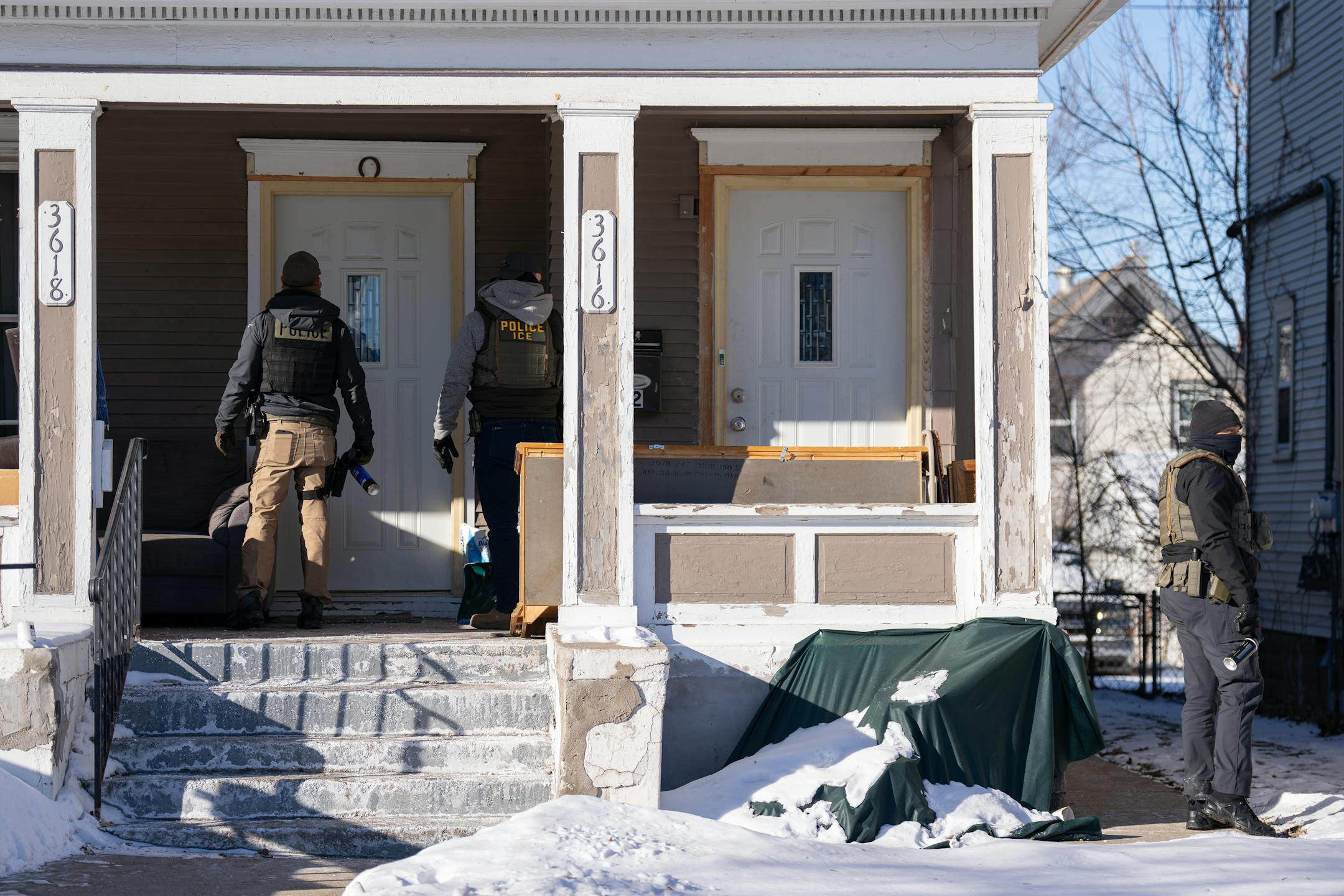
ICE agents knock on the door of a residential home in Minneapolis while holding cans of chemical irritants on Jan. 28. No one answered the door. (Alex Kormann/The Minnesota Star Tribune)

Opinion editor’s note: Strib Voices publishes a mix of guest commentaries online and in print each day. To contribute, click here.

•••

Back when Hennepin County was a safer place to live, go to school, visit or run a business, local police departments, county sheriffs’ offices and state law enforcement agencies worked to deliver nonpartisan public safety services — not just to citizens, but to all residents regardless of their legal status in the country.

When someone calls 911, they don’t expect to be forced to decide whether they want a red or blue variety of law enforcement services, or to decide between officers in blue, brown or maroon uniforms to answer their call for help.

I served as sheriff of Hennepin County from 2007 to 2018. During that time, we fully cooperated with ICE, arranged for an ICE office in the Hennepin County jail, allowed ICE to identify criminal illegal immigrants, and facilitated transfers of custody to federal authorities in a secure custodial setting.

We were safer then, too, due to a number of different factors. The violent crime rate (murder, robbery, assault and rape) in Minneapolis was 45% higher in 2024 than in 2018.

In 2020, the nation and the world witnessed mob violence in Minnesota’s largest cities and a dangerous breakdown of public order. The overheated tinder box in Minneapolis is not new, and dates back to before the death of George Floyd and the civil unrest that followed. Then and now, our local law enforcement officers have been told by elected officials to “stand down,” essentially allowing rioters to create chaos and violence in the interactions between residents, protesters and federal law enforcement officers.

Minneapolis police officers have become the object of scorn and hatred, and officers in various agencies have been blocked from fulfilling their duties to intervene. Hundreds of good police officers have quit and a large number of them have requested early retirement for post-traumatic stress.

Most officers, deputies and troopers don’t want to be used as a political tool or weapon; they became law enforcement officers to serve the community and swear an oath to serve and protect.

Too many elected and appointed leaders in Minnesota, especially in Minneapolis and St. Paul, have decided to weaponize and politicize policing services — to the great detriment of public safety. They need to step out of the way. Local police departments, sheriffs’ offices and state agencies in Minnesota all have a set of duties and responsibilities we need them to fulfill in order to restore calm and preserve the peace in our Minnesota communities.

Acting on behalf of federal law enforcement, White House border czar Tom Homan has requested three things, all of which are reasonable and fall squarely within the role of our law enforcement agencies, and all of which were in place prior to 2019.

First, an ICE detainer is a request, not a court order, to hold an inmate believed to be illegally in the U.S. Accordingly, Minnesota sheriffs are prohibited from holding any inmate in jail beyond their court ordered release. But sheriffs’ offices can notify ICE when an inmate with a detention request or order for removal is being released. By far the safest place for ICE to enforce an immigration order against a criminal illegal immigrant (who, after all, has been arrested and booked in jail for a serious criminal charge) is at the jail at the point of release.

By working with ICE to review jail records, sheriffs’ jail personnel can also assist in identifying legitimate suspects and clearing individuals wrongly suspected of immigration violations (due to misidentification, similar names, lack of fingerprints or aliases). It is the most dangerous policy of all to leave ICE with no other alternative but to search out and locate suspected individuals in our streets and neighborhoods. If we want this to stop, we must allow our sheriffs’ offices and jail personnel to assist them.

Second, local police and sheriffs’ deputies know our communities and residents better than federal law enforcement officers. Police and sheriffs must protect and respect our First Amendment right to protest. But they also have a duty to intervene in the event of threats or injury to officers, bystanders, lawful protesters or property damage to government facilities and equipment. Under different circumstances, the tragic deaths of Renee Good and Alex Pretti might have been avoided. We must allow our deputies and police officers to be on scene, to protect residents and officers and also allow ICE officers to safely do the job they have been directed and sworn to do.

Third, we must allow local law enforcement to work with ICE officers when they have to make a targeted enforcement action against a known criminal in our community. It is a myth that ICE officers are not trained law enforcement. Like every other officer in the U.S., ICE agents must follow the law. Every person regardless of their legal status is entitled to the constitutional protections of the Fifth Amendment, including due process and the right to a hearing in our immigration courts to determine whether they may remain. These courts have been in operation and funded by Congress for nearly 50 years; policymakers who disagree with the operation of these courts and enforcement operations have a political avenue for making change.

I also believe Homan and ICE would receive a greater level of cooperation by reassuring Minnesotans that they will not make an arrest in any of our homes without a warrant, unless there are clear legal exceptions (such as an emergency involving a threat to life). The constitutionality of these actions pose a significant legal question; we can and should take the time necessary to allow our courts to resolve them.

We can build a path toward peace and a return to “Minnesota Nice” only when our elected leaders first reaffirm respect for the law and follow up with reasonable and incremental steps toward cooperation.

Rich Stanek is a former Hennepin County sheriff and previously served as Minnesota’s commissioner for public safety. He is the principal consultant for the Public Safety Strategies Group.

about the writer

about the writer

Rich Stanek

More from Commentaries

See More
card image
Alex Kormann/The Minnesota Star Tribune

Is there still a place for us here in Minnesota? Place-based repercussions of the occupation.

card image
card image