

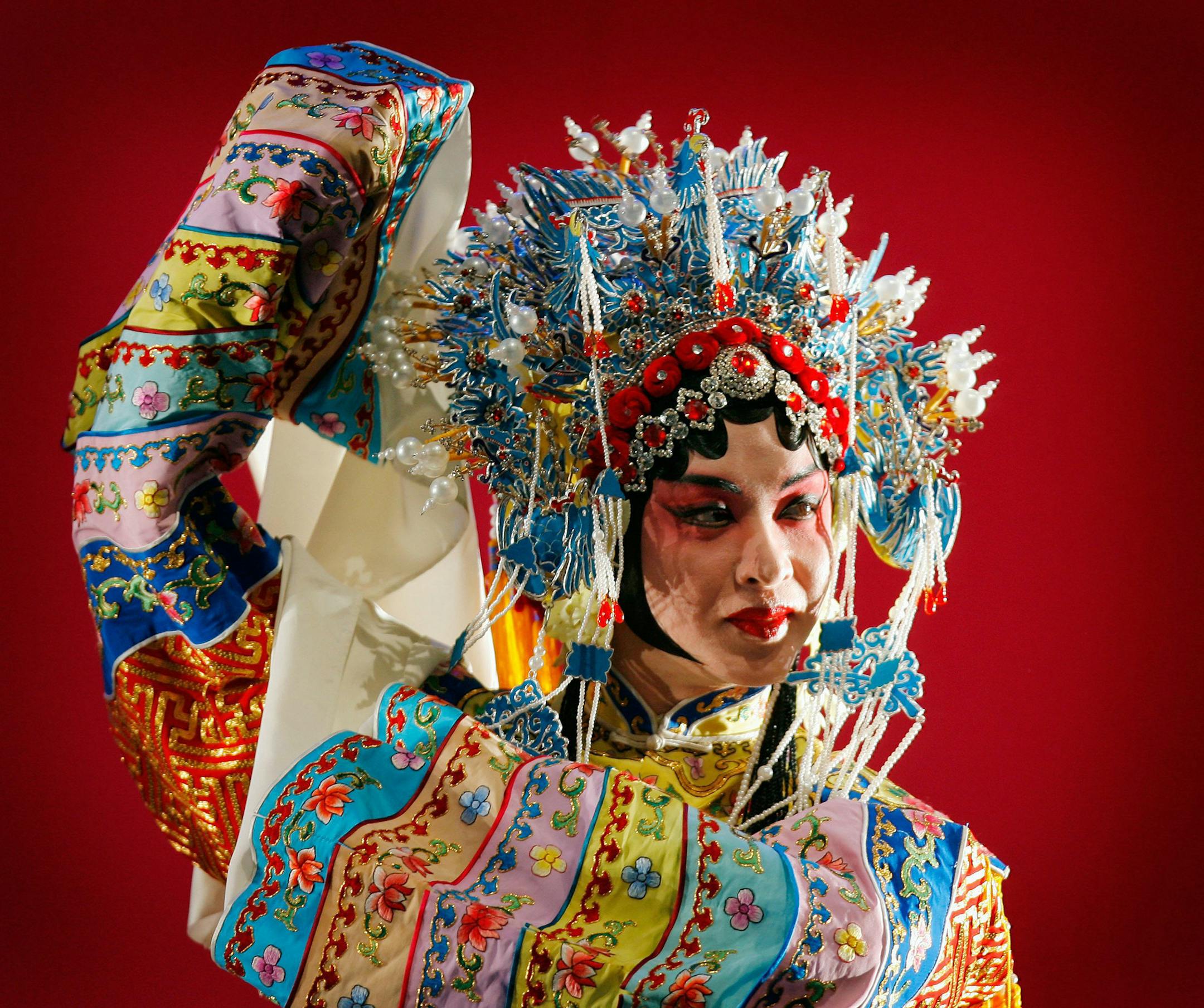
China's favorite chat-show host has had an extraordinary career. Jin Xing was the country's most successful dancer before becoming a colonel in an army entertainment troupe. He won fame in America, where the New York Times called him "a Chinese genius." He trained dancers in Brussels and Rome, before returning to China for sex-reassignment surgery. As a woman, she resumed her career as a ballerina, set up the country's first private ballet company, ran a bar in Beijing and married a German businessman.
In a conservative society where even homosexuality is frowned upon, let alone sex-reassignment, her life would seem to place Jin well outside the stodgy mainstream of Chinese broadcasting. Yet Jin, who is 49, is the country's most popular television judge.
She began with a local version of "So You Think You Can Dance" and hit the jackpot with "The Jin Xing Show," a variety and chat program with an audience of around 100 million. She has appeared with her husband on the Chinese version of "The Amazing Race," in which couples race each other around the world. Her latest venture, "Chinese Dating," is in its first season.
Jin's story reflects remarkable changes in Chinese society since her childhood. She joined the army at the age of 9 and endured a training regime that, as she puts it, would count as child abuse in the West. During her surgery, an oxygen shortage damaged her left leg so badly that doctors thought she would be lucky to walk again. Grueling retraining enabled her to resume dancing within a year.
Those struggles with adversity have helped Jin win favor among older Chinese, a more conservative cohort that is also, surprisingly, her biggest fan base. Many of them, too, have suffered enormous hardship — during the Cultural Revolution of the 1960s and 1970s, and the famine that followed the Great Leap Forward of the late 1950s, in which tens of millions died. Even those born after 1980 — roughly half the population — know well what their elders endured.
The tension between Jin's persona as a patriotic Chinese, and the one she displays as a globe-trotter with a foreign husband (in January she joined the global elite at the World Economic Forum in Davos, Switzerland), is one that is widely understood at home. The Chinese have become the world's great travelers. Over 100 million got visas for holidays abroad last year, more than the citizens of any other country.
Jin describes herself as having been "a little Chinese boy thirsting for the West." She writes of dreaming about Coca-Cola and freedom in Paris, or surreptitiously reading porn magazines and cruising gay bars in Greenwich Village. In her memoir, "Shanghai Tango," she says that in the gay communities of New York, she feels herself to be "a traveler in a foreign land twice over" — as a woman in a man's body and as a Chinese person abroad (who happens to be ethnic Korean).
In Belgium, she feels haunted by the Chinese words she sees on signs in the streets; their calls, she writes, "get louder and louder." She looks at a Ming vase at a market in Brussels and feels "ashamed" of Chinese who live abroad and have "only contempt" for their ancestral heritage.


