
New machine helps St. Paul patch potholes even when it’s cold outside

“January rains will bring pothole pain,” Public Works Director Sean Kershaw said during a recent street-patching demonstration.

The Minnesota Star Tribune
February 15, 2026 at 10:00PM
St. Paul Mayor Kaohly Her helps patch a pothole using mix from the city's new asphalt recycler. (St. Paul Public Works Department)

Potholes are popping like crazy in St. Paul — and elsewhere, too — and while it’s warm enough to feel like spring, it’s still too cold to get hot asphalt to fill the pesky craters.

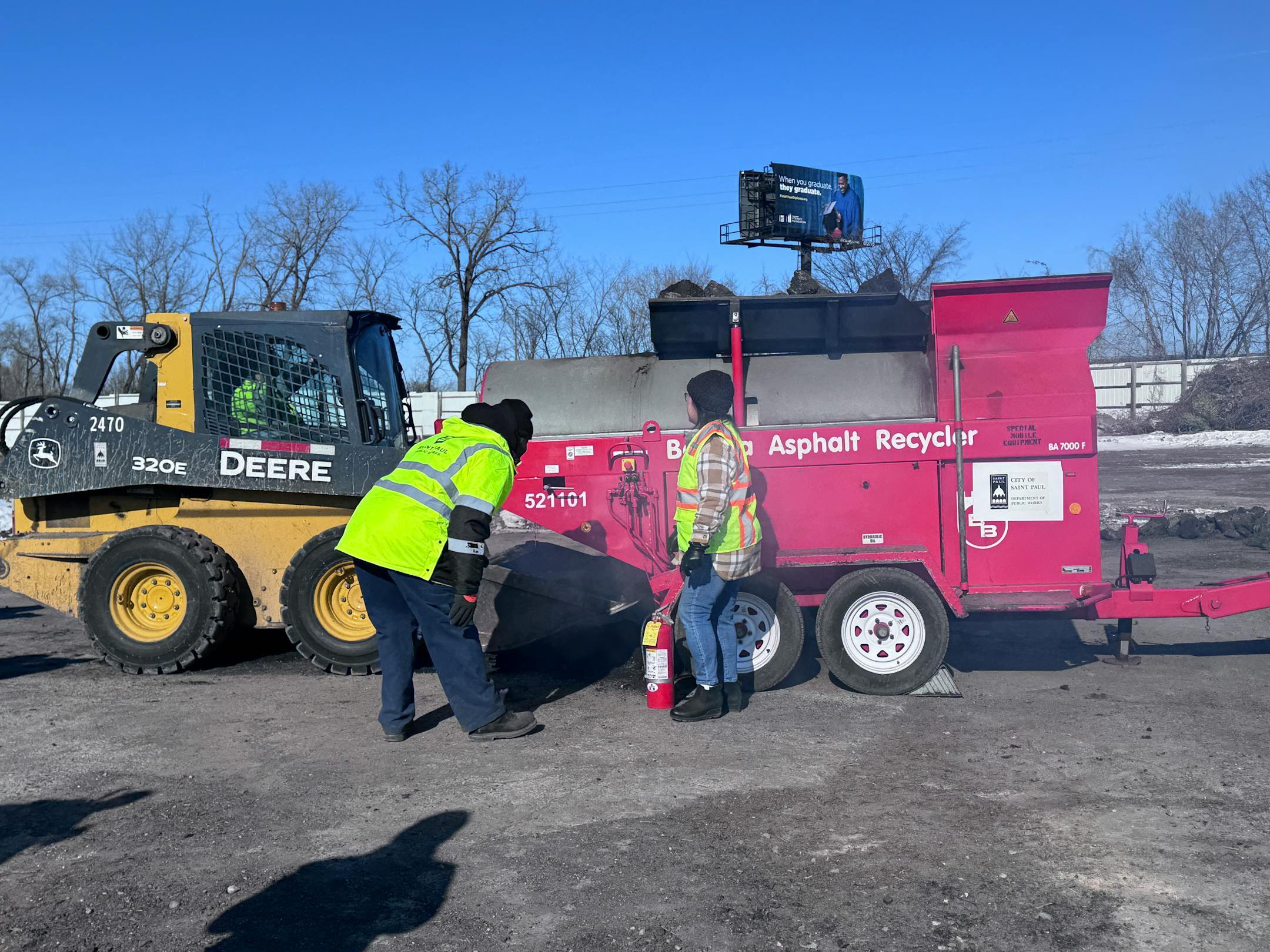
Enter the asphalt recycler, a machine that heats used asphalt into a “hot patch,” allowing crews to apply a more durable repair during the winter until a more permanent fix can be made.

St. Paul bought what’s called the Bagela Asphalt Recycler, and the city has been using the portable unit for the first time this year to keep up as big divots are appearing.

“January rains will bring pothole pain,” St. Paul Public Works Director Sean Kershaw said during a pothole-patching demonstration a few weeks ago. “This is going to be another bad season of potholes,” he told the Drive in a phone call.

The city uses what’s called a “cold mix” during winter months. Kershaw described it as being like bubble gum that fills potholes, but it does not last. When the weather warms, the city fires up its asphalt plant and makes hot mix asphalt, which bonds to the pavement to provide a more solid and long-lasting fix.

The blacktop mixture created with the recycler is somewhere in the middle. Chunks of previously used asphalt are put in the machine, crushed, fused together with a binding agent and heated up.

“It’s not as good as the hot mix that comes out of our plant,” Kershaw said. But, he added, “it’s more binding [than cold mix], durable and stays longer.”

Cold, snow, rain and periodic warm-ups this year, combined with aging streets, have created the “perfect recipe” for a bumper crop of the menacing depressions.

He points to the “Rough Road” signs the city has posted on Vandalia Street between Interstate 94 and University Avenue to warn drivers. Portions of Shephard Road and Summit Avenue are quite bumpy, too.

Kershaw said the city is triaging and tackling the worst ones first. Workers are coming in on overtime on weekends as the city tries to stay ahead of things.

“It’s going to be another long season of pothole repairs,” he said.

About the canceled I-94 closures in St. Paul

Nobody really wants to work outside in subzero weather, so it was understandable when St. Paul called off planned closures of I-94 on the city’s East Side on two consecutive weekends in January.

Then the Feb. 6-8 closure was scrubbed, too, but weather was not the issue.

As it turns out, crews attempting to place beams on the new Kellogg Boulevard/3rd Street Bridge ran into a snafu. The contractor was unable to get the trailer carrying the precast concrete beams into place where a crane could safely pull them up and drop them into place, said Brent Christensen, a bridge engineer for the city.

“It’s a quite a process,” Christensen said.

Over the weekend, Lunda Construction brought in specialized equipment to get each of the eight beams into a location where a pair of cranes picked them up and were able to “walk” them into place, Christensen said.

The work was further complicated by tight conditions, a seven-lane freeway and challenging topography, Christensen said.

Each of the eight beams are 8 feet tall, 3 feet wide and weigh about 250,000 pounds. Just getting them to the bridge site was a challenge, Christensen said.

The beams were so big that when they arrived from Elk River, they had to be trucked through downtown St. Paul on Kellogg Boulevard instead of staying on I-94.

“They had had to go downtown because they could not make the turn on the freeway,” Christensen said.

about the writer

about the writer

Tim Harlow

Reporter

Tim Harlow covers traffic and transportation issues in the Minneapolis-St. Paul area, and likes to get out of the office, even during rush hour. He also covers the suburbs in northern Hennepin and all of Anoka counties, plus breaking news and weather.

See Moreicon

More from News & Politics

See More
card image
Leila Navidi/The Minnesota Star Tribune

More than 1,000 agents have left Minnesota as many sheriffs say they haven't changed their policies in regards to working with federal authorities.