
Opinion | In challenging times, Somali teens are cultivating beauty in Cedar-Riverside

A recent tour of the Minneapolis neighborhood highlighted both the inspiring efforts to rejuvenate it as well as the difficult issues it is grappling with.

November 29, 2025 at 7:29PM
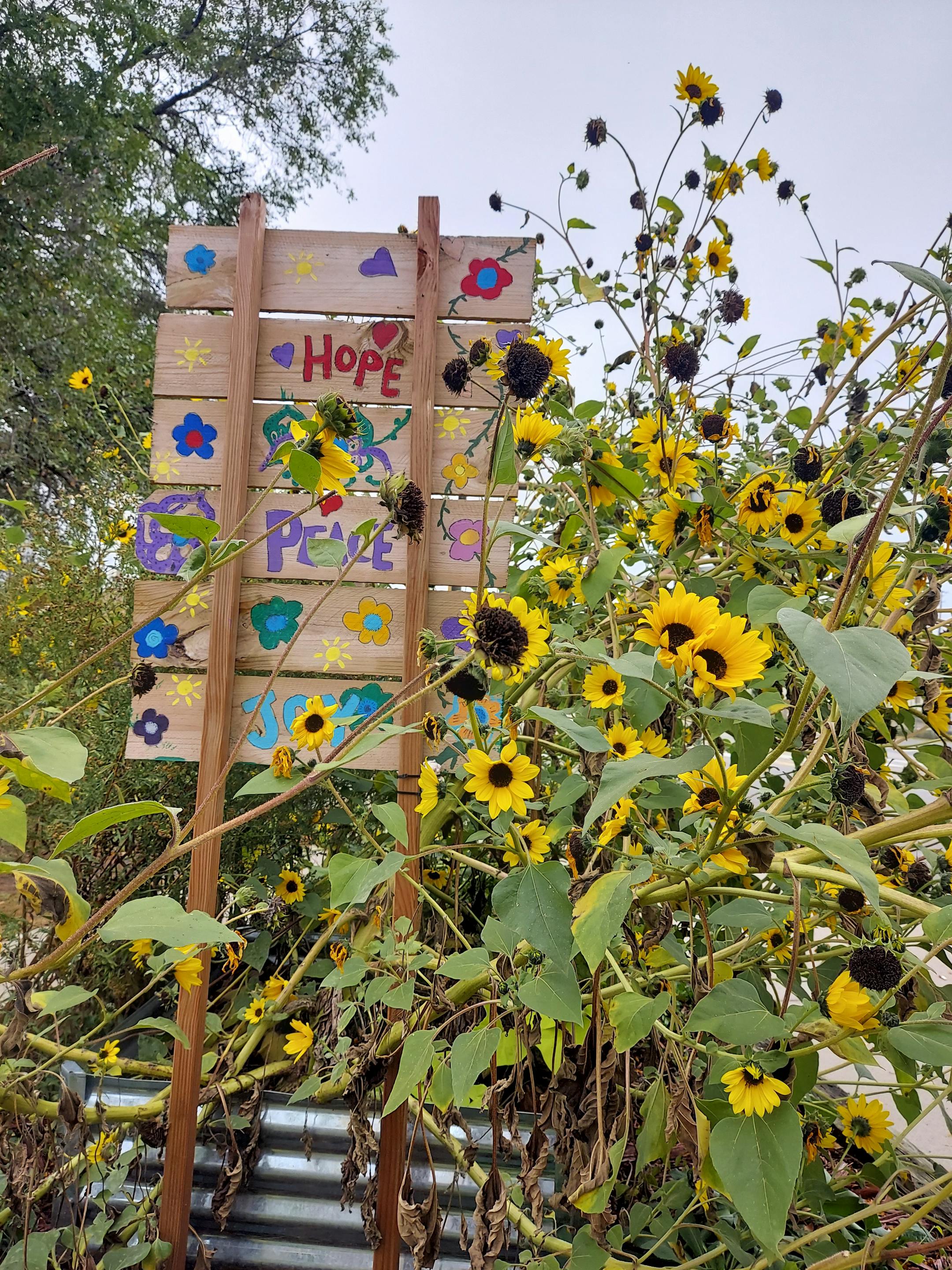
A sign reading "Hope" and "Peace" stands in a bed of sunflowers
"Ground Work’s mission is to reclaim blighted parts of Cedar-Riverside — corners fallen into disrepair, empty lots blown through with garbage, alcoves that have become narcotics hubs," Will McGrath writes. (Will McGrath)

Opinion editor’s note: Strib Voices publishes a mix of guest commentaries online and in print each day. To contribute, click here.

•••

On a glorious autumn afternoon, I went down to Cedar-Riverside, the cultural heart of the Somali American community in Minneapolis. I’d come to learn about a new program called Ground Work created by Jennifer Weber, a coach and community organizer. Weber runs the athletics and youth enrichment programs at the Brian Coyle Community Center and is a beloved and well-connected figure in the neighborhood — the kind of person who knows the name of every kid who passes through the rec center, knows their families, asks after hooyo and auntie and how big bro is doing at his new job. I worked for Weber as an assistant basketball coach a few years back and knew some of the kids involved in her new project.

“You’re going to want to see this,” Weber texted me.

Outside the Coyle Center, I found a group of 10 bubbly Somali teenagers fidgeting with the nervous energy of kids about to give a class presentation. They were going to lead us on a tour. Along with me were Minneapolis Community Safety Commissioner Todd Barnette, members of the West Bank Business Association and other neighborhood stakeholders.

Ground Work’s mission is to reclaim blighted parts of Cedar-Riverside — corners fallen into disrepair, empty lots blown through with garbage, alcoves that have become narcotics hubs. The program is youth-led and culturally attuned. Funded by grants and community backers, Weber hired a team of motivated local teens and, after polling the neighborhood youth council about what parts of the West Bank felt unsafe, the group launched into a project of rejuvenation.

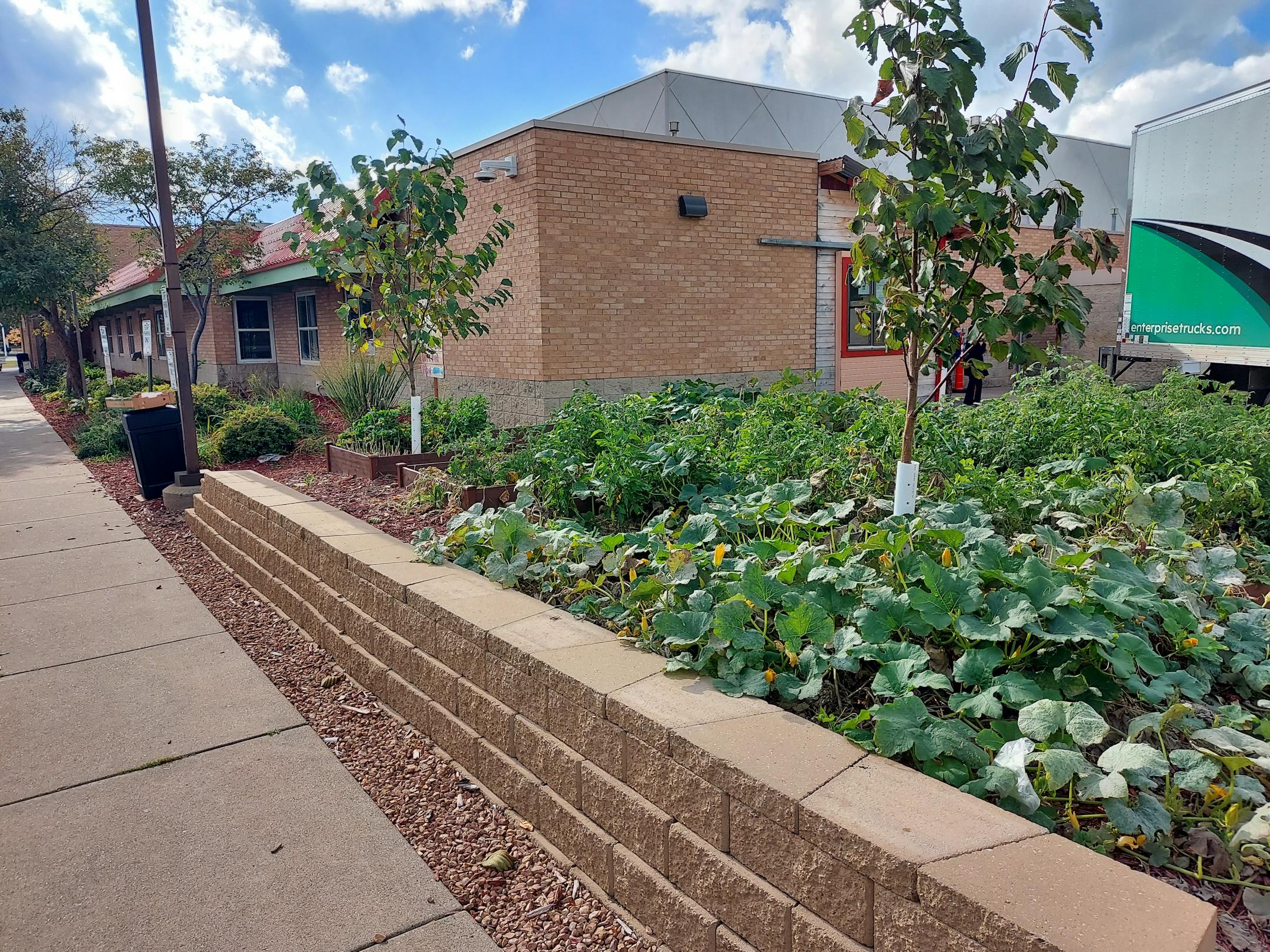
As the late afternoon sun lit up the towers of Riverside Plaza, we arrived at what had formerly been a dirt patch with a dead tree and was now a thriving food garden planted earlier in the season with tomatoes, cucumbers, watermelon, kale, lettuce and squash. One of the kids had the notion that it would be an ideal place for Somali elders to sit in the sunshine, so the group built a retaining wall for the garden with that height requirement in mind.

“That sitting wall was the best project,” Firomsa Sabsibe, one of the tour leaders, told me. “We see the elders sitting there every day under the tree.” Weber said the group didn’t even have to harvest the garden at season’s end. Neighbors plucked what they needed over the summer months, and by fall the garden had served its purpose.
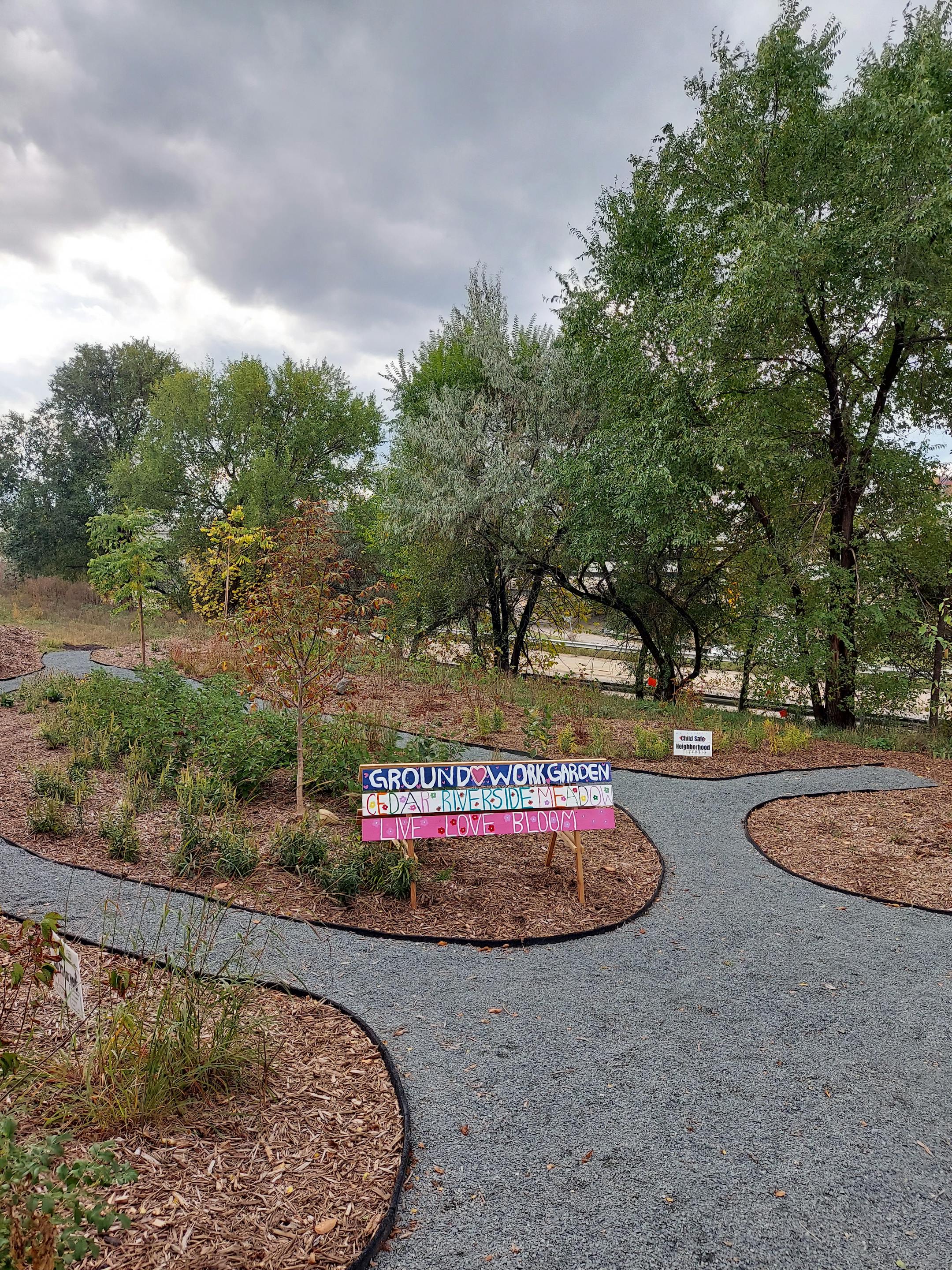
The kids eagerly led us through other locations that Ground Work had refurbished. Most stunning was the transformation of what had formerly been a large homeless encampment and the site of a 2023 homicide. The land was tucked into a dead end where light rail tracks and Interstate 35W cut through the neighborhood. Over the course of several months, the kids had landscaped the terrain into a verdant meadow packed with wildflowers and gravel walking paths, which the group hoped would draw parents and grandparents for their afternoon walks.

The newly landscaped "meadow" and walking paths, formerly the site of the homeless encampment. (Will McGrath )
Ground Work's community food garden and newly built retaining wall.
Ground Work's community food garden and newly built retaining wall. (Will McGrath)

Along the tour, Weber gestured to a towering effusion of sunflowers that nodded over us. “We didn’t even plant those,” she said. “Those sunflowers volunteered. We just cleared the space for them.”

But not everything was copacetic in Cedar-Riverside. Midway through the tour, we came to Edna’s Garden, a tiny lot hidden behind the Wienery. The space is obscured from major thoroughfares, which makes it a natural hotbed of narcotics activity. But the youth council and Ground Work had targeted Edna’s Garden as a top priority for reclamation. It was the primary walkway from the towers through to Cedar Avenue, where kids were dispatched daily on family errands. As we arrived, a knot of six or seven people were engaged in narcotics use, and the tour came to an awkward halt.

“Hey!” Weber barked out in her coach voice. “We need this to be a safe space for kids.” Then a young Somali woman broke off from the tour leaders, approached the group and spoke quietly with them. After a moment the group disbanded, with a few people briefly joining the tour themselves to hear about the plans for Edna’s Garden. There are walking paths to come and flowers to plant. “We’re going to keep coming back to do this work,” Weber told us. “And we don’t give up.”

Later, I asked Weber about the young woman who had broken up the drug circle.

“That’s Hodan,” Weber said, laughing. “She’s the boss lady.”

A few weeks later, I returned to meet her. Hodan Yusuf is a 28-year-old community connector. While a squad of teenagers pried up rotting timbers and wheelbarrowed dirt down Cedar Avenue, Yusuf sat with me and described how working for the program had changed her life.

In her mid-20s, Yusuf haunted the corners of Cedar-Riverside in active addiction. But in 2023 she dedicated herself to inpatient treatment, then outpatient treatment, and got clean. A mutual friend connected her to Weber, who hired Yusuf as the restorative justice coordinator for Ground Work’s pilot season in 2024.

In this role, Yusuf was authorized to reach out to drug users and employ them for daywork, offering stability, purpose and income. Her past made her a particularly effective liaison. “I know a lot of people in this neighborhood who are struggling with addiction,” Yusuf told me. “How can I get them back to work instead of tearing apart the community?” She felt energized by the process of revitalizing a place where she had once gone astray. “I’m trying to give an example to my old friends that you can turn your life around and do better by the community.”

As we talked, a man came by looking to work, someone Yusuf knew from her darker days. The afternoon light was falling, so she couldn’t offer him hours, but she told him to return the next day and then gave him a plate with chicken suqaar from Sagal, a local café. During workdays, Weber purchased the dish in large serving trays — fuel for Ground Work’s hungry teen laborers — but they were happy to share with anyone invested in the neighborhood’s future.

While Ground Work appeared thriving in its second season, challenges remain. Early this spring, a funder backed out suddenly, leaving Weber to scramble for community support, delaying the start of the planting season. Narcotics abuse is still a major concern in Cedar-Riverside, with recent years seeing a spike in teenage Somali users. Weber told me that many of the users in the neighborhood were people she recognized as teens who had come through the rec center, and who were now ashamed to look her in the eye. But she believed they still had a place in the community.

For years, we’ve been hearing about all the ways that Minneapolis is dying and of constant predictions of ruin, like the secretly funded hit piece, “A Precarious State.” Yet what I saw in Cedar-Riverside was a model of the best Minneapolis can be. Ground Work operates as a site of joyful cultural exchange and interdependence. It’s an organization where the adult generation takes the concerns of the youth seriously and honors its elders. It’s a program where young people invest sweat equity in their community, and where people like Hodan Yusuf invite those grappling with addiction into the process of rebirth, rather than shunting them toward the next neighborhood.

As Weber kept repeating the day of the tour, “If we clear the path, look what beauty can grow.”

Will McGrath is the author of the books “Farewell Transmission” and “Everything Lost Is Found Again.” He lives in Minneapolis.

about the writer

about the writer

Will McGrath

More from Commentaries

See More

Our current energy inefficiency is risking the future our kids will inherit.

card image
card image