

Opinion | A Christmastime miracle?

As a third-grader, I was a very poor reader. But a Christmastime morning in a barbershop changed that.

December 25, 2025 at 10:59AM
"Yes, memory is fragile," Dick Schwartz writes. "But my recollection is that this was the first time I experienced pure elation, in a barbershop of all places, reading to a group of old Jewish men on a Christmastime morning." (Getty Images)

Opinion editor’s note: Strib Voices publishes a mix of guest commentaries online and in print each day. To contribute, click here.

•••

One morning a long time ago, during Christmas vacation from school, I was pretending to read “Oliver Twist” at Swaiman’s Barber Shop.

My mother would often conveniently deposit me there, where Mr. Swaiman allowed me to sit for an hour or two while she shopped and kibitzed along Plymouth Avenue. That was fine by me. Mom never knew that Swaiman’s was my safe haven.

Mr. Swaiman, a man of letters at heart, had fashioned his quaint barbershop to double as a veritable reading room, stocking it with several daily newspapers (English and Yiddish), weekly magazines and “fat books” for the grown-ups. For the kids, there were Classics Illustrated comics books. If you’re old enough, you might remember those: literary masterpieces in comic book form you could buy off the rack at Piggly Wiggly, neighborhood markets and drugstores for 15 cents and later, a quarter. Works like: “Don Quixote,” “Hamlet,” “Gulliver’s Travels,” “Huckleberry Finn,” “Alice in Wonderland,” “20,000 Leagues Under the Sea,” Uncle Tom’s Cabin,” “A Christmas Carol” and “Oliver Twist.”

As a third-grader, those comic books were nearly impossible for me to read. That’s because I was a poor — very poor — reader. At “read aloud circle,” most of my classmates were already reading “The Call of the Wild,” “Old Yeller” and “The Lion, the Witch and the Wardrobe.” But not me and a handful of others who were assigned to a hallway table with our skinny “Early Readers.” It was humiliating.

But not at Swaiman’s Barber Shop. There, I soothed my fragile ego by pretending to read just like real readers did: sliding an index finger across a page, tossing in an occasional chuckle or casual head nod. No one there knew the wiser. I was one of them.

On that particular morning, I was staring at an illustration in “Oliver Twist” depicting a gargantuan brute grabbing hold of the young orphan, Oliver. I still don’t know why, but just then, frustration and sorrow spilled over; I cried out something like, “I can’t read what’s happening!” and threw the comic onto the floor.
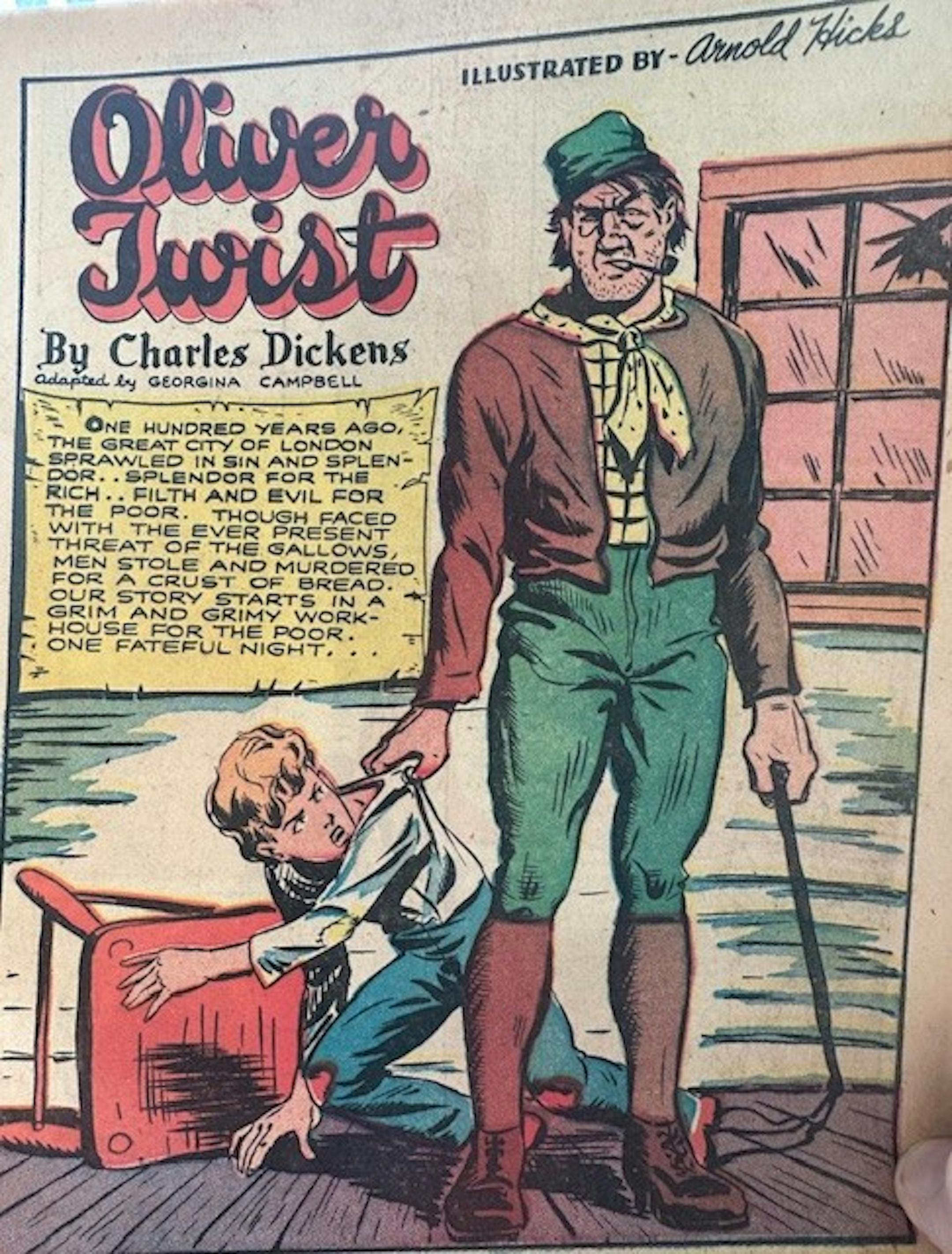
An illustration of "Oliver Twist" in a Classics Illustrated comic book. (Provided by Dick Schwartz)

Mr. Swaiman abandoned his customer, picked up the comic and sat down next to me. He didn’t say a word. I was only 7, but I knew he knew. Using his scissors, he pointed at the words below the illustration, enunciated their sounds, then had me repeat them several times that day, the next day, and the day after that, as well.

This is the passage: “One hundred years ago, the great city of London sprawled in sin and splendor, splendor for the rich, filth and evil for the poor. Though faced with the ever-present threat of the gallows, men stole and murdered for a crust of bread. Our story starts in a grim and grimy workhouse for the poor. One fateful night … ."

Each day, Mr. Swaiman would hand me the comic book and say, “go home, practice reading the passage with your mama and papa and come back to the shop tomorrow.”

I did. On the fourth morning, Mr. Swaiman ushered me onto his barber chair. Right then, my life changed. In his sonorous Russian dialect, he announced to the old-timers who read and smoked in his shop each morning, “Sha! Listen to the boy read Oliver Twist!” I’m sure I stuttered and stumbled through the passage, but when I finished, they cheered. “Mazel Tov!”

Yes, memory is fragile. But my recollection is that this was the first time I experienced pure elation, in a barbershop of all places, reading to a group of old Jewish men on a Christmastime morning.

Mr. Swaiman challenged me to read Classics Illustrated on my own and not to worry about how hard they were. “Just read,” he’d say.

Then Mr. Swaiman gifted me his “Oliver Twist” Classics Illustrated and sent me next door to Gertz Food Market with 15 cents. “Choose one you want to read,” he said. Naturally, I picked issue No. 26: “Frankenstein.” What 7-year-old wouldn’t?

You probably know what happened down the line: Four or five years later, along came Sports Illustrated and (my well-hidden stockpile of) Playboy magazines. The nearly completed set of Classics Illustrated I’d collected was demoted to basement storage. There, they collected dust until after I left home for good, until Mom inadvertently tossed away all 169 issues during one of her impulsive decluttering episodes. Mr. Swaiman’s “Oliver Twist” was one of them.

When you get old, an urge to replace long-lost artifacts that defined who you were, and perhaps still are, swells within you: a cherished Christmas tree ornament or menorah, a (now-vintage) Wilson A2000 baseball glove, a certain record album that will forever remind you of that once-upon-a-time coming-of-age summer.

This holiday season, after much searching, I found and gifted myself a duplicate copy of Mr. Swaiman’s “Oliver Twist.”

I carefully turned the brittle, musty pages. There it was, looking exactly as I remembered it from 67 years ago, the passage I read, miraculously — because sometimes there’s no other explanation — in a barbershop of all places, to some old Jewish men on a Christmastime morning.

“Sha! Listen to the boy read ‘Oliver Twist!’”

Dick Schwartz lives near Chicago. He taught for many years at Southwest High School in Minneapolis.

about the writer

about the writer

Dick Schwartz

More from Commentaries

See More
card image
Getty Images

As a third-grader, I was a very poor reader. But a Christmastime morning in a barbershop changed that.

card image
card image