

‘Super seniors’ boost public school enrollment. Who are they?

Students without enough credits to graduate but who return to school to earn their diplomas also are part of school district enrollment tallies.

The Minnesota Star Tribune
August 17, 2025 at 7:03PM
Adriana Lopez, who is from Guatemala, tackles a writing exercise at LEAP High School in St. Paul in September. Immigrant students like Lopez often take courses at LEAP High after their 18th birthdays. (Leila Navidi)

A little-known segment of students are boosting enrollment numbers at several dozen school districts across Minnesota.

“Super seniors” — students who did not graduate from high school in four years but continue to work toward their diplomas — are a fluid addition to public school populations from Rochester to the Twin Cities to Duluth.

Minneapolis and St. Paul public schools both posted surprise gains in student numbers in 2024-25 — and super seniors were key to the rise.

The students, who take extra learning to a fifth, sixth or seventh year, earn their credits, and off they go.

“The [school] numbers are up, but it’s not ‘count upon it’ growth,” said Hazel Reinhardt, a former state demographer who first pointed to the added presence of the students when making enrollment projections this summer for the Minneapolis and St. Paul districts.

The financial boost that such students can bring to a district can be fleeting, as such, if one simply were concerned with the system’s bottom line. At the same time, educators argue these are kids determined to graduate and the districts are providing every opportunity to do so.

“St. Paul does not give up on kids,” Adam Kunz, an assistant superintendent for the state’s second-largest district, said recently.

Continuing students are included in a district’s 12th-grade student count, and in the case of special-education students, can build life and career skills at school until their 22nd birthday.
Super seniors around the state and suburbs

Detailed statewide numbers are hard to come by, but rough estimates suggest the total number of returning students hit a 10-year high in 2024-25.

However, the state Department of Education said last week it cannot differentiate whether those students boosting its 12th-grade counts are there for the first time or are repeating that grade.

In addition, the agency noted that the percentages of high school students in the classes of 2020 to 2024 who continued their education into a fifth year has steadily declined from 8.7% in 2020 to 7.6% in 2024.

Reinhardt, who cited learning difficulties associated with the COVID pandemic as a potential factor in last year’s rise in returning students, estimated that Minneapolis had more than 600 such kids in 2024-25, which would be about half of the district’s total grades K-12 enrollment increase, she said.

St. Paul, Burnsville-Eagan-Savage, Bloomington, South St. Paul and Brooklyn Center also ranked high in the percentages of returning students being served in the metro area. Super seniors are common, too, in Duluth, St. Cloud and Rochester.

Brooklyn Center reported recently that 30 students graduated during summer school and that it expected to have 56 returning students this fall. Some have only a few course credits left to complete, district spokeswoman Olivia Doeden said in an email.

Scott Croonquist, executive director of the Association of Metropolitan School Districts, who was unaware of the enrollment-boosting presence of super seniors, said: “I think it’s a positive that these students are staying and continuing to work to get the credits they need to graduate. They’re sticking with it.”

Countdown to graduation

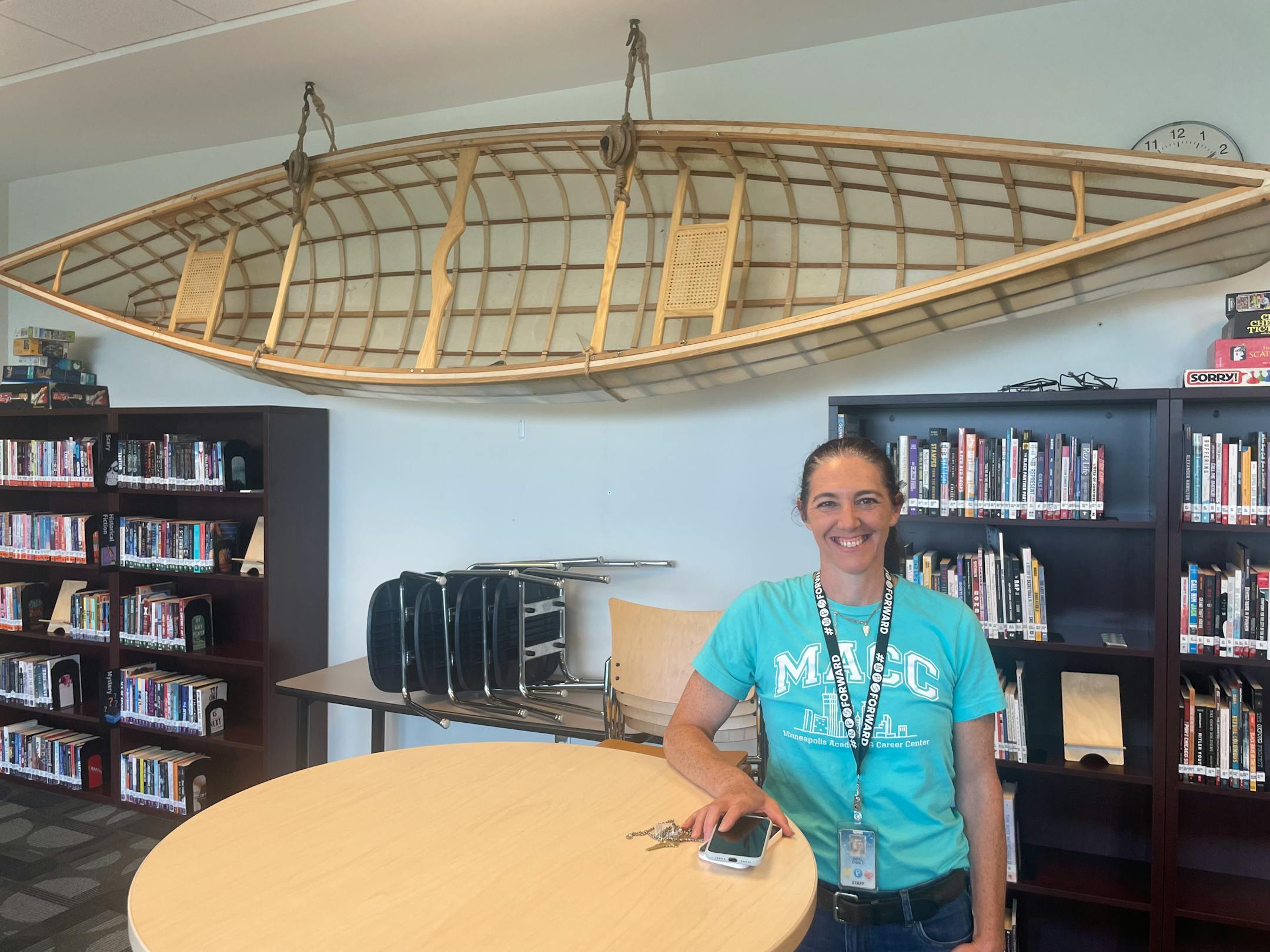
Minneapolis Academy and Career Center (MACC) is an alternative school housed in the Davis Center, the district’s central offices. There, students catch up on credits and seize opportunities to study for free in college — all as part of what director Opal Ehalt describes as a family atmosphere.

Opal Ehalt, director of contract alternative programs at Minneapolis Public Schools, says students taking part in a credit recovery program at district headquarters built a canoe two years ago without ever having been in one themselves. They earned credits toward graduation while sparking the interest of Davis Center staffers. "They felt really proud," she said. (Anthony Lonetree/The Minnesota Star Tribune)

“Every single student has a different story about why they didn’t graduate,” she said.

Joana Hussein, 18, left Southwest High to help care for her late father as he battled cancer. She resumed her studies at MACC in April and plans to graduate in December. She praised math teacher William Olson for his collaborative nature and recommends that similarly situated students continue their studies.

“If you are a fifth-year senior, you shouldn’t be embarrassed,” she said. “Nothing in my life was off track. If anything, it’s better. I just spoke up and said, ‘I need to take the time that I need right now.’”

St. Paul had 2,556 students in its class of 2024, of which 331 continued their studies in 2024-25. They represent a mix of kids who are behind on credits plus English language learners — many fairly new to the country — and special-ed students learning how to work and to live independently.

“It is often the things that give us the most pride: Can you take care of yourself? Can you interact with others on a job site and be successful?” said Micaela Smith, principal of Focus Beyond Transition Services. Her school has 235 to 240 students and she expects numbers to grow as demand for special-education services increases.

Many students have talents to nurture and showcase. A Focus Beyond student with experience in robotics assisted in the creation of a popular mini-golf hole at St. Paul’s Can Can Wonderland. A recent graduate teamed with his dad to open Highland Popcorn, a nonprofit small-batch popcorn shop that will make its Minnesota State Fair debut this week.

Now, the district’s faith in its continuing students is evident in a webpage displaying not just its four-year graduation rates, but its seven-year data. There, you’d learn that in 2024 that 77% of students graduated in four years, and 86% who first entered high school five, six or seven years ago earned diplomas.

MaryJo Webster of the Minnesota Star Tribune contributed to this story.

about the writer

about the writer

Anthony Lonetree

Reporter

Anthony Lonetree has been covering St. Paul Public Schools and general K-12 issues for the Star Tribune since 2012-13. He began work in the paper's St. Paul bureau in 1987 and was the City Hall reporter for five years before moving to various education, public safety and suburban beats.

See Moreicon