
Advertisement

Minnesotans testify in federal court about racial profiling by ICE agents

The ACLU lawsuit accuses federal agents of unlawfully targeting Somali and Latino residents.

The Minnesota Star Tribune
February 18, 2026 at 9:17PM
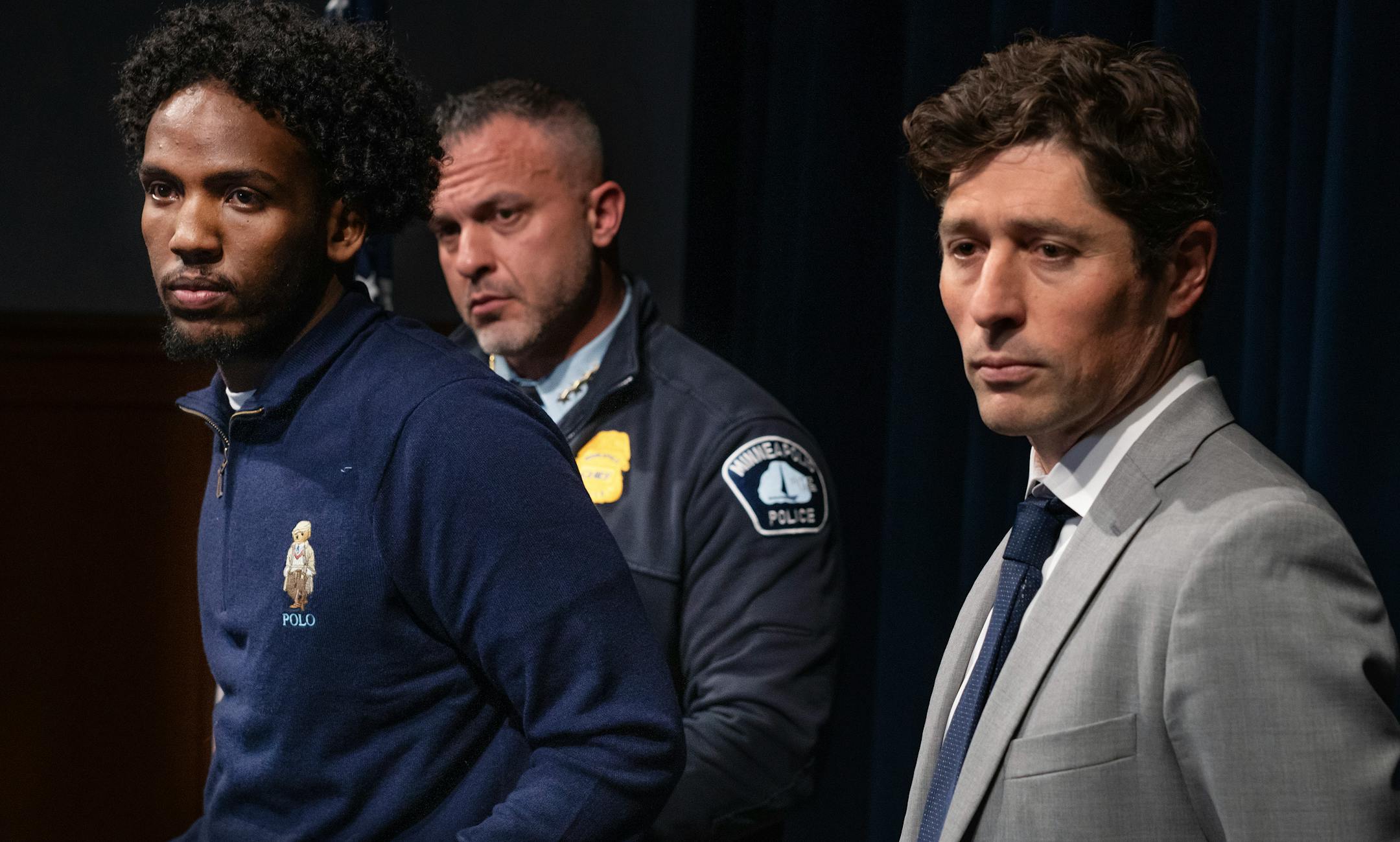
Mubashir, left, a Somali 20-year-old Minneapolis resident and U.S. citizen, speaks about his detainment by ICE as Minneapolis Police Chief Brian O’Hara, rear, and Mayor Jacob Frey look on during news conference at City Hall on Dec. 10 in Minneapolis. (Jerry Holt/The Minnesota Star Tribune)
Advertisement

Mubashir Khalif Hussen remembered the terror he felt when federal immigration agents slammed him against a stairwell doorframe in his Minneapolis neighborhood two months ago, ignoring a photo he attempted to show of his passport.

“I’m a U.S. citizen, bro!” he told the agents.

“I didn’t know what was going on,” Hussen, 20, recounted from a witness stand Feb. 17. “They were just roughing me up.”

Video of the violent encounter in the Cedar-Riverside neighborhood played in a St. Paul federal courtroom as Hussen described how he was taken to the Bishop Henry Whipple Federal Building and released roughly two hours after the arrest. But the mental and physical toll from that day remain, he said.

“I don’t want what happened to me happen to anyone else,” Hussen said. “I’m here to show my community that our rights still matter.”

Hussen, who is Somali American, is among several Minnesota residents who have accused federal agents of stopping or arresting them solely because of their race as part of the Trump administration’s immigration crackdown, dubbed Operation Metro Surge.

The ACLU of Minnesota filed a class-action lawsuit against the federal government on Jan. 15, accusing immigration agents of racially profiling Somali and Latino people through unlawful stops and arrests during the current enforcement surge across the Twin Cities.

The testimony, which detailed unlawful stops and warrantless arrests without probable cause alleged in the lawsuit, comes as the ACLU seeks a preliminary injunction that would restrict agents’ tactics. U.S. District Judge Eric Tostrud heard arguments over two days of proceedings.

Advertisement

Attorneys for the U.S. government repeatedly argued there’s no evidence to suggest racial profiling occurred during the surge, and questioned witnesses about whether immigration agents explicitly said their race or ethnicity served as the basis for the encounter. The attorneys also suggested the plaintiffs drew that conclusion from what they’ve seen online or in the news. At several points, the Justice Department lawyers asked witnesses about their social media presence.

“They don’t have anything else to show that’s what’s happening,” Justice Department attorney Sean Skedzielewski told the court.

Ramon Menera Romero, a U.S. citizen from Mexico, testified he was recording a federal enforcement operation from his yard when an agent asked where he was born. Romero said he refused to say at first, believing he wasn’t required to show proof. Romero said the agent then threatened to take him away because of his accent. Romero said he was handcuffed and eventually let go because the agents determined he’s a citizen.

“I felt I was protected by being a U.S. citizen and they couldn’t do anything to me,” Ramon said. Those feelings changed after the January encounter, he said.

Tostrud asked the Justice Department’s lawyers to explain ICE’s policy on warrantless stops, specifically their definition of “likely to escape,” which he called “unusual.”

The agency interprets the policy to mean at-large people may escape from an officer’s ability to find them later, Skedzielewski replied. Tostrud appeared to question the interpretation.

Advertisement

“When I think of escape, I think of ‘The Great Escape,’ the movie,” he said, referring to the 1963 film about Allied soldiers in World War II escaping from a prison camp. “You are detained, you are confined, you are restrained and you decide, I’m getting out of here.”

Judge asks how ICE drawdown affects case

Tostrud also asked how border czar Tom Homan’s announcement last week about a drawdown of the 3,000 federal agents deployed to Minnesota would affect the case, saying he couldn’t make a decision without knowing the status of the withdrawal.

Skedzielewski said he’s confirmed U.S. Customs and Border Protection and Immigration and Customs Enforcement agents have reduced their presence in the Twin Cities. Homeland Security investigators will remain in Minnesota to continue an investigation into fraud, he said, but they do not conduct immigration enforcement.

In arguing for court intervention, ACLU lawyer Kathryn Huddleston said there’s no “guarantee” the practices by the Department of Homeland Security will not happen again in Minnesota, and ICE agents could return.

Arguments concluded with Tostrud taking the case under advisement. He will issue a ruling at a later date.

about the writer

about the writer

Sarah Nelson

Reporter

Sarah Nelson is a reporter for the Minnesota Star Tribune.

See Moreicon

More from News & Politics

See More
Story Illustration
Brock Kaplan/The Minnesota Star Tribune

The Department of Human Services said the redactions are to protect trade secrets and security information. Lawmakers looking for answers to state government’s fraud problems are frustrated.

card image
card image
Advertisement