Minnesotan’s Ice Mile swim illuminates a new level of extreme

The sport is no stunt, as swimmer Mackenzie Koeck and her support crew learned in the yearlong runup of preparation.

The Minnesota Star Tribune
December 5, 2025 at 11:30AM
icon2:04
Mackenzie Koeck powers through her mile swim on Saturday on McCarrons Lake in Roseville. (Video provided by Heather Lendway)

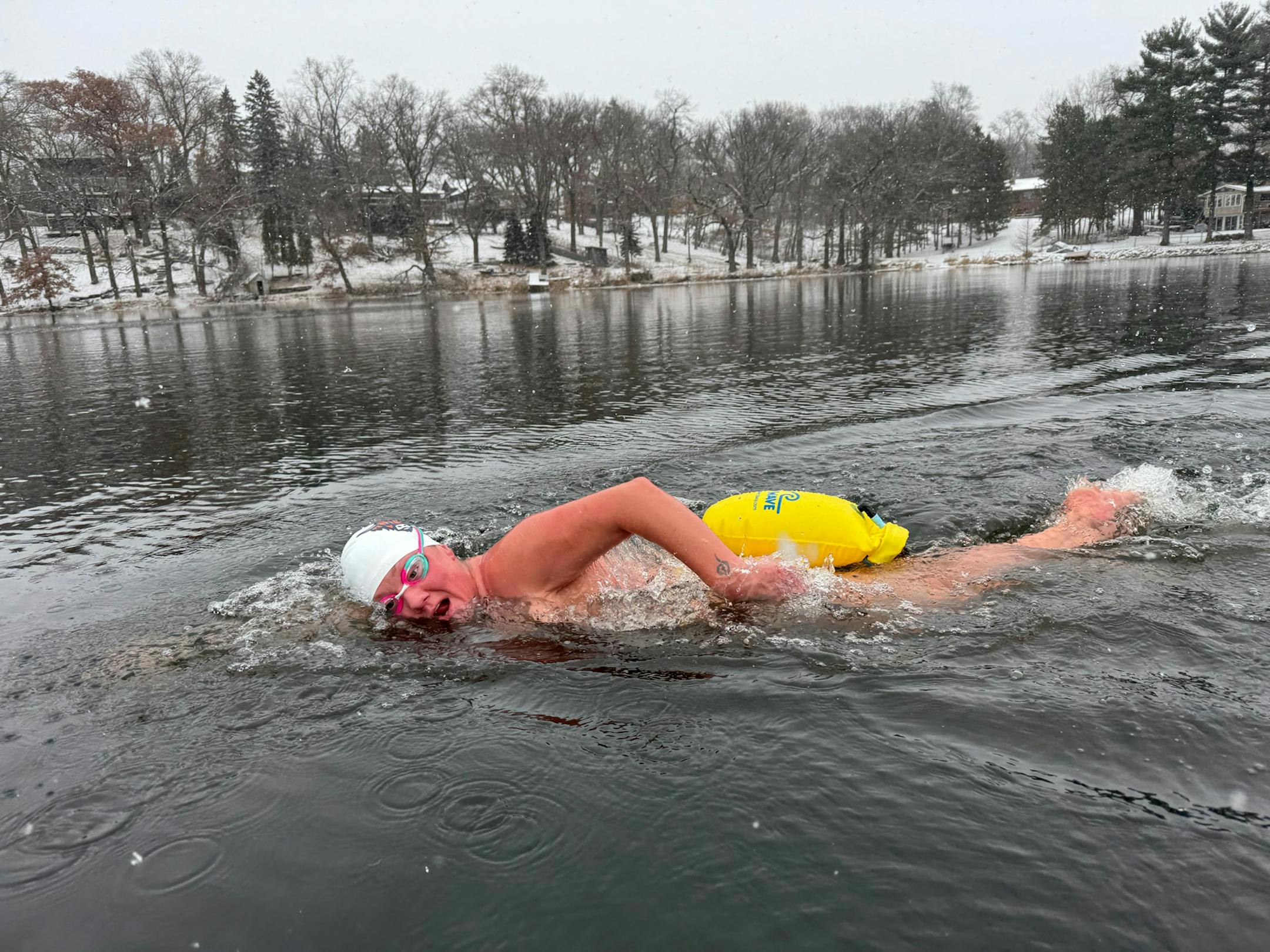
Only a swimsuit, goggles and a silicone cap stood between Mackenzie Koeck and a lake swim last Saturday morning.

The water in McCarrons Lake in Roseville was as cold as 39 degrees. With snow falling, Koeck got in quickly up to her waist before fully submerging.

Extreme, yes, but Koeck, 37, of St. Paul, had more in mind than a dunk in an ice hole. Her dive into the audacious was an attempt at an event called the Ice Mile.

It’s part of the unusual sport of ice swimming. While global, the sport exists far outside the mainstream. It’s more popular in Europe than in the United States.

“I did a lot of research on how to do this safely,” Koeck said. “It is an extreme sport and dangerous. I like to do things that are risky, but in a responsible way.”

Her attention to detail was evident as she waded into McCarrons Lake. She gave herself two minutes to acclimate. She was uncomfortable, but the sharp slap to her skin wasn’t painful. Still, before long, her hands and feet were numb.

Adrenaline now on overdrive, she steadied her breathing and secured her safety buoy. Then, with a nod from her support team shadowing her in a canoe and from the lake’s edge, Koeck was off into the deep.
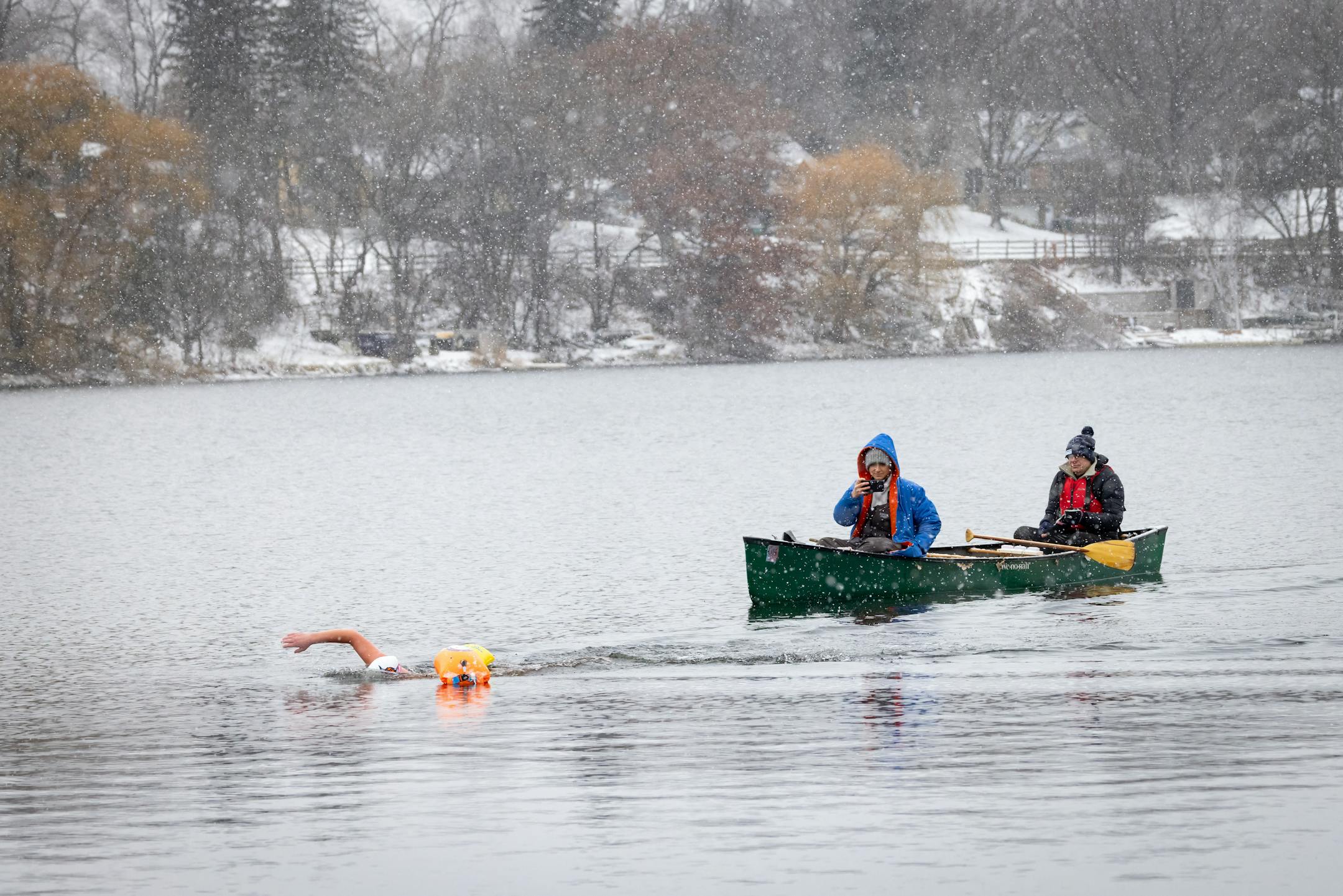
Heather Lendway, the official observer, watches from the bow and Robert King, in the stern, is the witness and also in charge of temperature readings during Mackenzie Koeck’s mile swim on McCarrons Lake in Roseville on Saturday. (Provided by Daniel Edwins)

Following a feeling

Koeck’s Ice Mile attempt was more than a year in the making. On some level, it was longer.

As kids, she and her siblings would test their resilience in Crystal Lake during ice-out in Otter Tail County, where her family has a cabin. It was all fun, but the experience stuck with Koeck.

“I love that cold feeling,” she said.

Koeck has followed that vibe. She swims with the Macalester Masters swimming group that stacks up laps at the St. Paul college’s pool. Some of the swimming lifers are quick to move their activity outside in summer at McCarrons and Lake Harriet in Minneapolis.

Those swimmers have extended their open-water season in recent years. Koeck took it longer than most.

Late in October last year, she waded into McCarrons for one last outdoor swim. Her friends were incredulous, but Koeck found the colder water exhilarating — and familiar.

Her push into new territory prompted one of her friends to send her a web link to explore the Ice Mile, a creation of the International Ice Swimming Association (IISA). Participants must swim the distance unassisted outdoors in water 41 degrees or colder.

Koeck considered attempting last winter but, upon studying the rigorous requirements, realized the window was too short.

An Ice Mile, she learned, is no stunt.

Koeck, an epidemiologist, underwent some personal science. She needed a physical, including an EKG to check her heart health. She submitted her medical information to IISA, which also required that she have an observer monitor her mile attempt, and a witness and a medic on site. (Her sister Emily, a doctor, filled the latter role.)

All three had to watch a training video and answer lengthy questionnaires. Then there were the other requirements. Among them:

  • No wetsuits. Only a traditional suit, cap and goggles.
    • Water temperature readings before and during her attempt, showing no more than 41 degrees.
      • Photos and video tracking Koeck’s swim.

        “Because it is pretty dangerous, they need to have barriers to entry,” Koeck said. “It is a sport that welcomes everybody, but with caution. It is not a Polar Plunge. It is not an ice bath.”

        Koeck prepared differently, including more cold water training.

        Icy water is a shock to the human body when immersed in it. The cold triggers hypothermia that, as a person’s body temperature drops, quickly hampers motor skills. Depending on the length of exposure and water temperature, organs can fail.

        Koeck focused on the initial cold shock. It can trigger a gasp for air. She learned to better control her breathing, rather than suck in water. Her training included submerging in ice baths at home.

        “I was figuring out what works,” she said. “For example, I have to make sure my entire body is submerged before swimming. I do everything while I can still touch the ground. It works for me.”

        The cold water sent other jolts. Koeck learned to immediately go in up to her waist, rather than tiptoe in, “because it’s going to burn anyway.”

        And there was brain freeze, of the ice cream variety, when her head and face first get wet. She practiced riding out the sharp pressure by holding her face in snow.

        Koeck also knew she’d have to repeat her learning in the real thing. While only one was required, she did two qualifying swims on successive weekend days before her official go last Saturday. The water temperature ranged from the low to mid-40s.

        The qualifiers were test runs for her support crew, too. They gathered on the shore to watch and also monitored from the water.

        Her vehicle, heat blasting, was a final but critical finish line.

        Koeck would end her cold swims by getting into dry clothes that were laid out in order. Hand and body warmers were already in pockets and shoes. The plan was mandatory because of what’s called the “afterdrop” — an intense post-swim moment during which her body generates heat to warm her core.

        Within 10 minutes of finishing, she would begin to shake violently. She sank into her jacket as her teeth chattered in bursts.

        The afterdrop is “inevitable and incapacitating,” Koeck said. “This type of cold isn’t something I’ve experienced outside of ice swimming. It’s a cold that penetrates to my bones.”

        Mackenzie Koeck during her mile swim on McCarrons Lake in Roseville on Saturday. (Provided by Heather Lendway)

        Into McCarrons Lake

        Back in McCarrons Lake last Saturday, Koeck knew how to react when the first splash of icy water took her breath. She settled herself before launching, knowing the first lap is the worst part of the swim.

        Her hands and feet immediately ached in the deep cold, and her stroke rate was faster than she could maintain. But she anticipated hitting what she called “a small wall.” The discomfort began to recede and she found a rhythm.

        She hit the first buoy, one of two set 500 meters apart. She would propel her 5-7 frame four full lengths.

        Two friends in a Wenonah canoe paddled nearby, monitoring her every stroke.

        Heather Lendway, a member of Koeck’s swimming friends group, was in the bow of a canoe to ensure Koeck was physically OK. Robert King was the witness and took water temperature readings. Flakes of ice formed on the gunwales and crusted the temperature gauges.

        “It is all fun but serious, and I definitely felt nervous at one point,” Lendway recalled.

        Koeck’s performance reassured her. “We were asking questions and she was slurry [because her face was cold]. But you could tell by her swim stroke and pace that she was fine,” Lendway said.

        The water was colder than her previous practice runs, but Koeck said she didn’t notice. Mentally, too, she was locked in, lifted by her friends. All told, she swam 2,050 meters, well over the mile distance (1,609 meters) just to be safe with the IISA judges. The swim lasted about 36 minutes before Koeck exited straight into her vehicle to begin the warming process.

        “I felt so happy the whole time we were at the swim site,” she recalled. “It was a celebration in and of itself.”

        Now, she is hoping IISA makes her Ice Mile official. If it’s approved, she will join 63 other U.S. “Ice Milers,” men and women, in the group’s records. Koeck believes she’d be the first Minnesota woman. Minnesotan Landon Ascheman recorded an Ice Mile in November 2014 on Square Lake in Washington County.

        She also hasn’t cooled on more ice swims.

        In March, she’ll compete in an event in Finland.

        “When it feels hard, I remember that I love this,” Koeck said. “It is a value-add to my life.”

        about the writer

        about the writer

        Bob Timmons

        Outdoors reporter

        Bob Timmons covers news across Minnesota's outdoors, from natural resources to recreation to wildlife.

        See Moreicon

        More from Outdoors

        See More

        The sport is no stunt, as swimmer Mackenzie Koeck and her support crew learned in the yearlong runup of preparation.

        Rising above the treeline (Top of this photo), on the shore of Birch Lake, the Twin Metals Copper Nickel Mine Plant site and Tailings Management site is part of the proposed plan. ] In theory, the copper-nickel mine Twin Metals wants to build in the headwaters of the Boundary Waters Canoe Area Wilderness is a zero-discharge mine — a closed loop that will endlessly recycle millions of gallons of water, including rainwater and the polluted process water it uses to extract ore and
        card image