
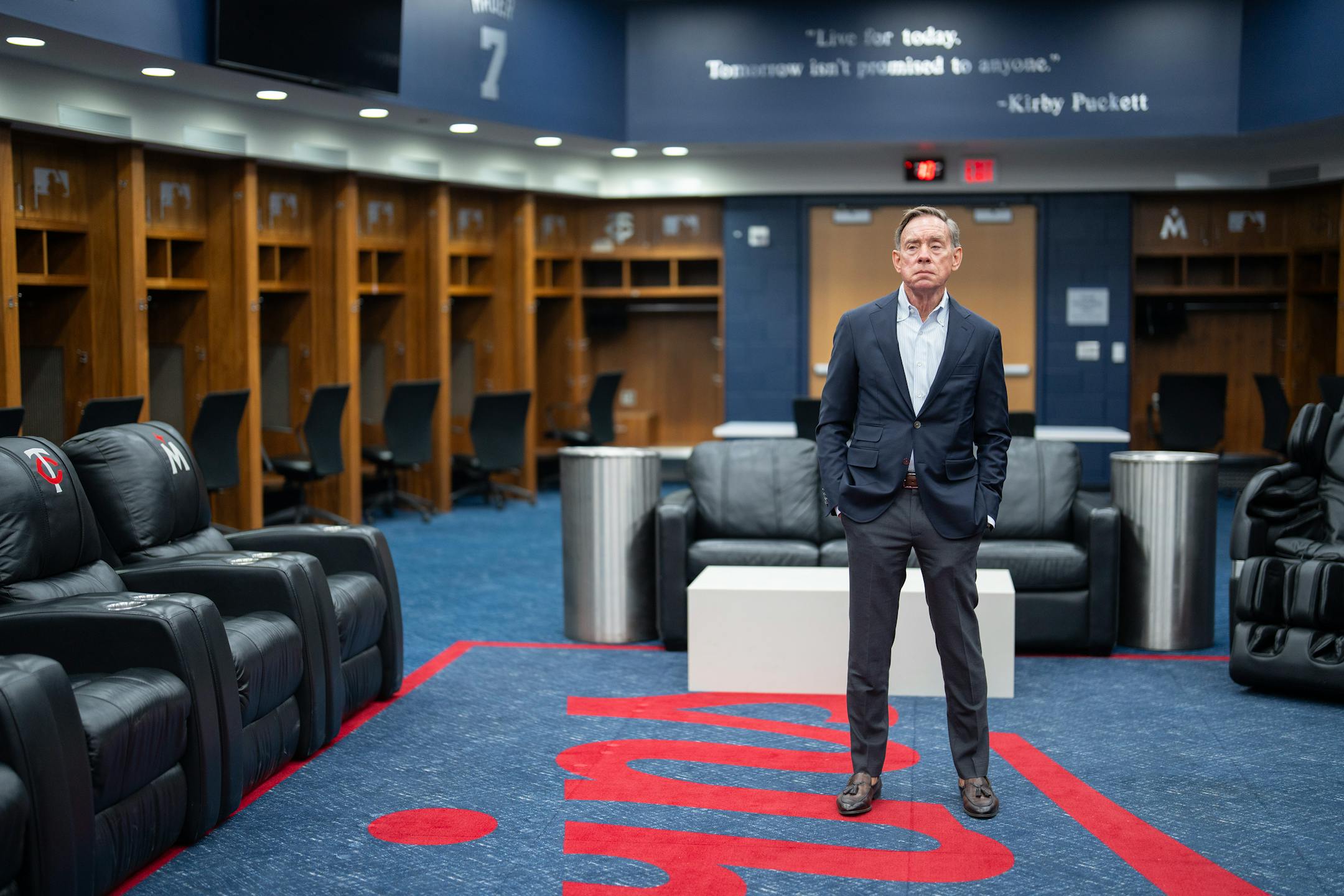
Neal: Are the Pohlads really in it for the long haul? Or are they waiting for the Twins’ value to escalate?

The team reshuffled its leadership with new investors coming on board, but there are two factors to keep a close eye on in MLB’s uncertain future.

Columnist Icon
The Minnesota Star Tribune
December 17, 2025 at 11:43PM
Bob Pohlad listens as his son Tom speaks Wednesday at Target Field. Tom takes over for his brother Joe in running the Twins. (Alex Kormann/The Minnesota Star Tribune)

Tom Pohlad, the latest Pohlad to take over day-to-day operations of the Twins, was straightforward on Wednesday when asked about the family’s long-term commitment to owning the franchise.

“We’re in it for the long haul,” he said.

This comes 14 months after the family announced its intention to find a buyer for the club and four months after changing their minds to instead search for investors. They discovered it’s kind of hard to sell a team loaded with $500 million in debt.

So consider me skeptical.

In four years, I expect this ownership group to look different. The Pohlads could receive an offer they can’t refuse. The new investors could cash out.

Fans might still be waiting for a winner to be put on the field.

Don’t expect this restructured group to suddenly push the payroll upward and make significant player acquisitions. They will lean into helping the younger players develop while figuring out which of their group of young pitchers should remain starters or be moved to the bullpen.

And not raise costs very much.

ADVERTISEMENT

The Twins have a payroll of around $100 million, including the pending signing of first baseman Josh Bell for $7 million. By the time spring training begins, the payroll will rise as they fill in the roster. But payroll will be much lower than it was at the start of last season (roughly $140 million) by the time the first pitch is thrown March 26 in Baltimore.

Pohlad said the Twins accumulated debt because they overspent. They likely will be more frugal.

“Our revenues don’t support the expenses we have, particularly when you talk about the level of investment that we’ve been making over the last couple of years in player payroll,” he said. “We have chosen for some time now to continue to invest beyond what the revenues support.

“You know, people like to say we’re not committed to investing in this team; $500 million of debt would tell you exactly the opposite. And so that’s how the debt got to where it is.”

The team can be sold at a bigger profit in the coming years, because of two things:

First, a new labor agreement is expected to be in place following the 2026 season. Many are predicting a work stoppage as owners push for a salary cap. There are also fears that the 2027 season may not be played at all.

Owners appear ready to dig in on this one. An ESPN report in September revealed that MLB owners believe their franchise values have suffered because of a lack of a salary cap, while other leagues have thrived because of cost certainty.

The disparities are growing. The Dodgers’ payroll was roughly $220 million more than the Twins’ last season. I’m not sure if owners will come away with a cap or a second apron or a luxury tax with more bite. But there will be change.

Second, MLB will improve its streaming game. The league hopes to bundle all its television rights and sell them to various services. It just has to wait until the end of 2028 when several current deals expire. The NBA’s success — it is receiving $77 billion over the next 11 seasons from ESPN, NBC and Amazon — is its guide. Another component to this is big-market teams realizing their local TV revenues must be shared, in full, with the other teams.

When these two developments occur, franchise values will rise. The Twins, it is safe to assume, will keep payrolls more manageable over the next few years. The team is using money from their new investors to pay down their sizable debt.

The Twins won’t be carrying a large debt load. They will not overspend. They also have cut costs by laying off personnel in baseball operations and ticket sales in recent months. As the sport emerges from its economic hellscape, the Twins will be worth more and will be more attractive to buy.

And the Twins, purchased for $44 million by Carl Pohlad in 1984, could be worth $4 billion or more by 2029.

When Glen Taylor agreed in 2021 to sell to Marc Lore and Alex Rodriguez, the Wolves were worth $1.5 billion. In October, a few months after the final installment payment was delivered, Forbes estimated the Wolves’ value at $3.6 billion.

The Twins could see a similar increase.

It would be more enticing for the Pohlads to divide their roughly 80% stake in the franchise at $4 billion rather than $1.75 billion. Surely, the family has considered this.

So when Tom Pohlad says “long haul,” I respond, “We’ll see in four years.”

As I remove my tinfoil hat, I realize that also means that the on-field product in 2026 will need to develop rapidly, because ownership isn’t splashing the cash anytime soon.

about the writer

about the writer

La Velle E. Neal III

Columnist

La Velle E. Neal III is a sports columnist for the Minnesota Star Tribune who previously covered the Twins for more than 20 years.

See Moreicon

More from Sports

See More
card image
Abbie Parr/The Associated Press

A foot injury kept Edwards on the sidelines, and Jaren Jackson Jr. scored 28 points to lead upstart Memphis.

card image
card image