
Minnesota fights to keep $62 million solar grant yanked by feds

The Environmental Protection Agency says the solar program was repealed by Congressional Republicans, but Minnesota officials say it’s too late to legally cancel the money.

The Minnesota Star Tribune
August 15, 2025 at 7:14PM
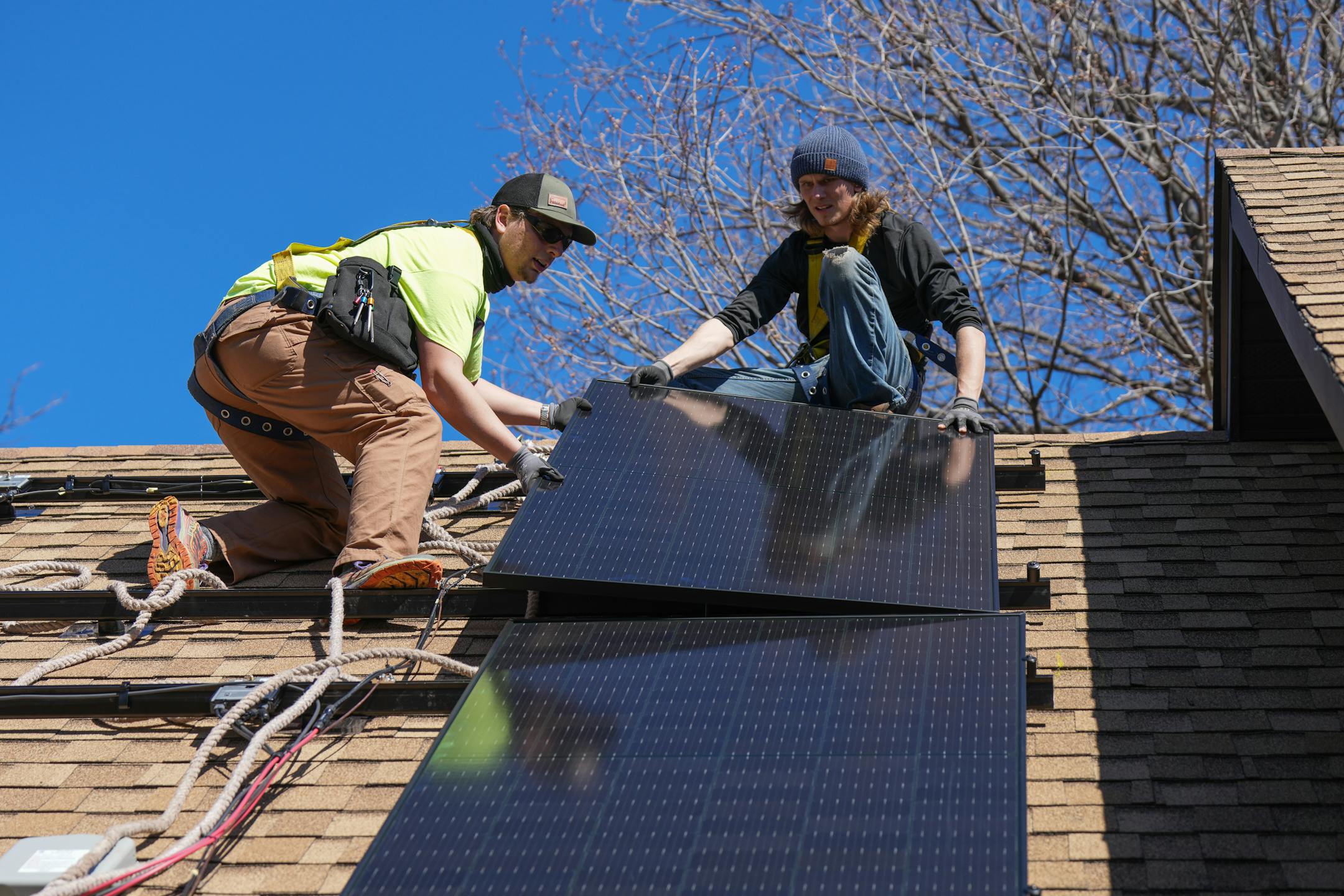
Workers installed a rooftop solar panel power system on a Golden Valley home last year. Minnesota hopes to salvage a $62 million solar grant that was canceled by the federal government. (Glen Stubbe/The Minnesota Star Tribune)

Minnesota officials hope to stop the federal government from canceling a $62 million grant for small-scale solar projects meant to reduce the cost of energy for poorer households.

The cash would pay mainly for solar arrays shared by residential utility customers, as well as panels on apartment buildings, houses and tribal lands in projects the state estimated would save more than 11,000 households 20% or more on their electric bills.

The projects under the program would have to benefit households that make less than 80% of an area’s median income, or people who live in certain designated communities, according to the Minnesota Department of Commerce.

The dispute is focused on whether the Trump administration can legally claw back money that states were already granted.

The Environmental Protection Agency said the “Solar for All” money was repealed by the “One Big Beautiful Bill” passed by a Republican-controlled Congress earlier this year and that EPA doesn’t have the authority to administer the $7 billion program.

“With clear language and intent from Congress in the One Big Beautiful Bill, EPA is taking action to end this program for good,” said EPA administrator Lee Zeldin, in a statement. “We are committed to the rule of law and being a good steward of taxpayer dollars.”

But the Department of Commerce said in a news release that it has a contract for the money, so it’s too late to be legally canceled. The agency said it’s “exploring immediate legal action.”

“This is about fairness, fiscal responsibility, and Minnesota’s progress to a clean energy future,” said Commerce Commissioner Grace Arnold, in a statement. “We’re working to pursue every legal tool to protect these funds because Minnesota families deserve better reliability and lower costs.”

The repeal of “Solar for All” eliminated another element of the Inflation Reduction Act passed under Joe Biden in 2022. That legislation included hundreds of billions in spending on programs meant to speed up the transition away from fossil fuels.

Republicans in Congress sharply limited tax breaks from the IRA for wind and solar production in the One Big Beautiful Bill approved earlier this year.

Those changes could cost Minnesota utility customers $10 billion to $20 billion over the next decade, said Lissa Pawlisch, an assistant commissioner at Commerce overseeing federal and state initiatives.

Pawlisch said Solar for All might seem modest in comparison, but it is “directly targeting” the most vulnerable households in the state with a high share of income eaten up by power bills.

“As rates are going up, as electricity will get more expensive because of the repeal of the tax credits, Solar for All funds would have been a way for those households to mitigate that harm,” she said.

Pawlisch said about $10 million was earmarked for solar projects on multi-family housing, like apartment complexes, and $24 million was for community solar gardens. Those are solar arrays run by third party developers that people can subscribe to in exchange for a bill credit from their power company. They’re meant to allow people who don’t own a house or don’t have a roof that can support a solar array, to tap into smaller-scale solar.

Another $10 million was for tribal solar projects. Smaller sums were set to be spent on rooftop solar projects and workforce development in the solar industry.

Zeldin said the money in Solar for All would have been diluted as the grants passed through middlemen before project construction, which he characterized as a “grift.” He also said little of the money had been spent.

“Recipients are still very much in the early planning phase, not the building and construction process,” Zeldin said.

Pawlisch rejected the accusations of grift. She said Minnesota is planning to work with the state’s housing agency because it has staff and expertise for projects on multifamily housing. But she said administrative funds for the agency would make the project more efficient, not less.

This is not the first clash over environmental money between the EPA and Minnesota entities. In June, a federal judge said EPA had to restore $180 million in environmental justice funds it awarded to the Minneapolis Foundation and two other nonprofits.

Attorney General Keith Ellison also sued the EPA in March over $25 million in cuts to a state-run “green bank,” which loans money to developers, businesses and nonprofits for projects meant to benefit the environment and general public.

In February, the Trump administration restored a $200 million grant for the Minnesota Pollution Control Agency aimed at reducing greenhouse gas emissions through initiatives like restoring peatlands and reducing food waste.

about the writer

about the writer

Walker Orenstein

Reporter

Walker Orenstein covers energy, natural resources and sustainability for the Star Tribune. Before that, he was a reporter at MinnPost and at news outlets in Washington state.

See Moreicon

More from Environment

See More
Rising above the treeline (Top of this photo), on the shore of Birch Lake, the Twin Metals Copper Nickel Mine Plant site and Tailings Management site is part of the proposed plan. ] In theory, the copper-nickel mine Twin Metals wants to build in the headwaters of the Boundary Waters Canoe Area Wilderness is a zero-discharge mine — a closed loop that will endlessly recycle millions of gallons of water, including rainwater and the polluted process water it uses to extract ore and
Brian Peterson/The Minnesota Star Tribune

The copper-nickel mine is controversial for its proximity to the Boundary Waters Canoe Area Wilderness, and the Biden Administration had canceled its leases.

card image
card image