
$12B bailout is ‘Band-Aid,’ not long-term stability for Minnesota farmers

Donald Trump’s trade war halted China’s purchases of U.S. soybeans earlier this year. On Monday, he announced a federal aid package.

The Minnesota Star Tribune
December 8, 2025 at 4:32PM
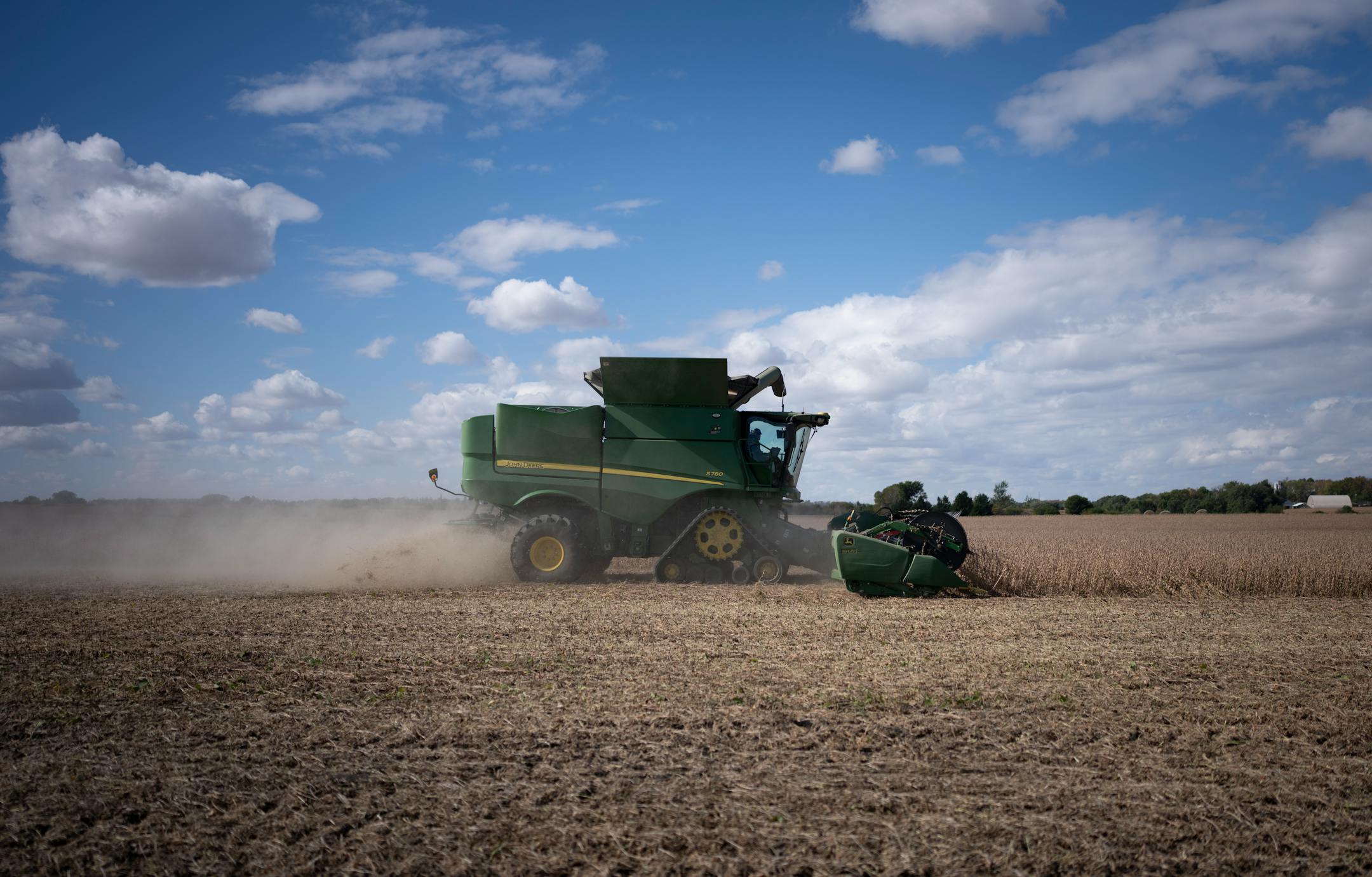
A combine harvests a soybean field that is part of the Fultz family farm in Tracy, Minn., on Tuesday, October 7, 2025. ] RENEE JONES SCHNEIDER • renee.jones@startribune.com (Renée Jones Schneider/The Minnesota Star Tribune)

WASHINGTON, D.C. — American farmers will receive a $12 billion bailout, the White House said Monday, after a sour year for Minnesota soybean farmers dealing with already-fragile markets and global tariffs.

On the road to St. Louis for a soybean conference, Wells, Minn., soybean farmer Darin Johnson called the funds a “good start.” But he cautioned the overall number — smaller than the $28 billion President Donald Trump’s administration offered during his first term in 2018 and 2019 — would leave many farmers still scrambling for operating loans.

“It’s going to be a little tougher to weather this time because of interest [rates] and costs we’re having to deal with in borrowing money,” said Johnson, president of the Minnesota Soybean Growers Association.

To survive the tariffs, high cost for fertilizer and low price for beans, farmers across rural Minnesota will need to lean into equity that parents and grandparents built up to weather the next year, Johnson said.

White House spokeswoman Anna Kelly, in a statement ahead of the official announcement Monday afternoon, blamed Joe Biden’s administration for growing a $1.2 billion trade deficit.

“In contrast, President Trump is helping our agriculture industry by negotiating new trade deals to open new export markets for our farmers,” Kelly said.

During a Monday roundtable with farmers, Trump said: Democrats ”caused it. We’re fixing it.”

U.S. Rep. Angie Craig, the Minnesota Democrat and highest-ranking member of her party on the House Agriculture Committee, said she was disappointed Trump could find $40 billion in funds for the Argentine government to help buoy its currency, but he couldn’t ante up more for hurting American farmers.

“This farm aid package picks winners and losers in the farm economy,” Craig said in a statement.

In Minnesota, row-crop farmers have seen stubbornly low prices on the state’s biggest commodity crops, corn and soybeans. But a framework announced this fall on a plan for China to begin re-purchasing U.S. soybeans — after a freeze-out in the wake of Trump’s tariffs — has pushed the price of soybeans to stronger territory, around $11 a bushel.

Soybeans are perennially one of Minnesota’s largest exports. Many analysts predict this fall’s harvest to be one of the strongest on record, but the Federal Reserve Bank of Minneapolis’ survey of agricultural bankers found that pessimism abounds for the sector’s profitability.

In all, the survey said, 79% of lenders said incomes fell in the third quarter compared with the same time in 2024.

Jennifer Zwagerman, director of the Drake Agricultural Law Center, said a “Band-Aid” was an apt description of aid payment that bridges a gap but doesn’t address “underlying reasons” behind the U.S. slumping ag economy.

“For a long time, the U.S. was the primary, the go-to for the international purchases,” Zwagerman said. “But over time, whether it be China’s purchases of soy [or other commodities], there are competitors out there now, and that’s something that our markets need to just plan for and adjust to.”

The White House announced $12 billion in total, with $11 billion coming from a U.S. Department of Agriculture Farmer Bridge Assistance Program and another $1 billion toward growers of specialty crops, such as fruits and vegetables.

USDA Secretary Brooke Rollins said at the roundtable the administration was ushering in a “new golden age for farmers.”

“Instead of farming for government checks,” Rollins said, “they can farm to feed their family and sell their products.”

Minnesota Sen. Amy Klobuchar, the top-ranking Democrat on the Senate Agriculture Committee, also issued a statement saying she needs to see more of the plan’s details, but “ultimately, farmers want trade — not aid.”

Minnesota Sen. Tina Smith, another Democrat on the Senate Agriculture Committee, said in a statement the payments to farmers are evidence of the “self-inflicted pain” from the administration.

Throughout Trump’s trade war, soybean farmers have become the face of pain, as China retaliated by zeroing out soybean orders. An October plan paved the way for China to purchase 12 million metric tons this year and 25 million in the next three years. But China has yet to fulfill its end of the deal, though Trump administration officials remain hopeful.

Treasury Secretary Scott Bessent told CBS’ “Face the Nation” on Sunday that China used soybean farmers “as pawns” in trade negotiations.

For many, this is a re-run of the first Trump administration.

In 2018 and 2019, after imposing tariffs on China and feeling the lash of retaliatory tariffs on American agricultural goods, Trump similarly bailed out farmers with tens of billions in aid payments. It remains uncertain how effective those payments were at stimulating long-term profitability in the market.

Gary Wertish, a Renville County farmer and president of the Minnesota Farmers Union, said producers were dealing with an unprecedented amount of instability, coming from Washington D.C., which brought flashbacks of seven years ago.

“I don’t think the previous payments made us whole,” Wertish said. “We lost sales and trade the following years.”

According to the American Soybean Association’s economic analysis, farmers have frequently lost money for every acre of soybeans they plant when considering the costs. In 2025, soybean farmers are projected to lose $89 on every planted acre.

Zwagerman said the payments might help farmers stave off bankruptcy in the immediate term, but they do nothing to alleviate America’s changed position as the lone agricultural superpower.

Without a renewed farm bill or clarity on trade, smaller farmers who might be renting their land or operating with more debt remain desperate.

“You have very little sense of security in really just about anything,” Zwagerman said.

But for many farmers, who have been a political bulwark for the president at the ballot box, the aid package will deliver meaningful relief through the winter months, when they buy seed and fertilizer for next year.

“It’s Christmas early for farmers,” said Cordt Holub, an Iowa cattle and soybean farmer who sat next to Trump at Monday’s roundtable.

about the writer

about the writer

Christopher Vondracek

Washington Correspondent

Christopher Vondracek covers Washington D.C. for the Minnesota Star Tribune.

See Moreicon

More from Agriculture

See More
card image
Glen Stubbe/The Minnesota Star Tribune

The diagnostic center in Willmar learned it got the exemption its supporters were seeking.

card image
card image