

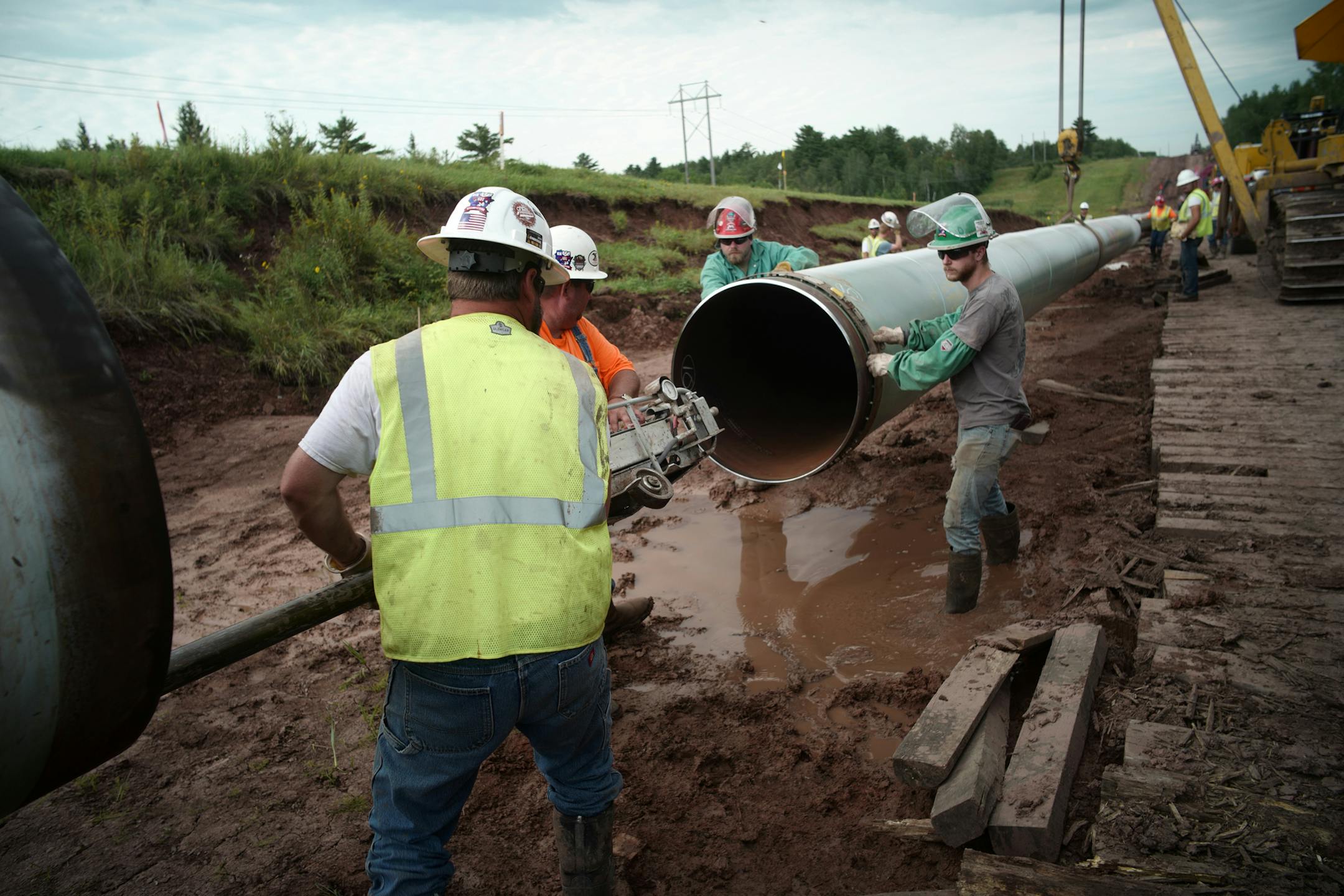
Enbridge has finally received some regulatory recognition that its proposed new Minnesota oil pipeline is economically needed — but not exactly the endorsement it wanted.
Administrative Law Judge Ann O'Reilly's much-awaited decision last week is suffused with skepticism about Enbridge's Line 3 replacement project, with recommendations that could throw boulders into the company's path and add $1.2 billion to its current $2.6 billion price tag.
O'Reilly is not shy about criticizing any of the stakeholders on the controversial and complicated project, and leaves a lot on the table for the state Public Utilities Commission (PUC) to consider as it makes its final decision in coming months.
Even though O'Reilly concludes that under Minnesota law there's a need for a new Line 3 — the current 1960s era pipeline is carrying only half its capacity because of corrosion and other maintenance issues — she laments that the pipeline's biggest beneficiaries are out-of-state.
"It is a bitter pill to swallow, however, that the 'need' for this project is to primarily assist foreign oil producers in transporting their products through [and mostly out of] Minnesota," she wrote. While oil passing through Enbridge pipelines supplies Minnesota's two refineries, most of it goes on to other markets.
Calgary, Alberta-based Enbridge is North America's largest pipeline operator, and its "mainline" — six pipelines running across northern Minnesota to Superior, Wis. — is the largest conduit of Canadian crude oil into the United States. Enbridge is proposing a route for the Line 3 replacement that follows the current route to a point and then jogs south.
O'Reilly essentially concludes that the environmental risk to pristine land under the proposed new route is not worth it. She noted that 47 percent of Enbridge's 340-mile proposed route currently contains no oil pipelines.
Heavy load for regulators
Her solution of extracting the current aging Line 3 and dropping another in its place not only would cost more, it would cross two reservations, requiring Enbridge to negotiate with Indian tribes that have made clear they don't want a new pipeline on their land.


