
Should Minneapolis deny liquor licenses to hotels that housed ICE agents? City Council debates it.

The City Council held a public hearing on the liquor licenses for the Canopy by Hilton and Depot Renaissance Hotel.

The Minnesota Star Tribune
February 17, 2026 at 11:35PM
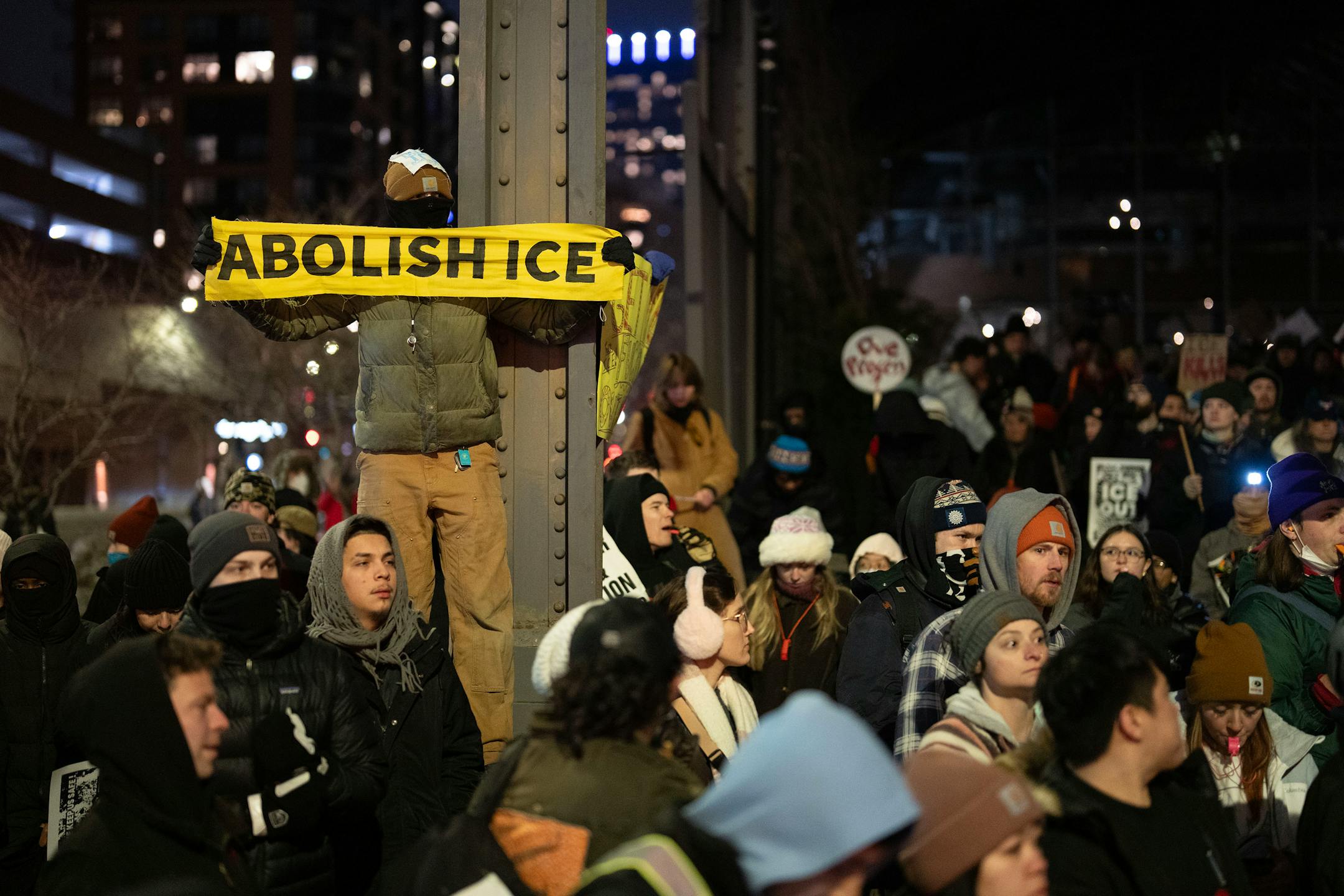
Protesters make noise near the Depot as hundreds of people march from hotel to hotel in downtown Minneapolis on Jan. 9. (Alex Kormann/The Minnesota Star Tribune)

Minneapolis City Council members debated on Tuesday whether to deny renewals of liquor licenses to two downtown hotels that housed federal immigration officers during the crackdown that has rattled the city and captured the attention of the nation.

The hotels at issue are Canopy by Hilton and Depot Renaissance Hotel, which have been the targets of protests because federal agents were believed to be staying in them during Operation Metro Surge, which brought 3,000 federal agents to the state.

Two days after an ICE agent killed Renee Good in south Minneapolis in January, about a thousand people converged outside the two hotels, blowing whistles and banging drums to disrupt the sleep of any agents inside.

The council is divided, with comparatively moderate Democrats questioning whether the city has any legal basis to deny the licenses and warning that any denials would only hurt already-suffering downtown businesses. It’s not clear whether there are enough votes among the council’s more progressive wing to deny the licenses.

A Minneapolis City Council committee, composed of the entire 13-member council, voted 11-2 on Tuesday, Feb. 17, to have staff look deeper into whether the hotels have met the requirements to have their licenses renewed, or whether their licenses should be yanked or approved with conditions.

The full council is expected to take up the issue again when it meets Thursday. Mayor Jacob Frey has expressed skepticism of the idea.

Hotel representatives declined to comment after the hearing.

Joan Soholt, who has been a hotel banquet server for 23 years and is a member of UNITE Local 17, a hospitality union, said she has witnessed fear, uncertainty and destruction at one of the hotels identified on social media as housing ICE. She said claims that the hotels are contracting with ICE or overserving liquor are false.

“The atmosphere of aggression and misinformation has created real anxiety,” she said. “ICE activity is not limited to one or two facilities.”

She said U.S. Immigration and Customs Enforcement and Border Patrol officials aren’t just staying at one or two hotels, contrary to a “narrative” that unfairly targets certain hotels.

Past comments by council members about an ICE agent who was arrested on suspicion of DUI implied that he was served at one of the hotels in question, which Soholt said was “false and deeply damaging.” Two weeks ago, committee chair Aurin Chowdhury mentioned during debate on the liquor licenses that a Border Patrol agent was arrested on suspicion of drunken driving while assigned to Minnesota.

Union officials describe agents in hotels

Soholt said using the liquor license as leverage without a valid legal basis “sends a chilling message” to hotel cooks, bartenders, housekeepers, dishwashers and cleaners who could lose their jobs due to the council’s political pressure or public controversies.

“Pulling or threatening liquor licenses without clear cause would be reckless and devastating to working people,” she said. “This is about economic stability. It is about protecting workers.”

Jon Erik Haines, an attorney representing the hospitality union, argued the council is within its rights to deny the liquor license, saying, “Selling liquor is a privilege, not a right.” The Minnesota Supreme Court has ruled that cities have “extremely broad” power to deny license renewals to promote a city’s general welfare as long as it’s not unreasonable, arbitrary, capricious or fraudulent. Because a hotel housed a “violent paramilitary” force is a legitimate reason to deny a liquor license, he said.

According to several union officials, immigration agents have stayed at the Depot for the past two months. In public comments Tuesday, the officials described an environment of fear among hotel employees, with a manager covering a window in the breakfast bar so the workers couldn’t be seen.

Sheli Stein, director of the Restaurant Opportunities Center, which works with restaurant workers across the Twin Cities, said restaurant workers in both hotels are living with “immense” fear. Stein said ICE agents are “terrorizing our community and making it impossible for workers to do their jobs.”

After being questioned by Council Member Soren Stevenson, Managing Attorney Quinn O’Reilly of the city attorney’s office said in his opinion, it would be legal for hotel operators to deny ICE agents from staying in their hotels, since their employer, the federal government, is not a protected class.

He recommended the council move forward as soon as possible, saying there’s a risk in delaying action on the liquor licenses, saying it creates a “cloud” over the licenses. City staff had already recommended approval of the liquor licenses two weeks ago after the regular renewal process.

Amy Lingo, the city’s manager for business licenses, said city staffers will do a more thorough review of all calls to and incidents at the hotels, make sure they’re following city ordinances and try to talk to the hotel operators before making a recommendation to the council, which could include adding conditions to the licenses. So far, staffers have found no nexus between serving alcohol and complaints about agents at the hotels.

Council Member Elizabeth Shaffer said delaying action beyond this week would signal that Minneapolis “is not a safe place to do business” because it doesn’t have a stable regulatory environment. Council Member Pearll Warren agreed, saying, “It’s unsettling, and it’s not making any kind of sense whatsoever.”

Council Member Michael Rainville, who represents the downtown area, said the hotel owners have already seen their businesses damaged by the delay in getting their liquor licenses renewed.

Other council members disagreed vehemently, with Chowdhury saying workers feel unsafe in the hotels and the hotels shouldn’t be treated any differently than “mom and pop” businesses.

Council Member LaTrisha Vetaw compared any denial of a license to what President Donald Trump’s administration did when it successfully pressured ABC to briefly dethrone late-night talk show host Jimmy Kimmel.

“I understand that we’re doing what Trump did to Jimmy Kimmel here,” Vetaw said. “I don’t like it, so I’m gonna use whatever power I have to get rid of it.”

Mayor Jacob Frey released a statement Tuesday saying the city should be focused on bringing people into the city, “not driving them away,” by backing events, filling venues and supporting local restaurants and small businesses.

“Venues like The Depot are economic engines for our city. Revoking their licenses doesn’t just hurt the venue — it hurts the workers, vendors, and nonprofits that rely on these spaces to keep running.”

$7 million for small businesses?

The council may also spend up to $7 million to help small businesses because many immigrant-owned enterprises have closed or scaled back hours as people stayed away and sales plummeted. The original proposal was $5 million, which a council committee increased by $2 million.

The council voted 11-2 to recommend spending the $7 million. The proposal now goes to the full council for a final vote on Thursday.

Frey has expressed caution about the proposal, saying last week, “There isn’t just free money.”

about the writer

about the writer

Deena Winter

Reporter

Deena Winter is Minneapolis City Hall reporter for the Star Tribune.

See Moreicon

More from Minneapolis

See More
card image
Alex Kormann/The Minnesota Star Tribune

The City Council held a public hearing on the liquor licenses for the Canopy by Hilton and Depot Renaissance Hotel.

card image
card image