Hennepin County to limit felony charges stemming from low-level traffic stops

County Attorney Mary Moriarty said the new policy addresses historical targeting of Black drivers.

The Minnesota Star Tribune
September 17, 2025 at 11:20PM
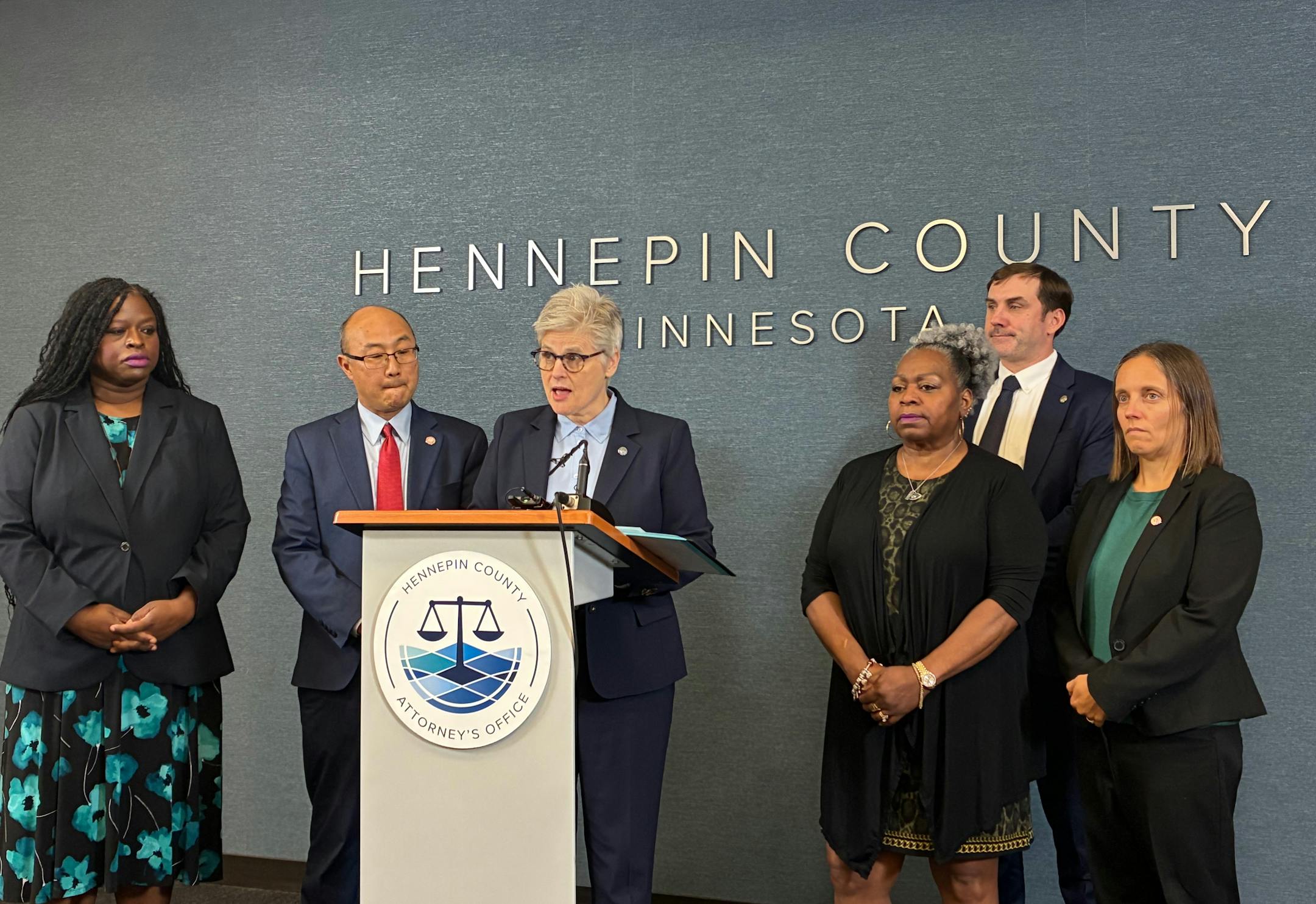
Hennepin County Attorney Mary Moriarty, center, announces the new traffic stop policy Wednesday alongside, from left, activist Nekima Levy Armstrong, Ramsey County Attorney John Choi, Valerie Castile, mother of Philando Castile, and Hennepin County Attorney's Office directors Morgan Kunz and Sarah Davis. (Jeff Day, Star Tribune)

Hennepin County Attorney Mary Moriarty’s office will no longer prosecute most felony cases arising from low-level traffic stops, arguing that law enforcement in the state’s most populous county has long disproportionately targeted minorities for violations like broken tail lights or improper turns.

It’s the latest of several changes Moriarty has pushed forward in recent months, including a policy to consider the racial identity of defendants in key prosecutorial decision points. The moves have inflamed her critics who say she is too focused on racial injustices rather than stopping crime. But the change largely tracks with her campaign promises to reform law enforcement in the County Attorney’s Office. She announced in July she is not seeking re-election. Her term expires Jan. 4, 2027.

She also announced Wednesday that her office would be unlikely to charge cases that come from a “consent search” during a pedestrian or vehicle stop when officers ask if they can search a car or person without a warrant.

“Consent searches allow officers to bypass all of the usual investigative steps necessary to establish probable cause,” Moriarty said. “Many people don’t feel that they can refuse a consent search because of the power differential or the concern or fear of what might happen if they say no.”

The new policy drew an instant rebuke from the state’s largest police organization, which argued that it would make the residents of Hennepin County less safe and bypassed state law, and that Moriarty didn’t engage with a single law enforcement agency about the change.

Several advocates said the traffic stop policy was not only a necessary corrective but would ultimately allow police more freedom to pursue serious traffic violations at a time when the Minneapolis Police Department has 600 sworn police officers, down from nearly 900 in 2020.

“We’re not talking about dangerous driving behavior,” Moriarty said in an interview with the Star Tribune this week. “When we’re talking about limited resources with law enforcement, you would rather have them focus on dangerous driving rather than these kind of things.”

Moriarty said she welcomes robust input from law enforcement and community members before the new policy is implemented Oct. 15. It lists several categories of driving infractions that will no longer be prosecuted if they are the only reason for a traffic stop and subsequent police search.

The infractions include: Failure to display tabs or driving with expired tabs; failure to illuminate a license plate or a partially obscured license plate; broken headlights, brake lights or taillights; a missing side mirror or rearview mirror; items dangling from the rearview mirror; broken windshield wipers; failure to signal a turn or lane change while otherwise driving safely; cracked windshield; and excessive window tint.

In practice, this means if a police officer were to pull over a driver for one of those infractions and discover more serious criminal behavior like gun or drug possession, that charge would not be pursued by the county attorney.

Moriarty said there would be exceptions to the rule if a stop and search turned up evidence vital to public safety, but her hope is that law enforcement agencies would ultimately no longer bring these cases forward.

At a news conference announcing the change, she was flanked by Ramsey County Attorney John Choi, civil rights advocate Nekima Levy Armstrong and Valerie Castile, the mother of Philando Castile, who was shot and killed by a police officer following a traffic stop over a broken taillight in 2016.

Choi instituted a nearly identical policy change in 2021 and said it was the most criticized decision of his career. He said it has taken years of working with law enforcement partners and community members to study the data after the change, but that “public safety was not negatively impacted at all” in Ramsey County.

He praised Moriarty for being courageous but noted that there wasn’t a single law enforcement official present.

“I believe that leaders consistently do the right thing and they stand for things that are important: justice, equity and safety,” Choi said. “This change is so important.”

Former Washington County prosecutor Imran Ali serves as general counsel for the Minnesota Police and Peace Officers Association. He blasted the decision for coming at a time when “Minneapolis is under siege with violent crime — and this is what County Attorney Moriarty chooses to prioritize?”

“It begs the question: Who would want to police in Hennepin County?” Ali asked in an interview with the Star Tribune.

He said Moriarty’s decision “usurps the authority of the Legislature that makes the laws and are elected by all of the people in Minnesota, and then it also takes away the judiciary’s response and sentencing those individuals.”

Moriarty pointed to decisions by the U.S. Supreme Court and Minnesota Supreme Court that have ruled police are allowed to use pretextual stops to perform their duties, but said she has believed for some time that those decisions should change.

She said a report from 2017 showed that of 20,170 Minneapolis Police Department traffic stops for moving and equipment violations, less than 0.5% led to a gun charge and 2.71% led to a drug charge. Moriarty said she has observed footage from squad cars and noted police have looked for traffic violations as a pretext for a stop, even if the driver isn’t being pursued for any other reason or driving dangerously.

“If you’re listening they’re like, ‘What should we pull that guy over for?’” Moriarty said. “They’re making an assumption, or they’re curious. ... Cops will tell you, I can follow you for a block or two or three and you’re going to commit something. You’re not going to signal in advance. You’re not going to do something.”

Moriarty also noted the police shooting deaths of Castile and Daunte Wright occurred after low-level traffic stops.

Jeronimo Yanez, the St. Anthony police officer who stopped Castile, told him the stop was for a broken taillight. Brooklyn Center officer Kim Potter stopped Wright for an improper turn and noted expired license plate tabs.

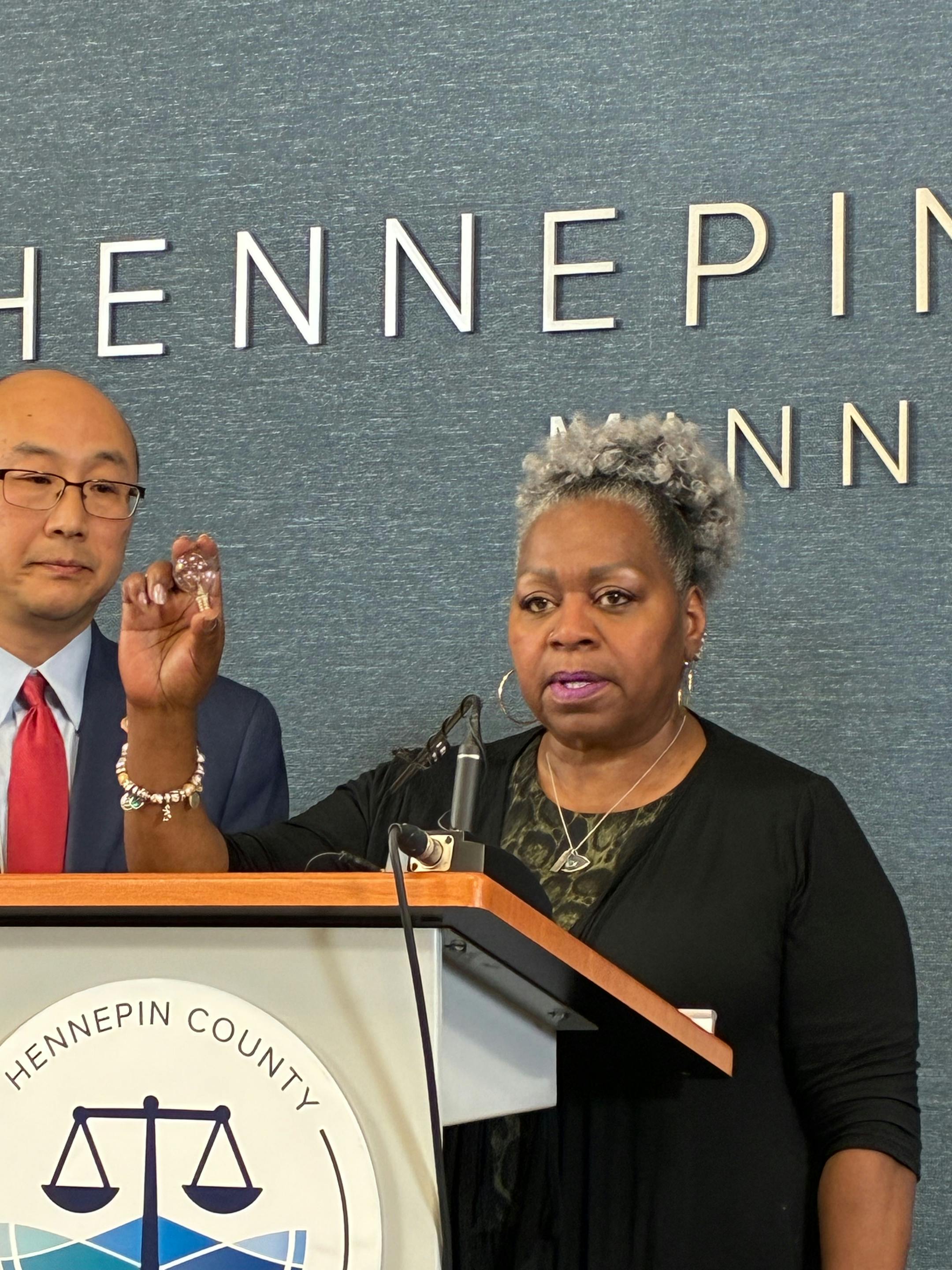
At the news conference, Valerie Castile held up a small light bulb for a taillight and said it cost 89 cents. She wondered aloud if her son’s life was worth being pulled over and interrogated over a broken taillight. Philando had been pulled over 49 times for minor traffic violations in 13 years. He had a permit to carry a gun but was shot after telling Yanez he had a firearm in the car.

Valerie Castile, mother of Philando Castile, holds up an $0.89 light bulb Wednesday, explaining the reason for the traffic stop that led to her son's death. (Jeff Day, Star Tribune)

Valerie Castile thanked Moriarty for making the policy change.

“It helps with the trust with police and the community, as well,” Castile said. “Our police officers, they are in danger, as well. We need police. We all know that and we all understand that. But we don’t need the type of policing that causes harm to our communities.”

One of the most notable cases of Moriarty’s tenure was the shooting death of Ricky Cobb, who was stopped by Minnesota State Troopers for a broken taillight. There was an active warrant for Cobb and he was asked to step out of the vehicle. Trooper Ryan Londregan shot Cobb when he accelerated as a trooper reached inside his car. Moriarty charged Londregan with second-degree murder and manslaughter, but later dismissed the charges.

This is not the first instance of law enforcement in Minneapolis engaging on this topic.

Minneapolis police spokesman Sgt. Garrett Parten said the policy will not affect the way MPD patrols, because “much of what was announced today has already been MPD policy since October 2021.”

That year, Minneapolis Police Chief Medaria Arradondo released an internal memo that said the department would no longer seek pretextual traffic stops, writing that the move was made “recognizing the continued importance of examining how we can better utilize time, resources and operational effectiveness.”

The department is engaged in a state consent decree, although the Minneapolis police union recently sued the organization overseeing the decree, Effective Law Enforcement for All (ELEFA), arguing it is attempting to violate the collective bargaining agreement between the police federation and the city of Minneapolis.

A recent ELEFA progress report said concerns remain over the constitutional behavior of MPD officers during traffic stops and that “some of the Command Staff” were focused on praising their officers for not escalating tension during traffic stops instead of asking why the stops had been “unnecessarily and inappropriately initiated in the first place.”

Because her office works with more than 30 law enforcement agencies, including the Minnesota State Patrol, having a clear countywide “Policy on Non-Public-Safety Traffic Stops” is important, Moriarty said.

When Choi implemented his policy in Ramsey County in 2021, he hailed it as a nation-leading collaboration between the county and cities within its jurisdiction, with the stated hope of building trust between law enforcement and communities of color.

Two years later, the Justice Innovation Lab did a year-over-year analysis of the impact of the change in Ramsey County and found that non-public-safety traffic stops decreased by 86% and searches decreased by 92%. The largest impact was seen on Black drivers, who were searched 66% less in the year after the policy was implemented.

Mark Ross, president of the St. Paul Police Federation, denounced the policy change as “more political posturing” that actually reduces the amount of face time officers have with the public – including positive interactions.

“When you interact with an officer and they have the ability and authority to cite you, but they don’t, I think that shows the real human side of policing.

“We have an awesome responsibility as police officers. To remove that discretion is a mistake; I don’t agree with it. If the county attorneys aren’t going to charge things, shame on them.”

Moriarty has been talking about these kinds of traffic stops dating back to her tenure as the chief public defender in Hennepin County. She joins a list of county prosecutors who have argued that these pretextual stops do little to increase public safety and instead harm minority communities.

She said data across the country backs that argument.

“These stops are not a good use of resources, in my mind,” she said. “They do a tremendous harm to community members, especially Black and brown community members.”

Minnesota Star Tribune staff writer Liz Sawyer contributed to this report.

about the writer

about the writer

Jeff Day

Reporter

Jeff Day is a Hennepin County courts reporter. He previously worked as a sports reporter and editor.

See Moreicon