
Rash: NBA gambling scandal fuels Minnesota sports betting critics

The FBI allegations come as Minnesota debates joining 39 other states where it’s legal.

Columnist Icon
The Minnesota Star Tribune
October 29, 2025 at 8:54PM
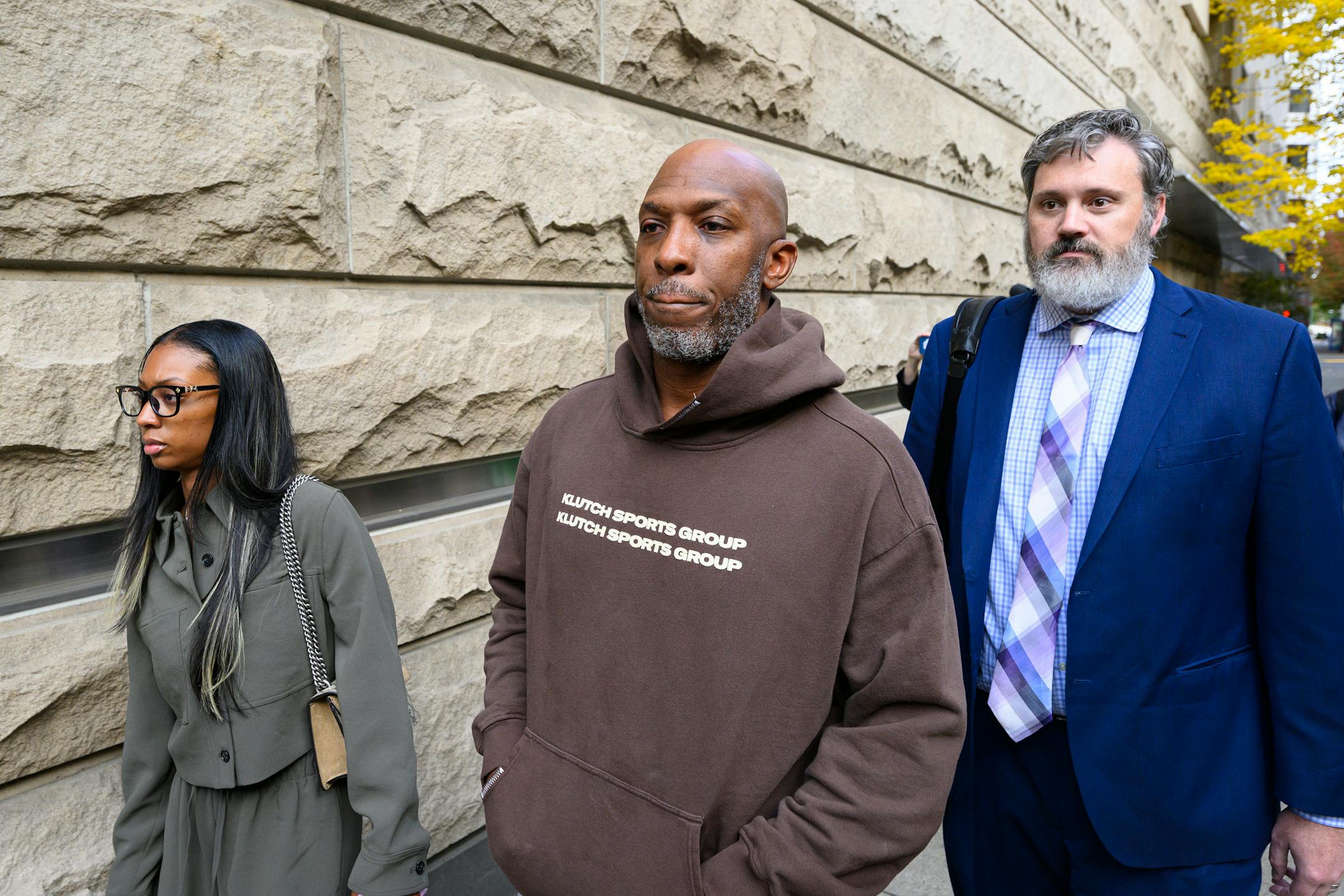
Portland Trail Blazers head coach Chauncey Billups exits the Mark O. Hatfield United States Courthouse after his arraignment on Oct. 23 in Portland, Ore. (Mathieu Lewis-Rolland)

Opinion editor’s note: Strib Voices publishes a mix of commentary online and in print each day. To contribute, click here.

•••

Harvest moons occur in October. So, occasionally, do “sports equinoxes,” the name given to a day when four major professional sports leagues take to the diamond, field, court and rink. Monday was such a rarity, and while the sports cornucopia likely fragmented audiences, it’s also likely that cumulative viewing reflected sports’ ever-increasing societal impact.

The most recent weekly Nielsen TV ratings, for example, saw nine of the top 10 shows sports-related (including seven NFL games or pre- or post-games and one college football game), with just one a scripted series. Those stats track with similar data as well as dollars spent on record-breaking sports-rights TV contracts.

The interest and the investment is because sports is one of the only entities occasionally uniting our deeply divided society. But binding those fragments is fragile, and faces tests, including the NBA gambling scandal alleged by the FBI last week.

Actually, allegedly two scandals (so far), with one directly involving integrity of play (so far). The first involves illegal, mafia-organized poker games that used high-profile NBA stars (including Chauncey Billups, a hall-of-fame player turned Portland Trail Blazers head coach, one of more than 34 arrested) to lure high-stakes poker players into games rigged by high-tech devices. The other involves insider information used to bet on aspects of games (commonly called “prop,” or proposition, bets). One current player, the Miami Heat’s Terry Rozier, was among those implicated, as was Damon Jones, a former player and assistant coach who was charged in both cases.

The bust, bursting onto front pages the week the league began its new $76 billion, 11-year television-rights deals, may have shocked. But it shouldn’t be a surprise, said Lisa Kihl, the director of the University of Minnesota’s Global Institute for Responsible Sport Organizations.

“Any other country in the world that has legalized betting, there has been these kinds of scandals,” said Kihl. “So am I surprised? Absolutely not.”

The scandal’s scope was described by the U.S. attorney for the Eastern District of New York as “one of the most brazen sports-corruption schemes since online sports betting became widely legalized in the United States.”

That would be in 2018, after a Supreme Court ruling resulted in 39 states, Washington, D.C. and Puerto Rico legalizing sports betting. Eleven states have resisted, including, notably, politically polar Texas and California, as well as Minnesota, which is bordered by states that allow it.

State Sen. Erin Maye Quade, a DFLer from Apple Valley, is among a bipartisan group of legislators opposing legalization. The indictments are “just another proof point amid the larger pot of proof points of why we should not do this in Minnesota,” Maye Quade said.

Among the many data-driven proof points she identified were surges in problem gambling in states that rushed to legalize it. The threat to athletes is another growing concern — so significant that the NCAA ran an anti-harassment video during March Madness to “curb abuse directed at student-athletes by fans who lost bets.”

The allegation that the Bonanno, Gambino, Genovese and Lucchese organized-crime families were involved in the poker scheme shows just how serious the safety risk can be. “Crime syndicates,” said Kihl, “know how to exploit young people; they know how to exploit systems.”

This calls for more regulation — via legalization, said Republican Rep. Nolan West of Blaine, who’s among a bipartisan group of legislators advocating legalization.

“Sports betting is already here,” West said. “One of the features of regulating it is that gambling, just like all the vices — alcohol, tobacco, cannabis — is always very heavily regulated when it is legalized, and with that information then you can track a whole lot more,” said West, who also mentioned potential benefits for American Indian tribes, horse racing tracks and other entities that could benefit from gaming revenue. “If we want to get to the bottom of something we at least have to have a very clear area to look.”

West said that regarding problem gambling “the ills are already here” and that the bills he’s introduced have proposals to address them. “It’s not like we’re avoiding this,” he said.

The scourge of problem gambling, which Maye Quade said disproportionally affects young men and boys, is exacerbated by technological transformations.

“It’s taking the most addictive thing we have, our phones, and then putting something highly addictive on that,” she said. Add advertising incessant on games and “it’s going to ruin lives. Rates of suicidal ideation go up. Substance-use disorder rates go up. Domestic-violence rates go up. It’s just not worth it.”

Sports gambling, said Kihl, “might be fun and sexy, but there’s real consequences.”

Conversations about those consequences will occur next legislative session. “I just hope,” said Kihl, “that when they have more hearings that they have experts at the table, and they listen to experts about the social responsibility of gambling and the impact of gambling.”

One of the potential impacts is integrity of the sports themselves. That’s one of the dynamics driving Maye Quade, a self-described big sports fan who says that the scandal might help her convince colleagues who are fellow fans. “If you care about the integrity of sports, you care about the players, their health and well-being, you care about the fans, you care about the integrity of the leagues, then we should not infuse gambling into sports culture.”

And since sports culture is one of the last vestiges of America’s common culture, the stakes are even higher.

The odds of taming gaming on sports are low, however.

For example, I received an unsolicited email the morning after the arrests from BetOnline.ag. While acknowledging that “this is quite sad, and we recognize the serious nature of these events and do not wish to minimize them,” recipients were given “NBA gambling scandal props,” including which NBA figure would receive a longer sentence, if they would receive a lifetime ban, and the next player/coach arrested for illegal gambling.

“The genie,” observed Kihl, “is out of the bottle.”

about the writer

about the writer

John Rash

Editorial Columnist

John Rash is an editorial writer and columnist. His Rash Report column analyzes media and politics, and his focus on foreign policy has taken him on international reporting trips to China, Japan, Rwanda, Kazakhstan, Turkey, Lithuania, Kuwait and Canada.

See Moreicon

More from Columnists

See More
card image
Wally Skalij/The Associated Press

Americans are seeing a split screen of conflicting imagery on deportations: The Trump administration offers one narrative, and amateur cellphone clips offer another.

Travis Pennings uses a pair of binoculars to look for deer in the early morning hours, Nov. 3, 2018, during opening weekend of the season in Sandstone, Minn.