
Advertisement

Lawmakers take aim at high-cost, low-ridership bus lines

Suburban transit providers say they are running a lean operation and claim data used to compile a new report is old and does not paint a true picture.

The Minnesota Star Tribune
February 25, 2026 at 12:00PM
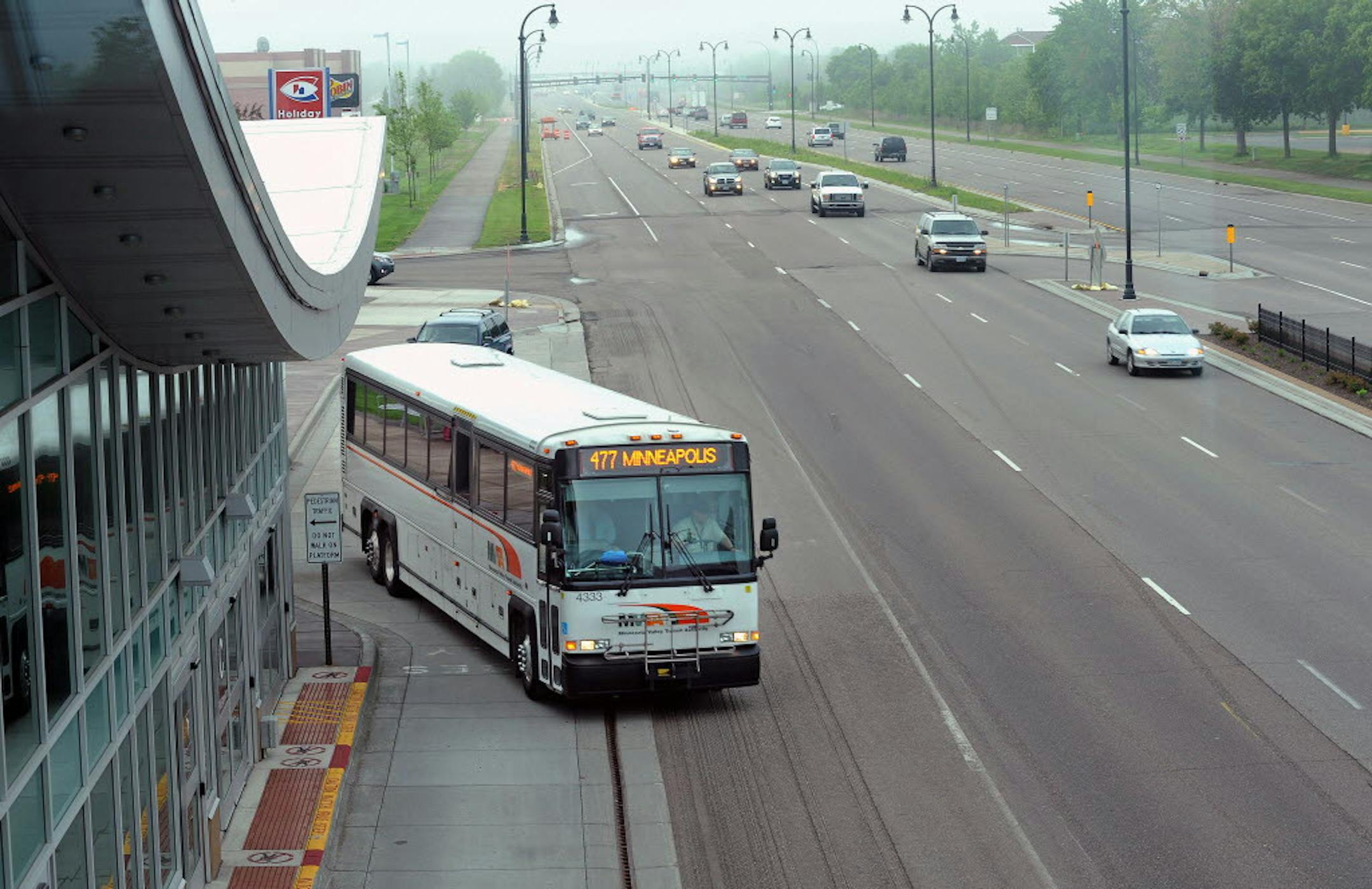
An MVTA Route 477 bus departs the Apple Valley Transit Station
A Minnesota Valley Transit Authority bus departs from the Apple Valley Transit Station. Some routes operated by suburban providers require large subsidies to operate. (The Minnesota Star Tribune)
Advertisement

State lawmakers will consider legislation this session aimed at eliminating little-used public transit lines and possibly consolidating transit agencies in the Twin Cities.

A bill has not yet been introduced. But the House Transportation Committee last week reviewed high-cost transit routes across the Twin Cities — many of which are operated by suburban providers and require large subsidies to operate — and several legislators said they wanted to rein in those costs.

“That definitely cannot continue,” said Committee Co-Chair Rep. Jon Koznick, R-Lakeville. “It’s an abuse of taxpayers.”

Koznick said draft legislation is in the works that would try to eliminate high-subsidy lines and look for “overhead and administration” savings as well. “We may entertain generally one provider … How that actually looks specifically we’ve still yet to determine,” he told the Minnesota Star Tribune.

Such a bill would likely target four suburban transit agencies based in the western and southern suburbs — the Plymouth Metrolink, Maple Grove Transit, SouthWest Transit and the Minnesota Valley Transit Authority. Those date to the 1980s and have for decades operated independently of the Metropolitan Council, which operates the vast majority of the metro area’s public transit service.

Some of those suburban transit agencies say their services are popular with riders and that they’ve already eliminated many high-cost, low ridership routes. They are also pushing legislators to send them more dollars from a regional sales tax that mostly goes to the Metropolitan Council.

Last week’s committee discussion was centered on a Metropolitan Council report that showed more than two dozen bus lines in 2024 had ridership low enough and per-passenger costs high enough to make them candidates for major restructuring or elimination.

One, the MVTA’s route 498, for example, which ran through Shakopee, Eden Prairie, Minnetonka and Edina, cost $201.11 per rider to operate. It’s since been discontinued. Other lines required a per passenger subsidy of between $23.83 and $142.58.

Advertisement

Those figures drew comparisons to the Metropolitan Council’s recently discontinued Northstar rail line, which required a subsidy of $116 per rider in 2023 after ridership tanked during the pandemic.

“If we’re outraged about that, we should be really outraged about this,” said Rep. Erin Koegel, DFL-Spring Lake Park.

The report said high-subsidy lines cost local transit agencies $23.3 million to operate in 2024. Many of the lines operate in low-density suburbs or were designed to bring commuters into downtown Minneapolis and St. Paul.

“I’m very pleased to see that we’re evaluating this,” said Rep. Bjorn Olson, R-Fairmont. “Because this is akin to throwing money in a pit and starting it on fire.”

Transit lines in dense urban areas are generally the most cost-effective to operate because they attract the most riders, whose fares help offset costs. Metro Transit’s D Line, for example, which primarily serves Minneapolis, carried nearly 3.5 million riders in 2024 and required a subsidy of just $5.14 per rider. In total, 206 of the 264 transit routes in 2024 measured in the report met subsidy standards adopted by the Met Council.

Senate Transportation Committee Chair Scott Dibble, DFL-Minneapolis, said he is open to discussions about transit efficiency but is not endorsing any policies yet.

Advertisement

“If we do have [a discussion] in the Senate, we will do it in the full light of day with full participation from everyone,” Dibble said.

Suburban agencies defend their turf

A majority of the 28 routes the report recommended for restructuring or elimination, based on 2024 ridership data, were operated by the Minnesota Valley Transit Authority, which serves eight communities south of the Minnesota River.

But that does not paint the true picture, said the agency’s executive director, Luther Wynder.

MVTA runs about 25 routes and some need significant subsidies to keep that service running in some areas, Wynder said. MVTA routinely adjusts its routes, and over half of the high-subsidy routes mentioned in the report have been or will be discontinued or suspended, he added. Three that were restructured in 2025 have seen double-digit ridership growth.

“It’s not like a product that sits on the shelf at Dollar Tree,” Wynder said. If a route does not work, “we pull it. We have been working on this for years.”

The agency provided 1.5 million rides last year, up 7.8% over 2024. More than 90% of MVTA riders give the agency high marks, according to its most recent customer survey. Wynder said local control is the best way to meet community needs rather than being lumped into one large metro-area transit system. Wynder said he’d welcome legislators to come out and see that MVTA is running efficiently.

Advertisement

“We’ll show that it is,” he said, adding that MVTA has never run a deficit.

Suburban transit providers are also angling to get a consistent piece of a metro-wide sales tax dedicated to transit and have that written in state statute to ensure “more budget certainty,” Wynder said.

SouthWest Transit, meanwhile, has launched a social media campaign asking riders to urge their legislators to keep it a stand-alone agency.

“SouthWest Transit is the fastest-growing transit agency in Minnesota. Yet despite this growth and our commitment to operating in a cost-effective manner, we could lose SWT as discussions continue at the Capitol,” a campaign on its website and social media says.

about the writers

about the writers

Tim Harlow

Reporter

Tim Harlow covers traffic and transportation issues in the Minneapolis-St. Paul area, and likes to get out of the office, even during rush hour. He also covers the suburbs in northern Hennepin and all of Anoka counties, plus breaking news and weather.

See Moreicon

Nathaniel Minor

Reporter

Nathaniel Minor is a reporter for the Minnesota Star Tribune.

See Moreicon

More from News & Politics

See More
card image
With permission from GoFundMe

Alexif Loeza Galvan was killed when a drug deal went sour and the buyer sped off with Loeza Galvan leaning into the window of an SUV.

Advertisement