
Amy Klobuchar navigates thorny politics of immigration as first test in run for governor

The moment will test Klobuchar’s record of bipartisan work in Washington and relationships with Minnesota progressives, who want a fighter against the Trump administration.

The Minnesota Star Tribune
February 1, 2026 at 12:00PM
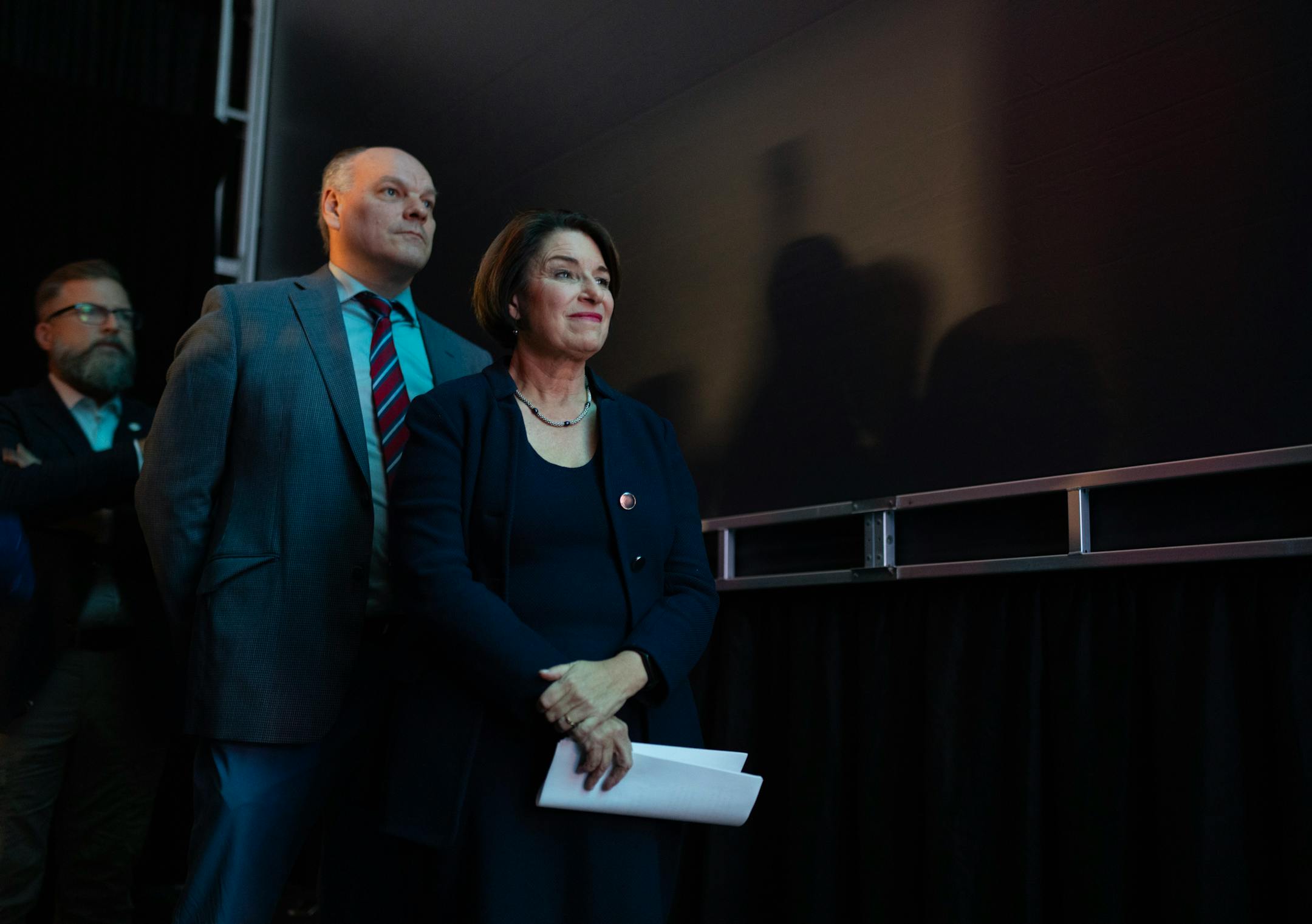
Sen. Amy Klobchar, with her husband, John Bessler, moments before she took the stage to address the DFL Party convention. (Jeff Wheeler/The Minnesota Star Tribune)

Just hours after a second Minnesotan was fatally shot by federal agents during President Donald Trump’s immigration crackdown, Sen. Amy Klobuchar stepped up to a podium at a news conference with Minneapolis Mayor Jacob Frey and other lawmakers.

“We need ICE out of Minnesota,” Klobuchar declared as she called on Republicans to “stand with us.” “I know they know what’s going on here, because it’s happening in their own districts.”

The moment was a declaration of solidarity with Frey and Gov. Tim Walz, who have borne the brunt of federal officials’ ire over the state’s opposition to Operation Metro Surge. But it could also be seen as the opening act of her bid for governor, which Klobuchar announced days later.

It put the senator and her nascent campaign into the center of the debate over immigration enforcement, an issue that is likely to test her decades of bipartisan work with Republicans in Washington and relationships within her own party, especially with progressives.

In Washington, Klobuchar was among the Senate Democrats leading the push against additional funding for the Department of Homeland Security (DHS), which includes immigration enforcement. Over the past week, she’s shuttled between meetings with members of both parties to negotiate pulling funding for the agency out of a broader budget bill and avert a partial government shutdown.

The Senate passed a spending package Friday, Jan. 30, to fund most of the government, including two weeks of stop gap funding for the DHS that will buy more time for negotiations on the immigration crackdown.

In a recent call with the White House, Klobuchar warned administration officials, “that someone else was going to die,” she said in an interview hours after she entered the governor’s race.

In the Senate, both Minnesota senators have regularly updated their colleagues about the situation on the ground in the state and Klobuchar helped craft Democrats’ demands to Republicans about the government funding package.

“She’s been in constant touch with all of us, often in one-on-one conversations, to make sure that we know what’s happening in her state,” said Sen. Chris Murphy of Connecticut.

Klobuchar has been meeting with local police, mayors and activists to understand their needs. She plans to meet with border czar Tom Homan next.

Outwardly, Klobuchar has criticized her Republican colleagues, telling them during a speech on the Senate floor that they should be “horrified” by what’s happening in Minnesota.

But Klobuchar, who’s long touted her ability to work with the other party, is quick to emphasize the time she’s spent time talking to Republican senators as they debated the DHS funding bill.

“For many of them, they saw that video, they know what happened,” she said of her conversations with Republicans, which she said focused on getting immigration agents out of Minnesota.

Klobuchar could be seen huddling on the Senate floor last week with a group of Republicans that included Senate Majority Leader John Thune and Majority Whip John Barrasso. She later said she urged them to remove DHS funding from the broader bill and told them ICE needs a “complete overhaul.”

GOP Sen. Lisa Murkowski of Alaska, who offered one of the sharpest Republican critiques of the Trump administration after Alex Pretti’s shooting on Jan. 24, said Klobuchar reached out to thank her for her comments. Murkowski said Klobuchar has been central in navigating “how we’re going to resolve this” in the Senate.

Now, Klobuchar says all she can do is hope, when asked if she thinks the White House or the Republican senators she spoke with have heard her.

“It’s not always about votes or where you are ideologically,” she said. “It’s sometimes the tone you use when you’re able to have a relationship with someone that you don’t always agree with by any means, but that you’re able to make the case and they listen to you because you’ve worked with them in the past.”

As a gubernatorial candidate, Klobuchar will have to balance being a “Democrat that can work with Republicans,” as former Minnesota GOP Rep. Vin Weber described her, while appeasing the state’s progressive base, which could push her into more partisan positions.

Weber said he thinks the positions she will have to take on ICE in this moment could tarnish her bipartisan reputation.

“She’s not going to be able to maintain what she’s been, which is the single unifying political figure in Minnesota,” Weber said. “I don’t think she goes through a campaign for the next 10 months in this environment, having to defend decisions surrounding these issues without beginning to be viewed as a much more partisan figure.”

That dynamic was on display during an interview on NBC’s “Meet the Press” after Pretti’s shooting when she was asked whether she supports abolishing ICE, a question that’s becoming a litmus test for progressive Democrats.

“We’re always going to have some immigration enforcement in this country and border control,” Klobuchar responded.

She insists bipartisanship is “ingrained in who I am” when asked how she plans to maintain that image throughout the campaign. “I just believe you can be strong and stand up for things and still find ways to work with people,” she said.

Minnesota state Sen. Zaynab Mohamed, a Democrat and one of the most progressive lawmakers in the Legislature, said she thinks all factions of the party will still unite behind Klobuchar, especially now.

Mohamed said Klobuchar’s relationships with Republicans has been crucial in this moment. She’s turned to Klobuchar’s office for help in recent weeks when her constituents have been separated by ICE because of the senator’s GOP ties. “She can move them,” Mohamed said.

“I do think that the last four weeks with ICE being here has been horrible for our community, but for leaders, it’s almost gotten us to a place where we are all collectively fighting for the same thing.”

about the writer

about the writer

Sydney Kashiwagi

Washington Correspondent

Sydney Kashiwagi is a Washington Correspondent for the Star Tribune.

See Moreicon

More from News & Politics

See More
card image
Jeff Wheeler/The Minnesota Star Tribune

The moment will test Klobuchar’s record of bipartisan work in Washington and relationships with Minnesota progressives, who want a fighter against the Trump administration.

card image
card image