Opinion | The cases for and against self-defense in the killing of Renee Good

Here’s what the courts would consider.

January 12, 2026 at 7:51PM
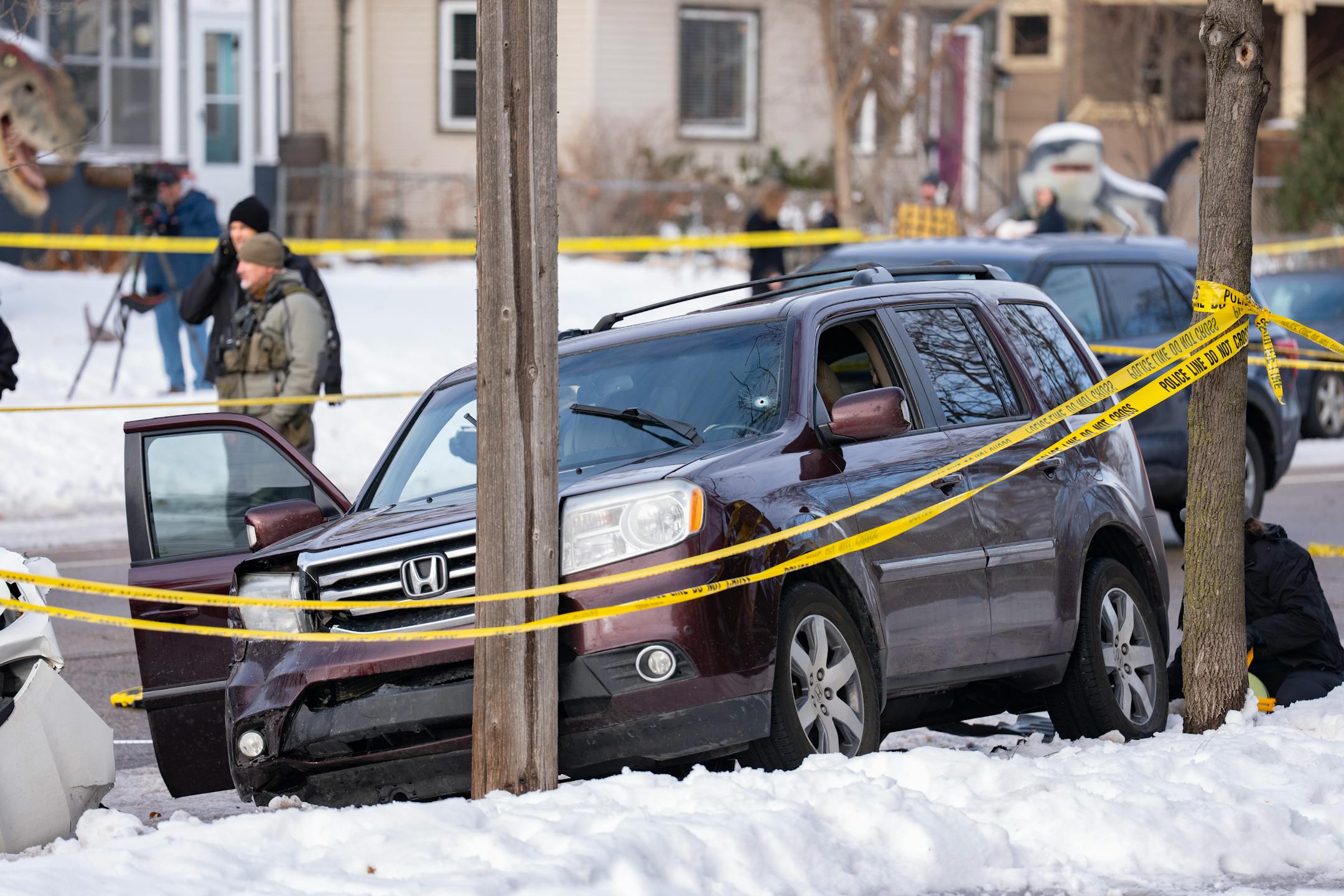
A single bullet hole can be seen on the driver’s side of the windshield of the vehicle that Renee Good was shot and killed in by a federal officer in Minneapolis on Jan. 7. (Alex Kormann/The Minnesota Star Tribune)

Opinion editor’s note: Strib Voices publishes a mix of guest commentaries online and in print each day. To contribute, click here.

•••

Public debate over the Jan. 7 ICE shooting that took the life of Renee Good has settled into familiar grooves: competing narratives, edited video clips and categorical claims of either “self-defense” or “murder.” Each newly released video predictably hardens existing views, supplying fresh confirmation for positions already taken rather than influencing open minds.

Courts do not decide use-of-force cases that way. They decide them by applying a narrow constitutional test to a specific sequence of facts.

Under Graham v. Connor, force must be evaluated for objective reasonableness from the perspective of a reasonable officer on the scene, not judged with the benefit of 20/20 hindsight. Deadly force against a fleeing subject is governed by Tennessee v. Garner: It may be lawful only if the officer has probable cause to believe the subject poses an imminent threat of death or serious physical injury to the officer or others.

The U.S. Supreme Court’s 2025 decision in Barnes v. Felix is also particularly relevant here because it directly rejects the Fifth Circuit’s habit of treating everything leading up to a shooting — including an officer’s own tactics and positioning — as legally irrelevant. In that case, the lower courts applied a “moment-of-threat” rule that asked only whether the officer was in danger at the instant he fired, and expressly excluded prior events from the Fourth Amendment analysis. The Supreme Court unanimously rejected that narrowing, holding that objective reasonableness must be evaluated under the totality of the circumstances, and that courts may not put on “chronological blinders” by isolating only the final seconds.

Barnes does not create a per se rule about force near vehicles or automatically convert tactical mistakes into constitutional violations. However, the lead-up, including an officer’s placement relative to a moving vehicle and the sequence of decisions that produced the claimed “moment of threat,” remains part of the objective reasonableness analysis.

Applied to this case, the evidence cuts both ways.

Facts that may support the agent’s defense narrative:

  • Ambiguity of driver intent. The act of advancing the vehicle toward the agent after commands to exit could reasonably be interpreted as intentional rather than accidental, and Graham allows officers to draw reasonable inferences about threat from conduct without requiring certainty as to intent.
    • Compressed timeline. The encounter unfolded rapidly, which likely limited the agent’s ability to recognize whether he had fully exited the zone of danger before shots were fired.
      • Limited visual information. The agent likely could not see the angle of the tires (a detail many commentators emphasize in hindsight), though it remains unknown whether the agent appreciated the movement of the steering wheel away from his direction.
        • Vehicle contact. At least one angle appears to show the agent struck by the SUV, which could support a reasonable perception of imminent danger at that moment.

          Facts that could complicate a self-defense claim:

          • Threat persistence. The agent’s second and third shots happened after the front of the vehicle passed and appeared to be made through the driver’s side window. Deadly force remains permissible only so long as an ongoing, imminent threat of death or serious bodily harm reasonably appears to exist.
            • Officer positioning. The agent’s decision to place himself in front of a moving vehicle, or to advance toward it, is part of the totality courts must consider. When that positioning creates the alleged justification for the use of force, it weighs against a finding of objective reasonableness.
              • Pre-encounter conduct. Good was cordial and showed no animosity or threatening behavior just before the encounter escalated, which minimizes the degree to which a reasonable officer could infer hostile intent from otherwise ambiguous movement.
                • Post-incident language. The agent’s apparent vulgar utterance toward Good after shooting her is not itself dispositive, but it can be read by a fact finder as reflecting a mindset of compelling control or compliance rather than fear of death, undercutting a self-defense narrative.

                  Federal use-of-force policy fits naturally into this analysis, not as an independent legal standard, but as context. Department of Homeland Security guidance permits deadly force only when an officer reasonably believes there is an imminent threat of death or serious bodily injury and prohibits firing at moving vehicles except where deadly force is otherwise justified. While policy violations do not establish constitutional violations, courts routinely consider professional norms and standards as part of the totality of the circumstances when evaluating objective reasonableness.

                  All of this is, in a sense, only a legal thought experiment. The practical reality is that there is no indication that the U.S. Attorney’s Office will pursue such charges here, and Minnesota’s ability to build a state case is severely hindered by the fact that the Minnesota Bureau of Criminal Apprehension has been boxed out of the investigation. Federal authorities control the scene evidence, the vehicle and federal witnesses, limiting access to the very evidence and testimony a state prosecutor would need to evaluate or pursue charges. As the federal government investigates itself and denies state authorities access to critical evidence and witnesses, the criminal justice system’s capacity to deliver transparency and accountability is fundamentally compromised.

                  Rob Doar is a Twin Cities-based lawyer who works in public defense. He also serves as president of the Minnesota Gun Owners Law Center. He writes on topics related to law, civil liberties and public policy.

                  about the writer

                  about the writer

                  Rob Doar

                  More from Commentaries

                  See More
                  card image
                  Alex Kormann/The Minnesota Star Tribune

                  A look at the business case and the community impacts of the deal announced Jan. 11 with Allegiant Air.

                  card image